Snarr Brendan D, Qureshi Salman T, Sheppard Donald C
Department of Microbiology and Immunology, McGill University, Montreal, QC H3A 2B4, Canada.
Department of Medicine, Infectious Diseases and Immunity in Global Health Program, Centre for Translational Biology, McGill University Health Centre, Montreal, QC H4A 3J1, Canada.
J Fungi (Basel). 2017 Aug 28;3(3):47. doi: 10.3390/jof3030047.
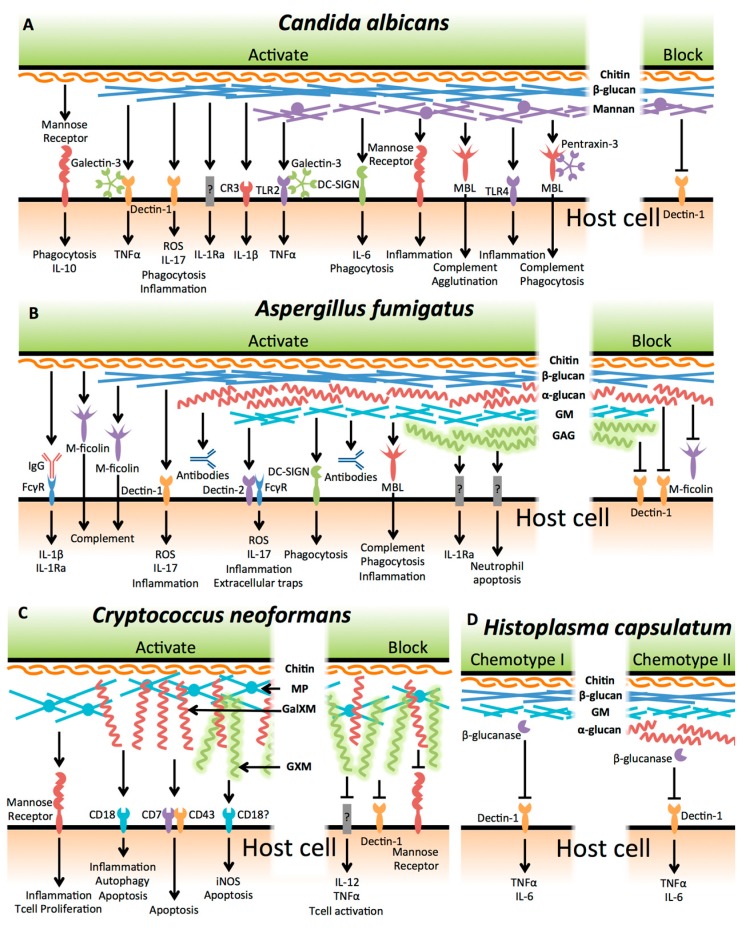
The incidence of fungal infections has dramatically increased in recent years, in large part due to increased use of immunosuppressive medications, as well as aggressive medical and surgical interventions that compromise natural skin and mucosal barriers. There are relatively few currently licensed antifungal drugs, and rising resistance to these agents has led to interest in the development of novel preventative and therapeutic strategies targeting these devastating infections. One approach to combat fungal infections is to augment the host immune response towards these organisms. The polysaccharide-rich cell wall is the initial point of contact between fungi and the host immune system, and therefore, represents an important target for immunotherapeutic approaches. This review highlights the advances made in our understanding of the mechanisms by which the immune system recognizes and interacts with exopolysaccharides produced by four of the most common fungal pathogens: , , , and . Work to date suggests that inner cell wall polysaccharides that play an important structural role are the most conserved across diverse members of the fungal kingdom, and elicit the strongest innate immune responses. The immune system senses these carbohydrates through receptors, such as lectins and complement proteins. In contrast, a greater diversity of polysaccharides is found within the outer cell walls of pathogenic fungi. These glycans play an important role in immune evasion, and can even induce anti-inflammatory host responses. Further study of the complex interactions between the host immune system and the fungal polysaccharides will be necessary to develop more effective therapeutic strategies, as well as to explore the use of immunosuppressive polysaccharides as therapeutic agents to modulate inflammation.
近年来,真菌感染的发生率急剧上升,这在很大程度上归因于免疫抑制药物使用的增加,以及激进的医疗和外科干预措施破坏了天然的皮肤和黏膜屏障。目前获批的抗真菌药物相对较少,而且对这些药物的耐药性不断上升,这引发了人们对开发针对这些毁灭性感染的新型预防和治疗策略的兴趣。对抗真菌感染的一种方法是增强宿主对这些病原体的免疫反应。富含多糖的细胞壁是真菌与宿主免疫系统接触的起始点,因此,是免疫治疗方法的一个重要靶点。这篇综述重点介绍了我们在理解免疫系统识别四种最常见真菌病原体( 、 、 和 )产生的胞外多糖并与之相互作用的机制方面所取得的进展。迄今为止的研究表明,在真菌界不同成员中起重要结构作用的内层细胞壁多糖最为保守,并能引发最强的先天免疫反应。免疫系统通过凝集素和补体蛋白等受体感知这些碳水化合物。相比之下,在致病真菌的外层细胞壁中发现了更多种类的多糖。这些聚糖在免疫逃避中起重要作用,甚至可以诱导宿主产生抗炎反应。要开发更有效的治疗策略,以及探索使用免疫抑制性多糖作为调节炎症的治疗药物,有必要进一步研究宿主免疫系统与真菌多糖之间的复杂相互作用。