Tenn Mark W, Steacy Lisa M, Ng Charlene C, Ellis Anne K
1Department of Biomedical and Molecular Sciences, Queen's University, Kingston, ON Canada.
2Allergy Research Unit, Kingston General Hospital, 76 Stuart Street, Kingston, ON Canada.
Allergy Asthma Clin Immunol. 2018 Jan 16;14:5. doi: 10.1186/s13223-017-0227-4. eCollection 2018.
Loratadine is a second-generation, non-sedating antihistamine used for the relief of allergic rhinitis symptoms. Previous studies reported that when loratadine was encapsulated, the onset of action for symptom relief was 180 min. However, unmodified loratadine tablets were not evaluated at that time. Using data from a previously published Environmental Exposure Unit (EEU) study comparing azelastine nasal spray with loratadine tablets, cetirizine tablets, and placebo, this post hoc analysis determines the onset of action of loratadine tablets (i.e. unmodified) by analyzing the total symptom score for the relief of nasal and ocular seasonal allergic rhinitis (SAR) symptoms.
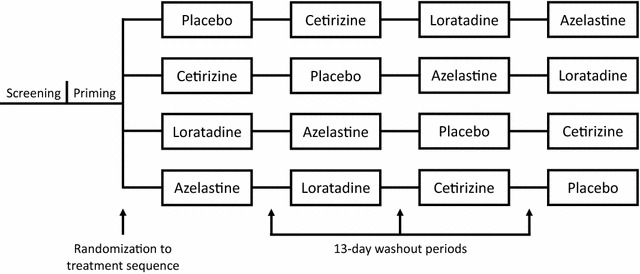
A Phase IV, randomized, single-center, double-blind, placebo-controlled, double-dummy, four-way crossover study was conducted in the EEU. Seventy participants were randomized sequentially into one of the four treatments during ragweed pollen exposure. Nasal and ocular symptom scores were self-reported by the participants and recorded. The original study analysis was carried out by evaluating the nasal symptom scores only. For this post hoc analysis, both nasal and ocular data from the loratadine and placebo treatment arms were analyzed. The primary endpoint for this analysis was the onset of action of loratadine as measured by the change in total symptom score (TSS) from baseline in comparison to placebo. The onset of ocular symptom relief using the total ocular symptom score (TOSS) was also reported.
Loratadine tablets demonstrated a significant and durable improvement in both TSS ( = .005) and TOSS ( = .013) at 75 min post-treatment administration compared to placebo. The mean proportion of participants reporting none or mild for all component symptoms of TSS and TOSS at 75 min and thereafter was significantly higher in the loratadine (TSS, = .0005; TOSS, ≤ .0001) vs. placebo treatment arm.
The onset of action of loratadine tablets was 75 min for the relief of nasal and ocular symptoms in adults with SAR. These results suggest a faster onset of action for loratadine tablets (75 min) compared to previously reported studies which were conducted with modified (i.e. gelatin-encapsulated) loratadine tablets (180 min). Clinicaltrials.gov identifier NCT00561717.
氯雷他定是一种第二代非镇静性抗组胺药,用于缓解过敏性鼻炎症状。既往研究报道,氯雷他定被封装时,症状缓解的起效时间为180分钟。然而,当时未对未改良的氯雷他定片进行评估。利用先前发表的一项环境暴露单元(EEU)研究的数据,该研究比较了氮卓斯汀鼻喷雾剂与氯雷他定片、西替利嗪片及安慰剂,这项事后分析通过分析鼻和眼季节性过敏性鼻炎(SAR)症状缓解的总症状评分来确定氯雷他定片(即未改良的)的起效时间。
在EEU进行了一项IV期、随机、单中心、双盲、安慰剂对照、双模拟、四交叉研究。70名参与者在豚草花粉暴露期间被顺序随机分为四种治疗之一。参与者自行报告并记录鼻和眼症状评分。原始研究分析仅通过评估鼻症状评分进行。对于这项事后分析,分析了氯雷他定和安慰剂治疗组的鼻和眼数据。该分析的主要终点是氯雷他定的起效时间,通过与安慰剂相比总症状评分(TSS)从基线的变化来衡量。还报告了使用总眼症状评分(TOSS)缓解眼症状的起效时间。
与安慰剂相比,氯雷他定片在治疗给药后75分钟时TSS(P = 0.005)和TOSS(P = 0.013)均有显著且持久的改善。在氯雷他定组(TSS,P = 0.0005;TOSS,P≤0.0001)与安慰剂治疗组相比,在75分钟及之后报告TSS和TOSS所有组成症状无或轻度的参与者的平均比例显著更高。
氯雷他定片缓解成人SAR鼻和眼症状的起效时间为75分钟。这些结果表明,与先前使用改良(即明胶封装)氯雷他定片进行的研究(180分钟)相比,氯雷他定片的起效时间更快。Clinicaltrials.gov标识符NCT00561717。