Division of Allergy & Immunology, Department of Medicine, Queen's University, Kingston, ON, Canada ; Allergy Research Unit, Kingston General Hospital, Kingston, ON, Canada.
Life Sciences, Queen's University, Kingston, ON, Canada.
Allergy Asthma Clin Immunol. 2013 May 1;9(1):16. doi: 10.1186/1710-1492-9-16. eCollection 2013.
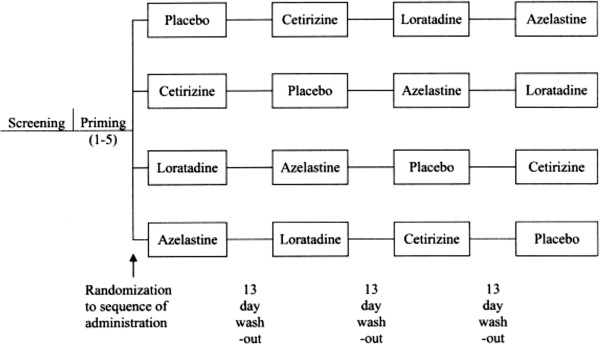
Azelastine has been shown to be effective against seasonal allergic rhinitis (SAR). The Environmental Exposure Unit (EEU) is a validated model of experimental SAR. The objective of this double-blind, four-way crossover study was to evaluate the onset of action of azelastine nasal spray, versus the oral antihistamines loratadine 10 mg and cetirizine 10 mg in the relief of the symptoms of SAR.
70 participants, aged 18-65, were randomized to receive azelastine nasal spray, cetirizine, loratadine, or placebo after controlled ragweed pollen exposure in the EEU. Symptoms were evaluated using the total nasal symptom score (TNSS). The primary efficacy parameter was the onset of action as measured by the change from baseline in TNSS.
Azelastine displayed a statistically significant improvement in TNSS compared with placebo at all time points from 15 minutes through 6 hours post dose. Azelastine, cetirizine, and loratadine reduced TNSS compared to placebo with an onset of action of 15 (p < 0.001), 60 (p = 0.015), and 75 (p = 0.034) minutes, respectively. The overall assessment of efficacy was rated as good or very good by 46% of the participants for azelastine, 51% of the participants for cetirizine, and 30% of the participants for loratadine compared to 18% of the participants for placebo.
Azelastine's onset of action for symptom relief was faster than that of cetirizine and loratadine. The overall participant satisfaction in treatment with azelastine is comparable to cetirizine and statistically superior to loratadine. These results suggest that azelastine may be preferential to oral antihistamines for the rapid relief of SAR symptoms.
盐酸氮卓斯汀对季节性变应性鼻炎(SAR)有效。环境暴露单元(EEU)是 SAR 实验的有效模型。本双盲、四交叉研究的目的是评估氮卓斯汀鼻喷剂相对于口服抗组胺药氯雷他定 10mg 和西替利嗪 10mg 对 SAR 症状缓解的起效时间。
70 名 18-65 岁的参与者在 EEU 中接受控制的豚草花粉暴露后,随机接受氮卓斯汀鼻喷剂、西替利嗪、氯雷他定或安慰剂治疗。症状使用总鼻症状评分(TNSS)进行评估。主要疗效参数是 TNSS 从基线变化的起效时间。
氮卓斯汀与安慰剂相比,在给药后 15 分钟至 6 小时的所有时间点,TNSS 均有统计学显著改善。氮卓斯汀、西替利嗪和氯雷他定与安慰剂相比,TNSS 降低起效时间分别为 15 分钟(p<0.001)、60 分钟(p=0.015)和 75 分钟(p=0.034)。46%的参与者对氮卓斯汀的疗效总体评估为良好或非常好,51%的参与者对西替利嗪的疗效总体评估为良好或非常好,30%的参与者对氯雷他定的疗效总体评估为良好或非常好,而安慰剂组为 18%。
氮卓斯汀缓解症状的起效时间快于西替利嗪和氯雷他定。与安慰剂相比,氮卓斯汀的整体治疗满意度与西替利嗪相当,统计学上优于氯雷他定。这些结果表明,氮卓斯汀可能是快速缓解 SAR 症状的口服抗组胺药的首选。