Wang Xuedong, Wang Xinguo, Gu Juan, Zhou Ming, He Zhimin, Wang Xinhui, Ferrone Soldano
Department of Medical Laboratory Science, The Fifth People's Hospital of Wuxi, The Medical School of Jiangnan University, Wuxi, Jiangsu 214005, China.
Department of Pathology, The Fifth People's Hospital of Wuxi, Nanjing Medical University, Wuxi, Jiangsu 214005, China.
Oncotarget. 2017 Dec 6;8(69):113837-113846. doi: 10.18632/oncotarget.22985. eCollection 2017 Dec 26.
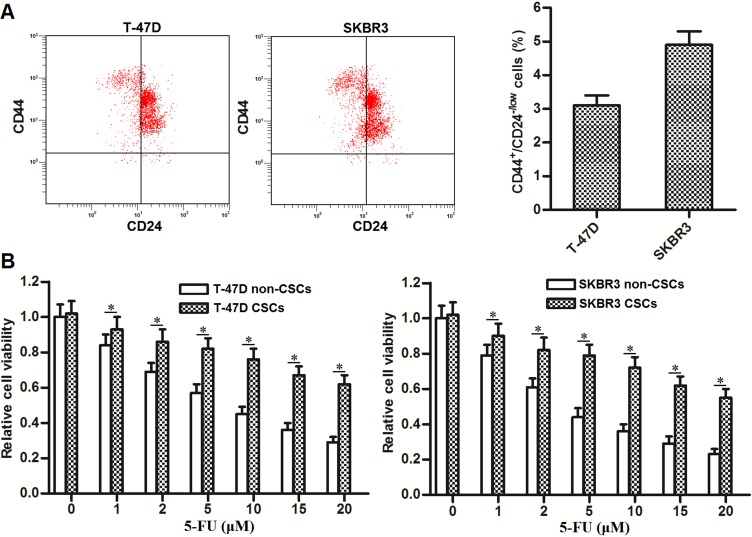
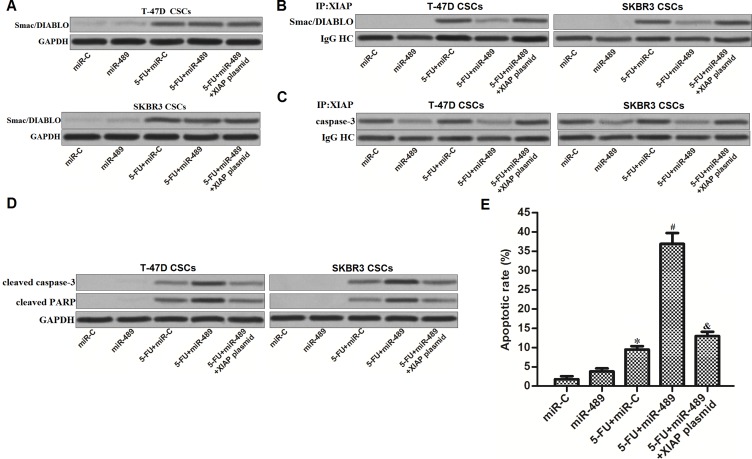
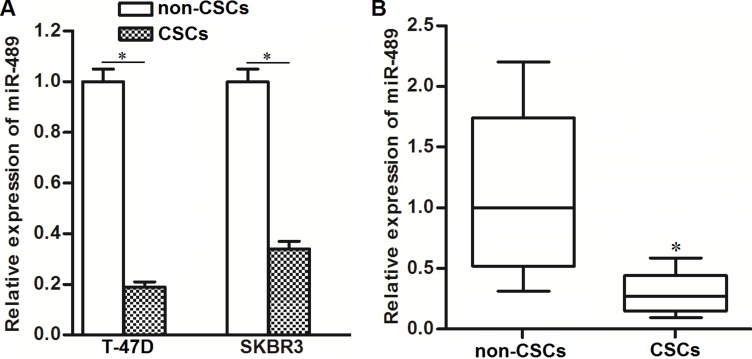
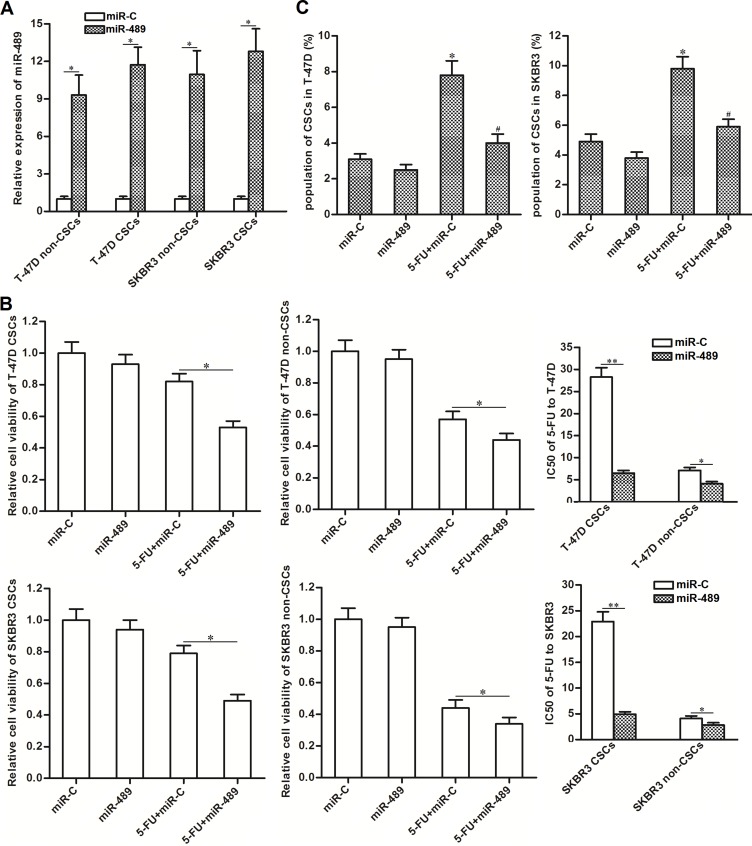
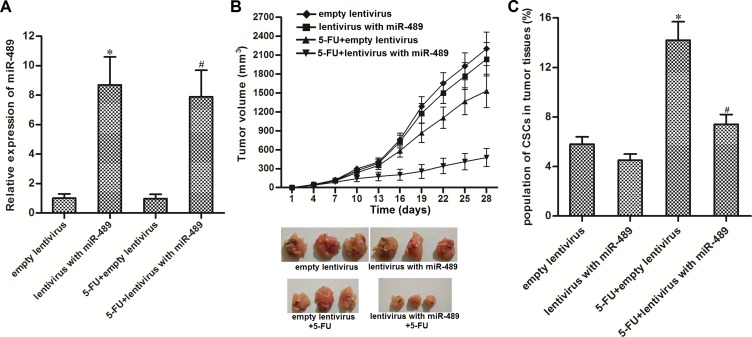
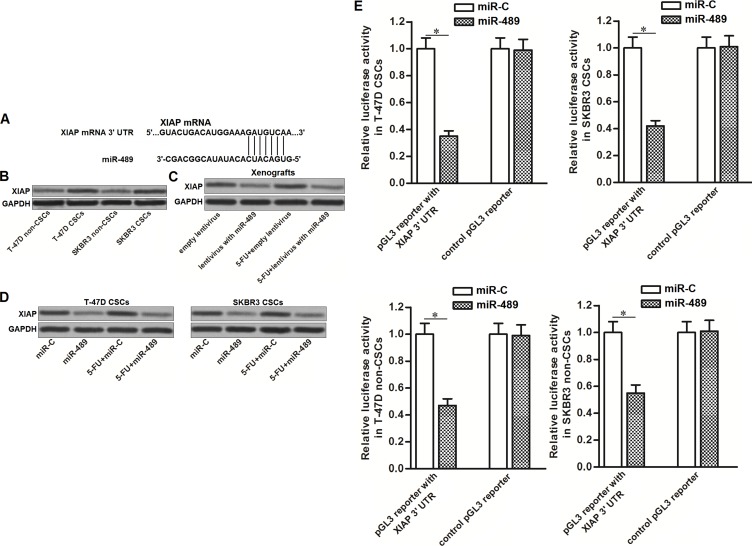
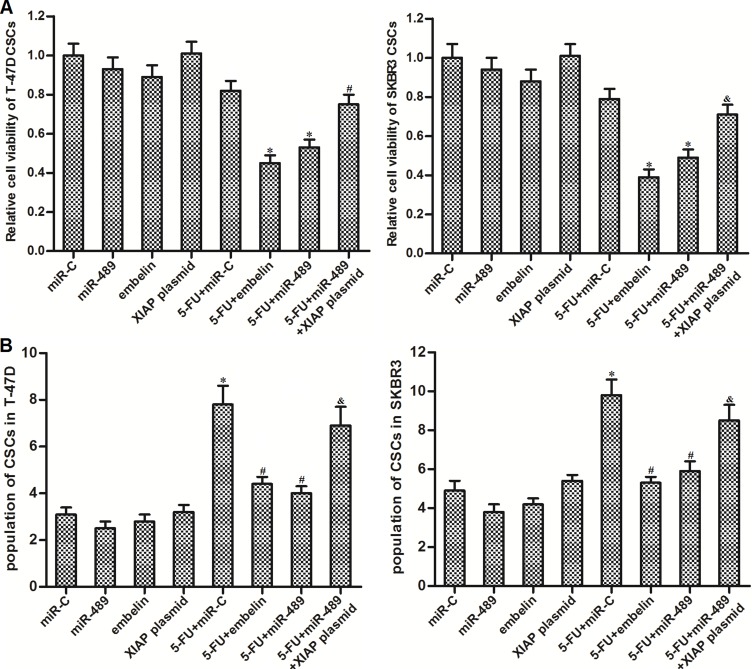
Population of cancer stem cells (CSCs) in breast cancer is reported to be resistant to chemotherapy. Furthermore, many cases of treatment failure are induced by the chemoresistance of CSCs in breast cancer patients. Therefore, novel strategies should be explored urgently to reverse drug-resistance in breast cancer stem cells (BCSCs). In this study, we isolated and cultured the BCSCs from the T-47D and SKBR3 breast cancer cell lines. We observed significant resistance to 5-fluorouracil in BCSCs. Mechanically, we found that expression of miR-489 was decreased in BCSCs. Furthermore, overexpression of miR-489 was found to increase the cytotoxicity of 5-fluorouracil to BCSCs. XIAP, a key anti-apoptotic protein, was proved to be the target of miR-489. We found that enforced expression of XIAP through its recombinant expression vector abolished the effect of miR-489 on reversing the 5-fluorouracil resistance. On the contrary, embelin, a XIAP specific inhibitor, was found to sensitize BCSCs to 5-fluorouracil similarly with miR-489. In summary, our data demonstrate that introduction with miR-489 represents a novel strategy to enhance efficacy of 5-fluorouracil-based treatment in BCSCs.
据报道,乳腺癌中的癌症干细胞(CSCs)群体对化疗具有抗性。此外,许多治疗失败的病例是由乳腺癌患者中CSCs的化疗抗性引起的。因此,迫切需要探索新的策略来逆转乳腺癌干细胞(BCSCs)的耐药性。在本研究中,我们从T-47D和SKBR3乳腺癌细胞系中分离并培养了BCSCs。我们观察到BCSCs对5-氟尿嘧啶具有显著抗性。从机制上讲,我们发现miR-489在BCSCs中的表达降低。此外,发现miR-489的过表达会增加5-氟尿嘧啶对BCSCs的细胞毒性。XIAP是一种关键的抗凋亡蛋白,被证明是miR-489的靶标。我们发现通过其重组表达载体强制表达XIAP消除了miR-489对逆转5-氟尿嘧啶抗性的作用。相反,发现XIAP特异性抑制剂 embelin与miR-489类似,可使BCSCs对5-氟尿嘧啶敏感。总之,我们的数据表明,引入miR-489代表了一种增强基于5-氟尿嘧啶的治疗对BCSCs疗效的新策略。