Goodman Avi D, Lemme Nicholas, DeFroda Steven F, Gil Joseph A, Owens Brett D
Department of Orthopaedics, Alpert Medical School of Brown University, Rhode Island Hospital, Providence, Rhode Island, USA.
Alpert Medical School of Brown University, Providence, Rhode Island, USA.
Orthop J Sports Med. 2018 Jan 16;6(1):2325967117750105. doi: 10.1177/2325967117750105. eCollection 2018 Jan.
Examination of the incidence of elbow dislocation and subluxation injuries in the collegiate athlete population is limited.
To determine the incidence of elbow dislocation and subluxation injuries in the National Collegiate Athletic Association (NCAA) and investigate the risk factors involved.
Descriptive epidemiology study.
All elbow subluxation and dislocation injuries from the 2009-2010 through 2013-2014 academic years in the NCAA Injury Surveillance Program database were extracted. The incidence was calculated for different injuries, sports, activity, time in game, competition status, and injury characteristics. Such differences were compared by use of risk ratios to determine risk factors for injury.
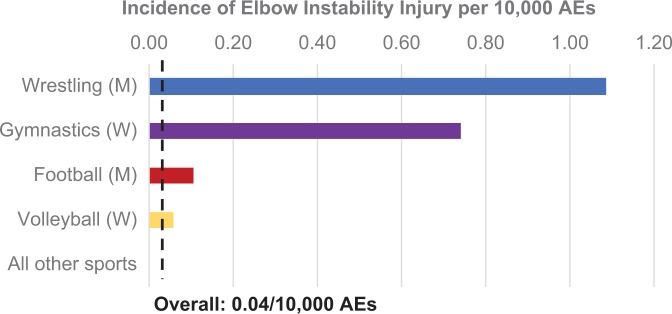
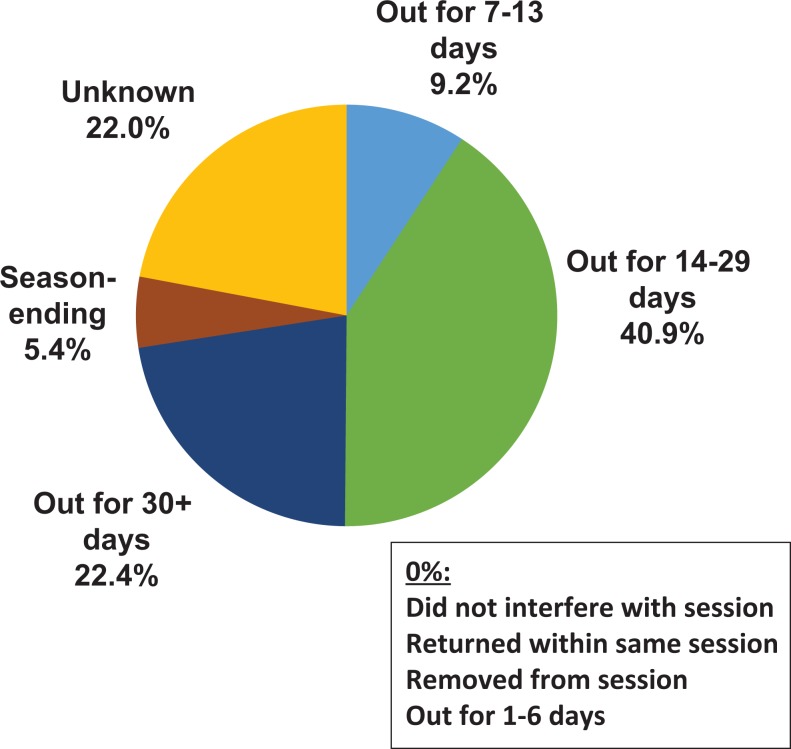
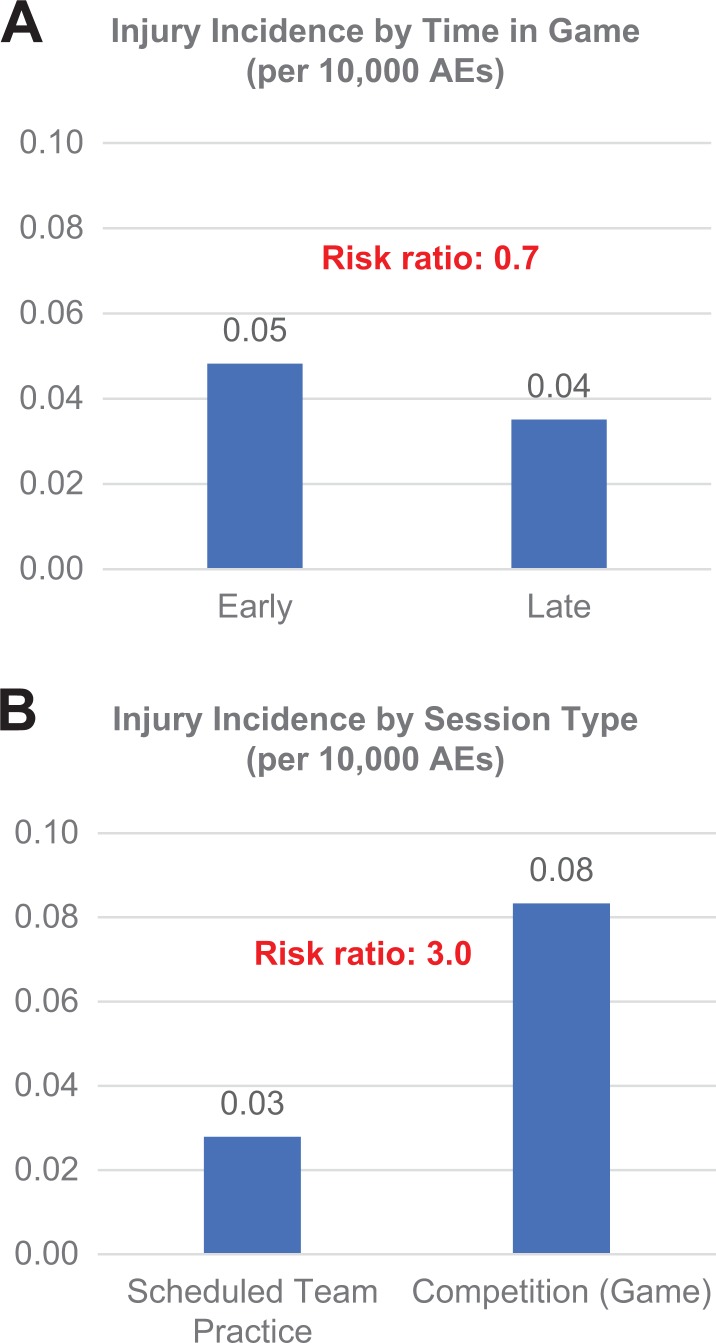
The overall incidence of elbow instability injuries was 0.04 per 10,000 athlete-exposures (AEs). Elbow dislocations were more common, with 553 injuries (82.2%, 0.03/10,000 AEs), while elbow subluxations were the minority, with 119 injuries (17.8%, 0.01/10,000 AEs). Men's wrestling had the highest incidence of elbow instability (1.08/10,000 AEs), more than women's gymnastics (0.74), men's football (0.11), and women's volleyball (0.06). All injuries occurred via a contact mechanism, and 99.2% were new injuries. Sixty-nine percent of injuries kept athletes sidelined for more than 2 weeks. Injuries were 3 times more likely to occur in competition (0.08/10,000 AEs) than practice (0.03/10,000 AEs). Injuries sustained during competition were 1.4 times more likely to occur early in the match than late.
Elbow instability injuries are an infrequent but serious source of disability for select NCAA athletes, with a number of associated risk factors. Athletes sustaining these injuries, along with their coaches and medical providers, may benefit from these return-to-play data to best manage expectations and outcomes.
对大学生运动员人群中肘关节脱位和半脱位损伤发生率的研究有限。
确定美国国家大学体育协会(NCAA)中肘关节脱位和半脱位损伤的发生率,并调查相关危险因素。
描述性流行病学研究。
从NCAA损伤监测计划数据库中提取2009 - 2010学年至2013 - 2014学年所有的肘关节半脱位和脱位损伤数据。计算不同损伤类型、运动项目、活动、比赛时间、比赛状态和损伤特征的发生率。通过风险比比较这些差异,以确定损伤的危险因素。
肘关节不稳定损伤的总体发生率为每10000运动员暴露次数(AE)0.04例。肘关节脱位更为常见,有553例损伤(82.2%,每10000 AE 0.03例),而肘关节半脱位较少,有119例损伤(17.8%,每10000 AE 0.01例)。男子摔跤的肘关节不稳定发生率最高(每10000 AE 1.08例),高于女子体操(0.74)、男子橄榄球(0.11)和女子排球(0.06)。所有损伤均通过接触机制发生,且99.2%为新伤。69%的损伤使运动员缺阵超过2周。损伤在比赛中发生的可能性(每10000 AE 0.08例)是训练中(每10000 AE 0.03例)的3倍。比赛中发生的损伤在比赛早期比晚期发生的可能性高1.4倍。
肘关节不稳定损伤在特定的NCAA运动员中虽不常见但却是导致残疾的严重原因,存在多种相关危险因素。遭受这些损伤的运动员及其教练和医疗人员可能会从这些重返赛场的数据中受益,以便更好地管理预期和结果。