Department of Biomechanics, University of Nebraska at Omaha, Omaha, NE, USA.
Department of Clinical and Scientific Affairs, Hanger Clinic, Houston Medical Center, Houston, TX, USA.
J Neuroeng Rehabil. 2018 Jan 27;15(1):6. doi: 10.1186/s12984-018-0347-1.
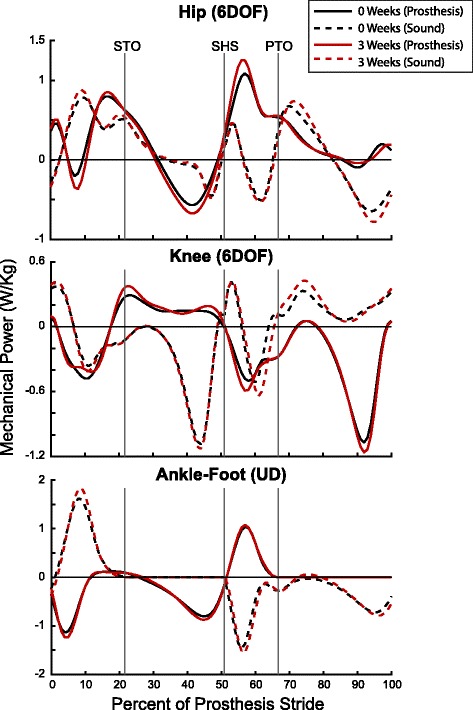
There are many studies that have investigated biomechanical differences among prosthetic feet, but not changes due to adaptation over time. There is a need for objective measures to quantify the process of adaptation for individuals with a transtibial amputation. Mechanical power and work profiles are a primary focus for modern energy-storage-and-return type prostheses, which strive to increase energy return from the prosthesis. The amount of energy a prosthesis stores and returns (i.e., negative and positive work) during stance is directly influenced by the user's loading strategy, which may be sensitive to alterations during the course of an adaptation period. The purpose of this study was to examine changes in lower limb mechanical work profiles during walking following a three-week adaptation to a new prosthesis.
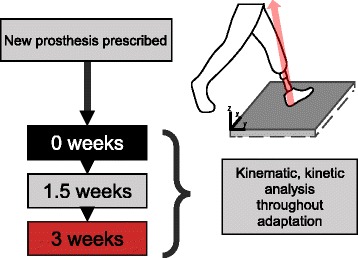
A retrospective analysis was performed on 22 individuals with a unilateral transtibial amputation. Individuals were given a new prosthesis at their current mobility level (K3 or above) and wore it for three weeks. Kinematic and kinetic measures were recorded from overground walking at 0, 1.5, and 3 weeks into the adaptation period at a self-selected pace. Positive and negative work done by the prosthesis and sound ankle-foot were calculated using a unified deformable segment model and a six-degrees-of-freedom model for the knee and hip.
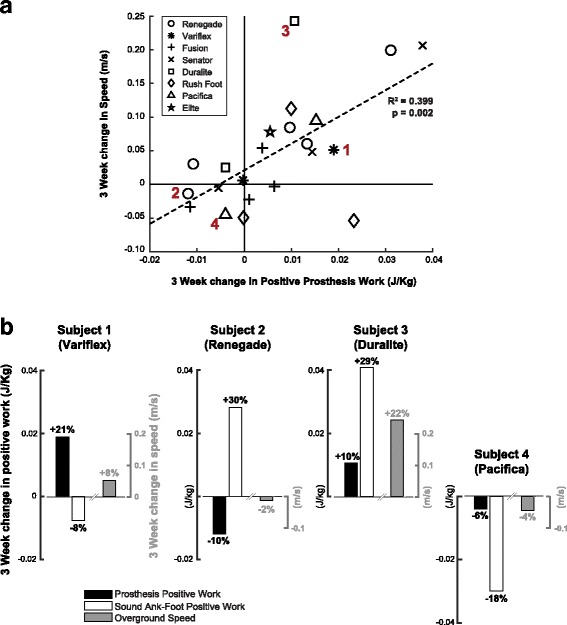
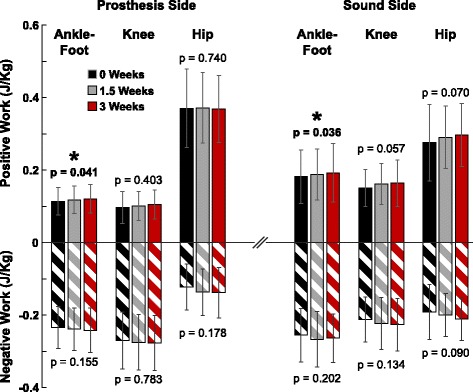
Positive work from the prosthesis ankle-foot increased by 6.1% and sound ankle-foot by 5.7% after 3 weeks (p = 0.041, 0.036). No significant changes were seen in negative work from prosthesis or sound ankle-foot (p = 0.115, 0.192). There was also a 4.1% increase in self-selected walking speed after 3 weeks (p = 0.038). Our data exhibited large inter-subject variations, in which some individuals followed group trends in work profiles while others had opposite trends in outcome variables.
After a 3-week adaptation, 14 out of 22 individuals with a transtibial amputation increased energy return from the prosthesis. Such findings could indicate that individuals may better utilize the spring-like function of the prosthesis after an adaptation period.
有许多研究调查了假肢之间的生物力学差异,但没有研究随着时间的推移而产生的变化。需要有客观的测量方法来量化接受胫骨截肢的个体的适应过程。机械功率和功谱是现代储能和回能型假肢的主要关注点,这些假肢努力增加来自假肢的能量回传。假肢在站立阶段储存和返回的能量(即负功和正功)的多少直接受使用者的加载策略的影响,而这种加载策略在适应期内可能会发生敏感的变化。本研究的目的是检查在适应新假肢的 3 周期间,行走时下肢机械功谱的变化。
对 22 名单侧胫骨截肢患者进行了回顾性分析。这些患者在当前的移动水平(K3 或更高)下获得了新的假肢,并佩戴了 3 周。在适应期的第 0、1.5 和 3 周,以自我选择的速度在地面上行走时,记录了运动学和动力学测量值。使用统一的可变形段模型和六自由度模型对假肢踝关节和正常踝关节进行正功和负功的计算。
在 3 周后,假肢踝关节的正功增加了 6.1%,正常踝关节的正功增加了 5.7%(p=0.041,0.036)。假肢或正常踝关节的负功没有明显变化(p=0.115,0.192)。3 周后,自我选择的行走速度也增加了 4.1%(p=0.038)。我们的数据显示出较大的个体间差异,其中一些个体的功谱随组趋势变化,而另一些个体的结果变量则呈现相反的趋势。
在 3 周的适应期后,22 名胫骨截肢患者中有 14 名增加了来自假肢的能量回传。这些发现可能表明,在适应期后,个体可能更好地利用假肢的弹簧功能。