Graduate Program in Neuroengineering, Edmond and Lily Safra International Institute of Neuroscience, Santos Dumont Institute, Macaiba, Brazil.
Front Neural Circuits. 2018 Jan 11;11:114. doi: 10.3389/fncir.2017.00114. eCollection 2017.
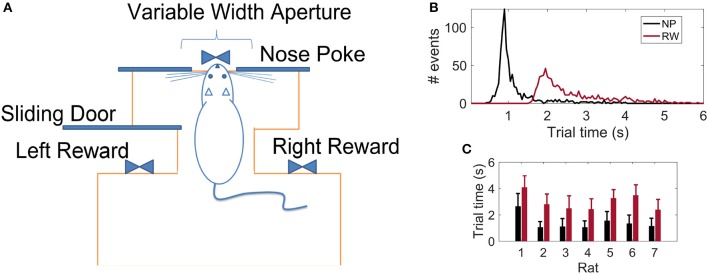
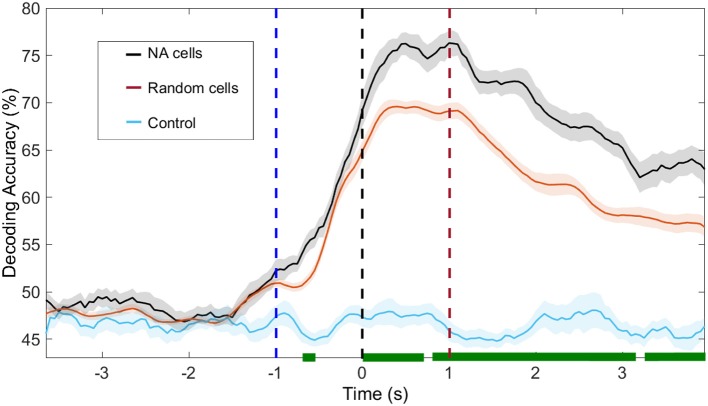
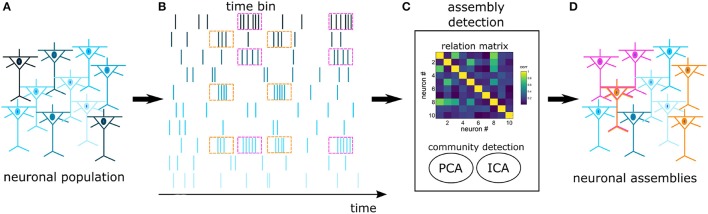
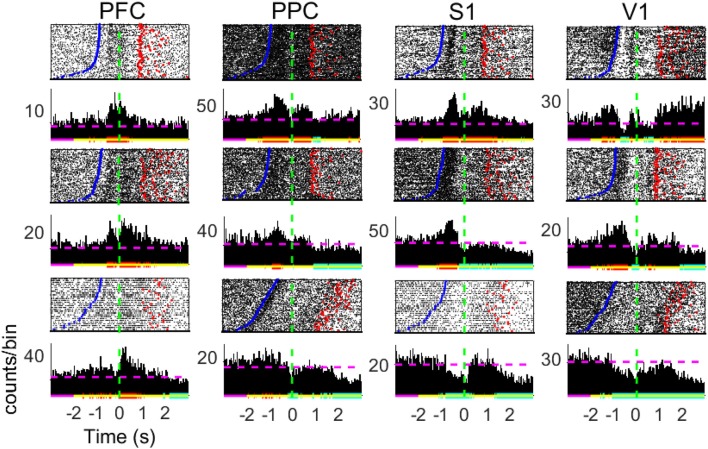
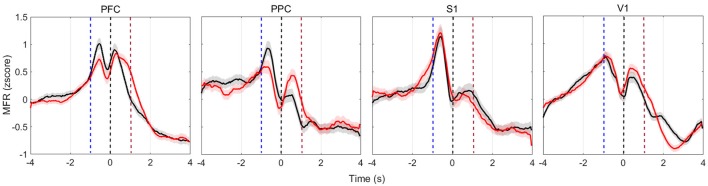
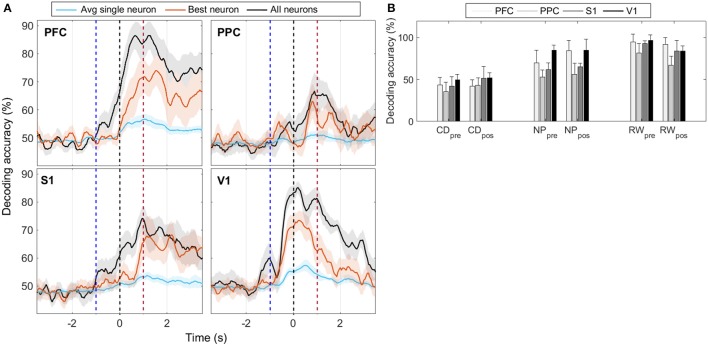
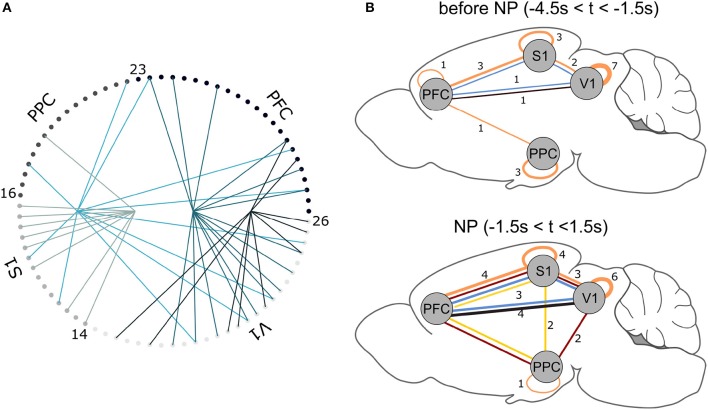
Accumulating evidence suggests that neural interactions are distributed and relate to animal behavior, but many open questions remain. The neural assembly hypothesis, formulated by Hebb, states that synchronously active single neurons may transiently organize into functional neural circuits-neuronal assemblies (NAs)-and that would constitute the fundamental unit of information processing in the brain. However, the formation, vanishing, and temporal evolution of NAs are not fully understood. In particular, characterizing NAs in multiple brain regions over the course of behavioral tasks is relevant to assess the highly distributed nature of brain processing. In the context of NA characterization, active tactile discrimination tasks with rats are elucidative because they engage several cortical areas in the processing of information that are otherwise masked in passive or anesthetized scenarios. In this work, we investigate the dynamic formation of NAs within and among four different cortical regions in long-range fronto-parieto-occipital networks (primary somatosensory, primary visual, prefrontal, and posterior parietal cortices), simultaneously recorded from seven rats engaged in an active tactile discrimination task. Our results first confirm that task-related neuronal firing rate dynamics in all four regions is significantly modulated. Notably, a support vector machine decoder reveals that neural populations contain more information about the tactile stimulus than the majority of single neurons alone. Then, over the course of the task, we identify the emergence and vanishing of NAs whose participating neurons are shown to contain more information about animal behavior than randomly chosen neurons. Taken together, our results further support the role of multiple and distributed neurons as the functional unit of information processing in the brain (NA hypothesis) and their link to active animal behavior.
越来越多的证据表明,神经相互作用是分布式的,与动物行为有关,但仍有许多悬而未决的问题。赫布(Hebb)提出的神经集合假说指出,同步活动的单个神经元可能会暂时组织成功能性神经回路——神经元集合(NAs),而这将构成大脑信息处理的基本单位。然而,NAs 的形成、消失和时间演化尚不完全清楚。特别是,在行为任务过程中对多个脑区的 NAs 进行特征描述,对于评估大脑处理的高度分布式特性具有重要意义。在 NAs 特征描述的背景下,用大鼠进行主动触觉辨别任务具有启发性,因为它们使几个皮质区域参与信息处理,而在被动或麻醉情况下则会掩盖这些信息。在这项工作中,我们研究了长程额顶枕叶网络内和之间的四个不同皮质区域(初级体感、初级视觉、前额叶和后顶叶皮质)内和之间的 NAs 的动态形成,这是从七只参与主动触觉辨别任务的大鼠中同时记录的。我们的结果首先证实,所有四个区域的与任务相关的神经元放电率动态都受到显著调节。值得注意的是,支持向量机解码器表明,神经群体包含的关于触觉刺激的信息比大多数单独的神经元多。然后,在任务过程中,我们确定了 NAs 的出现和消失,参与 NAs 的神经元被证明比随机选择的神经元包含更多关于动物行为的信息。总之,我们的结果进一步支持了多个分布式神经元作为大脑信息处理的功能单位(NA 假说)及其与动物主动行为的联系。