Ruan Zeng-Liang, Liu Li, Strodl Esben, Fan Li-Jun, Yin Xiao-Na, Wen Guo-Min, Sun Deng-Li, Xian Dan-Xia, Jiang Hui, Jing Jin, Jin Yu, Wu Chuan-An, Chen Wei-Qing
Department of Biostatistics and Epidemiology, School of Public Health, Sun Yat-sen University, Guangzhou, China.
School of Psychology and Counselling, Queensland University of Technology, Brisbane, QLD, Australia.
Front Psychiatry. 2018 Jan 11;8:305. doi: 10.3389/fpsyt.2017.00305. eCollection 2017.
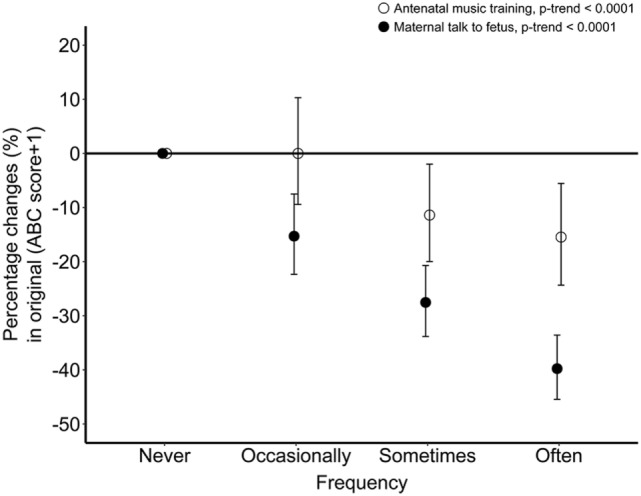
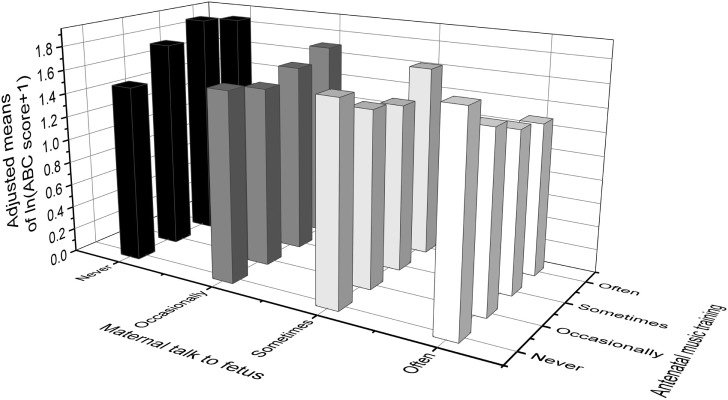
Antenatal training through music and maternal talk to the unborn fetus is a topic of general interest for parents-to-be in China, but we still lack a comprehensive assessment of their effects on the development of autistic-like behaviors during early childhood. During 2014-2016, 34,749 parents of children around the age of 3 years who were enrolled at kindergarten in the Longhua district of Shenzhen participated in this study. Self-administered questionnaires regarding demographics, antenatal music training, and maternal talk to the fetus during pregnancy were completed by the children's primary caregivers. Autistic-like behaviors were assessed using the Autism Behavioral Checklist. Tobit regression analyses revealed that antenatal music training and maternal talk to the fetus was associated with a reduction in autistic-like behaviors in children, with a dose-dependent relationship. Furthermore, factorial analysis of covariance indicated a significant interaction effect between antenatal music training and maternal talk to the fetus on the autistic-like behaviors and found that children who often experienced antenatal music training and maternal talk concurrently had the lowest risk of autistic-like behaviors, while children who were never exposed to maternal talk and only sometimes experienced antenatal music training had the highest risk. Our results suggest that antenatal training through both music and maternal talk to the unborn fetus might reduce the risk of children's autistic-like behaviors at around 3 years of age.
在中国,通过音乐和母亲与未出生胎儿交谈进行产前训练是准父母普遍感兴趣的话题,但我们仍缺乏对其对幼儿期自闭症样行为发展影响的全面评估。在2014年至2016年期间,深圳龙华区34749名3岁左右在幼儿园入学儿童的家长参与了这项研究。儿童的主要照料者完成了关于人口统计学、产前音乐训练以及孕期母亲与胎儿交谈情况的自填式问卷。使用《自闭症行为检查表》评估自闭症样行为。托比特回归分析显示,产前音乐训练和母亲与胎儿交谈与儿童自闭症样行为的减少有关,且存在剂量依赖关系。此外,协方差因子分析表明,产前音乐训练和母亲与胎儿交谈之间对自闭症样行为存在显著的交互作用,发现经常同时经历产前音乐训练和母亲交谈的儿童患自闭症样行为的风险最低,而从未接受母亲交谈且只是偶尔经历产前音乐训练的儿童风险最高。我们的结果表明,通过音乐和母亲与未出生胎儿交谈进行产前训练可能会降低3岁左右儿童患自闭症样行为的风险。