Department of Medical Statistics and Epidemiology, Guangzhou Key Laboratory of Environmental Pollution and Health Assessment, Guangdong Provincial Key Laboratory of Food, Nutrition and Health, School of Public Health, Sun Yat-sen University, Guangzhou, China.
School of Optometry and Vision Science, Faculty of Health, Queensland University of Technology, Brisbane, QLD, Australia.
Front Public Health. 2021 Mar 5;9:607911. doi: 10.3389/fpubh.2021.607911. eCollection 2021.
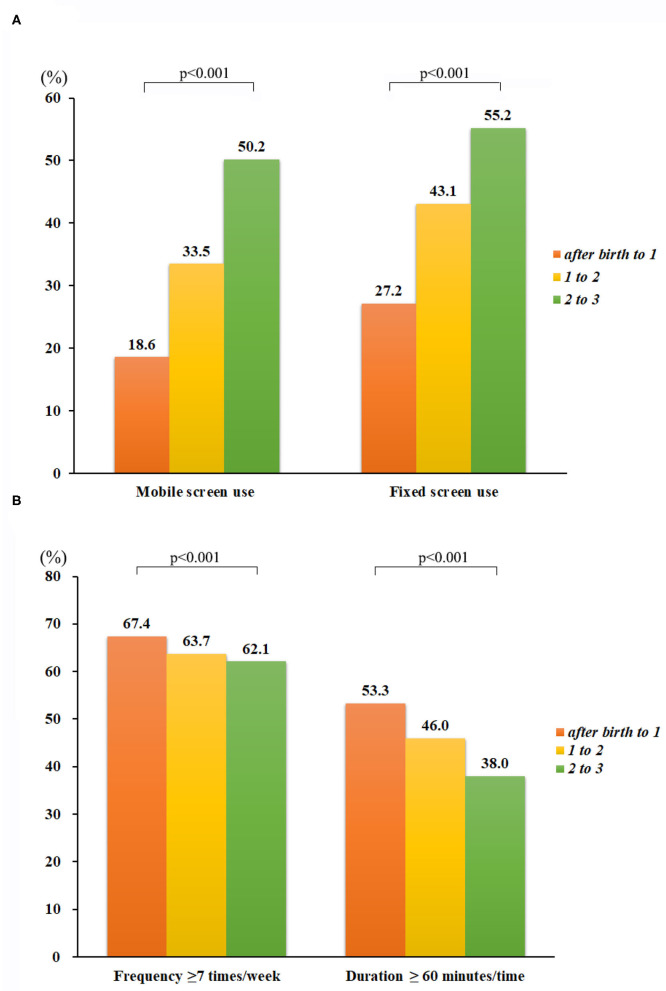
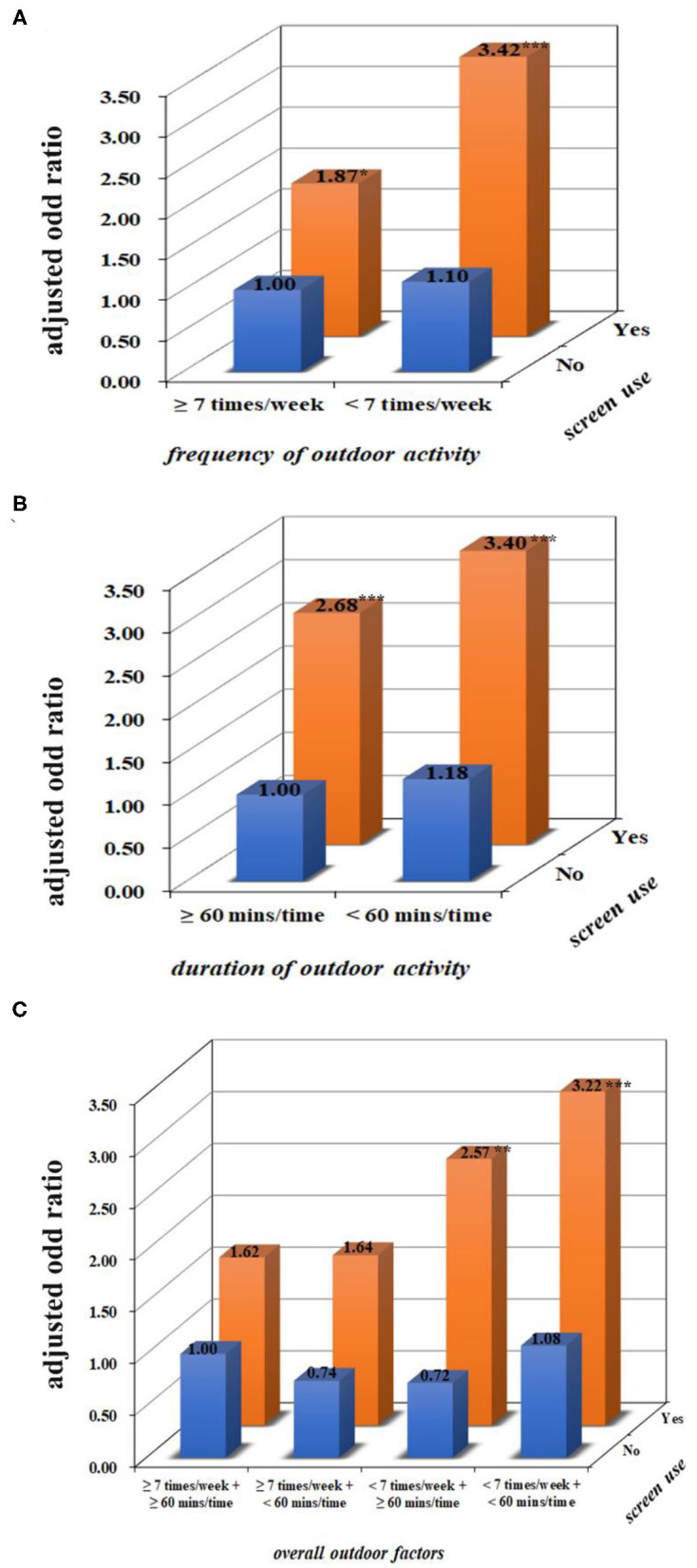
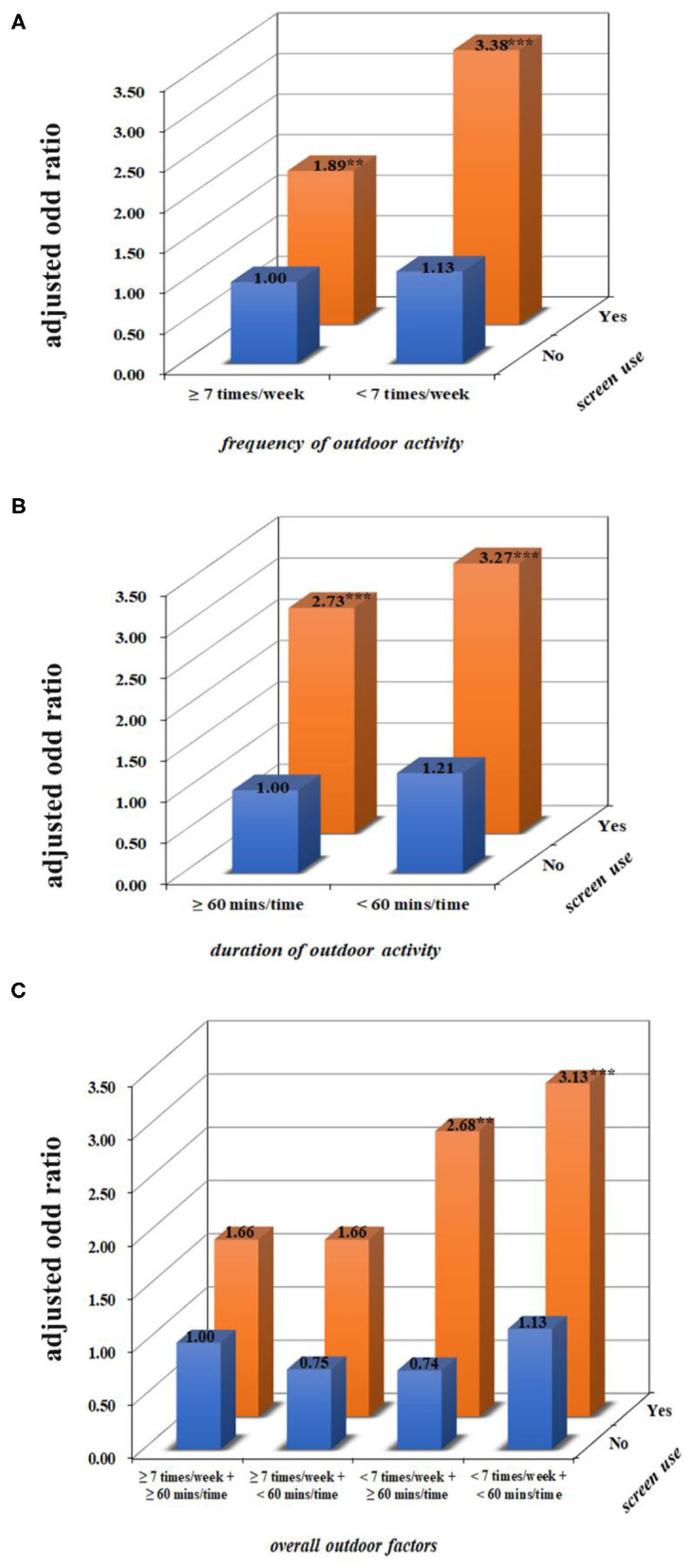
Evidence regarding screen use and outdoor activity during very early childhood (i. e., from aged 1 to 3 years) and their potential combined links to the later preschool myopia is limited. This information is needed to release effective public health messages and propose intervention strategies against preschool myopia. We collected information regarding very early childhood screen use, outdoor activity and the kindergartens vision screenings of 26,611 preschoolers from Longhua Child Cohort Study by questionnaires. Logistic regression models were used to examine the associations between reported outdoor activity, screen use from 1 to 3 years of age, and preschool myopia. Throughout very early childhood, from 1 to 3 years, the proportion of children exposed to screens increased (from 35.8 to 68.4%, < 0.001), whereas the proportion of children who went outdoors ≥7 times/week (67.4-62.1%, < 0.001) and who went outdoors for ≥60 min/time (53.3-38.0%, < 0.001) declined. Exposure to fixed screen devices [adjusted odds ratio (AOR) = 2.66, 95% confidence interval (CI) = 2.09-3.44], mobile screen devices (AOR = 2.76, 95% CI = 2.15-3.58), and limited outdoor activity (AOR = 1.87, 95% CI = 1.42-2.51) during early childhood were associated with preschool myopia. Among children whose parents were myopic, the interactions between outdoor activity and fixed or mobile screen use on later preschool myopia were significant; the ORs and 95% CI were 3.34 (1.19-9.98) and 3.04 (1.06-9.21), respectively. Our findings suggest the possibility that the impact of screen exposure during early childhood on preschool myopia could be diminished by outdoor activity for children whose parents have myopia.
关于婴幼儿期(即 1 至 3 岁)内屏幕使用和户外活动的相关证据及其与学龄前近视潜在的综合联系有限。为了发布有效的公共卫生信息并提出预防学龄前近视的干预策略,我们需要了解这些信息。我们通过问卷调查收集了来自龙华儿童队列研究的 26611 名学龄前儿童的婴幼儿期屏幕使用、户外活动和幼儿园视力筛查信息。使用逻辑回归模型来检查报告的户外活动、1 至 3 岁期间的屏幕使用与学龄前近视之间的关联。在整个婴幼儿期,从 1 岁到 3 岁,暴露于屏幕的儿童比例增加(从 35.8%到 68.4%,<0.001),而每周户外活动≥7 次(67.4%-62.1%,<0.001)和每次户外活动≥60 分钟(53.3%-38.0%,<0.001)的儿童比例下降。在婴幼儿期接触固定屏幕设备(调整后的优势比(AOR)=2.66,95%置信区间(CI)=2.09-3.44)、移动屏幕设备(AOR=2.76,95%CI=2.15-3.58)和户外活动受限(AOR=1.87,95%CI=1.42-2.51)与学龄前近视有关。在父母近视的儿童中,户外活动与固定或移动屏幕使用之间对后期学龄前近视的相互作用具有统计学意义;比值比(OR)和 95%置信区间(CI)分别为 3.34(1.19-9.98)和 3.04(1.06-9.21)。我们的研究结果表明,对于父母近视的儿童,户外活动可能会降低婴幼儿期屏幕暴露对学龄前近视的影响。