Moriya Jun
Faculty of Sociology, Kansai University, Osaka, Japan.
Front Psychol. 2018 Jan 11;8:2323. doi: 10.3389/fpsyg.2017.02323. eCollection 2017.
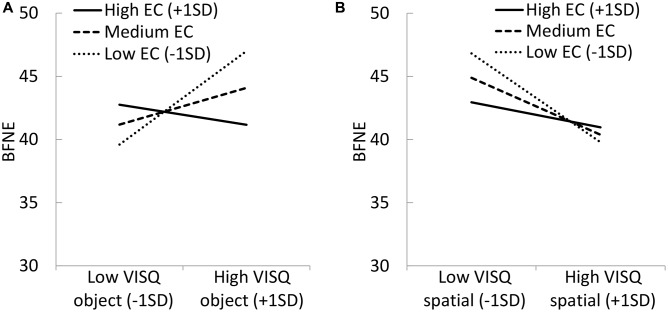
According to cognitive theories, verbal processing attenuates emotional processing, whereas visual imagery enhances emotional processing and contributes to the maintenance of social anxiety. Individuals with social anxiety report negative mental images in social situations. However, the general ability of visual mental imagery of neutral scenes in individuals with social anxiety is still unclear. The present study investigated the general ability of non-emotional mental imagery (vividness, preferences for imagery vs. verbal processing, and object or spatial imagery) and the moderating role of effortful control in attenuating social anxiety. The participants ( = 231) completed five questionnaires. The results showed that social anxiety was not necessarily associated with all aspects of mental imagery. As suggested by theories, social anxiety was not associated with a preference for verbal processing. However, social anxiety was positively correlated with the visual imagery scale, especially the object imagery scale, which concerns the ability to construct pictorial images of individual objects. Further, it was negatively correlated with the spatial imagery scale, which concerns the ability to process information about spatial relations between objects. Although object imagery and spatial imagery positively and negatively predicted the degree of social anxiety, respectively, these effects were attenuated when socially anxious individuals had high effortful control. Specifically, in individuals with high effortful control, both object and spatial imagery were not associated with social anxiety. Socially anxious individuals might prefer to construct pictorial images of individual objects in natural scenes through object imagery. However, even in individuals who exhibit these features of mental imagery, effortful control could inhibit the increase in social anxiety.
根据认知理论,言语加工会削弱情绪加工,而视觉表象则会增强情绪加工并导致社交焦虑的持续存在。患有社交焦虑症的个体在社交情境中会报告负面的心理意象。然而,社交焦虑症患者对中性场景的视觉心理表象的一般能力仍不清楚。本研究调查了非情绪性心理表象的一般能力(生动性、对表象与言语加工的偏好以及物体或空间表象)以及努力控制在减轻社交焦虑中的调节作用。参与者(n = 231)完成了五份问卷。结果表明,社交焦虑不一定与心理表象的所有方面相关。正如理论所表明的,社交焦虑与对言语加工的偏好无关。然而,社交焦虑与视觉表象量表呈正相关,尤其是物体表象量表,该量表涉及构建单个物体的图像的能力。此外,它与空间表象量表呈负相关,该量表涉及处理物体之间空间关系信息的能力。虽然物体表象和空间表象分别正向和负向预测社交焦虑的程度,但当社交焦虑个体具有较高的努力控制时,这些影响会减弱。具体而言,在具有高努力控制的个体中,物体表象和空间表象均与社交焦虑无关。社交焦虑个体可能更倾向于通过物体表象在自然场景中构建单个物体的图像。然而,即使在表现出这些心理表象特征的个体中,努力控制也可以抑制社交焦虑的增加。