Sánchez-Pérez Noelia, Castillo Alejandro, López-López José A, Pina Violeta, Puga Jorge L, Campoy Guillermo, González-Salinas Carmen, Fuentes Luis J
Department of Basic Psychology and Methodology, Faculty of Psychology, University of Murcia, Murcia, Spain.
School of Social and Community Medicine, University of Bristol, Bristol, United Kingdom.
Front Psychol. 2018 Jan 9;8:2327. doi: 10.3389/fpsyg.2017.02327. eCollection 2017.
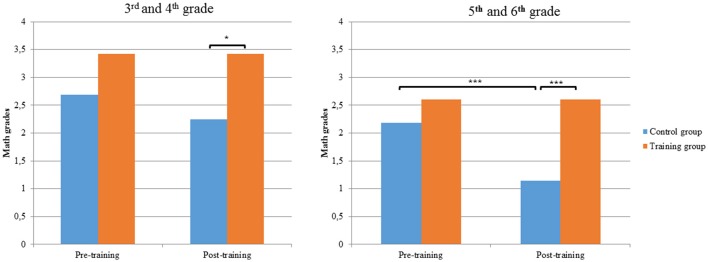
Student academic achievement has been positively related to further development outcomes, such as the attainment of higher educational, employment, and socioeconomic aspirations. Among all the academic competences, mathematics has been identified as an essential skill in the field of international leadership as well as for those seeking positions in disciplines related to science, technology, and engineering. Given its positive consequences, studies have designed trainings to enhance children's mathematical skills. Additionally, the ability to regulate and control actions and cognitions, i.e., executive functions (EF), has been associated with school success, which has resulted in a strong effort to develop EF training programs to improve students' EF and academic achievement. The present study examined the efficacy of a school computer-based training composed of two components, namely, working memory and mathematics tasks. Among the advantages of using a computer-based training program is the ease with which it can be implemented in school settings and the ease by which the difficulty of the tasks can be adapted to fit the child's ability level. To test the effects of the training, children's cognitive skills (EF and IQ) and their school achievement (math and language grades and abilities) were evaluated. The results revealed a significant improvement in cognitive skills, such as non-verbal IQ and inhibition, and better school performance in math and reading among the children who participated in the training compared to those children who did not. Most of the improvements were related to training on WM tasks. These findings confirmed the efficacy of a computer-based training that combined WM and mathematics activities as part of the school routines based on the training's impact on children's academic competences and cognitive skills.
学生的学业成绩与进一步的发展成果呈正相关,比如在高等教育、就业以及社会经济抱负的实现方面。在所有学术能力中,数学已被认定为在国际领导力领域以及那些寻求科学、技术和工程相关学科职位的人所必备的技能。鉴于其积极影响,研究设计了培训以提高儿童的数学技能。此外,调节和控制行为与认知的能力,即执行功能(EF),已与学业成功相关联,这导致人们大力努力开发执行功能培训项目以提高学生的执行功能和学业成绩。本研究考察了一种基于学校计算机的培训的效果,该培训由两个部分组成,即工作记忆和数学任务。使用基于计算机的培训项目的优势之一在于它能轻松地在学校环境中实施,并且任务难度能轻松调整以适应儿童的能力水平。为了测试培训的效果,对儿童的认知技能(执行功能和智商)以及他们的学业成绩(数学和语言成绩及能力)进行了评估。结果显示,与未参加培训的儿童相比,参加培训的儿童在认知技能方面有显著提高,如非言语智商和抑制能力,并且在数学和阅读方面的学业表现更好。大部分提高与工作记忆任务的培训有关。这些发现证实了基于计算机的培训的有效性,该培训将工作记忆和数学活动结合起来,作为学校日常活动的一部分,基于其对儿童学术能力和认知技能的影响。