Department of Medical Psychology, VU University Medical Center, De Boelenlaan 1117, 1081 HV Amsterdam, Netherlands.
Department of Epidemiology and Biostatistics, Amsterdam Public Health Research Institute, Van der Boechorststraat 7, 1081 BT Amsterdam, Netherlands.
J Diabetes Res. 2017;2017:1462064. doi: 10.1155/2017/1462064. Epub 2017 Dec 10.
To evaluate (1) the longitudinal relationship between parental well-being and glycemic control in youth with type 1 diabetes and (2) if youth's problem behavior, diabetes parenting behavior, and parental diabetes-distress influence this relationship.
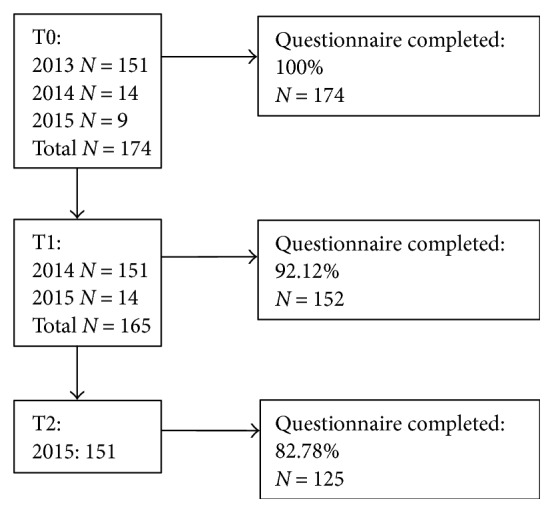
Parents of youth 8-15 yrs (at baseline) ( = 174) participating in the DINO study completed questionnaires at three time waves (1 yr interval). Using generalized estimating equations, the relationship between parental well-being (WHO-5) and youth's HbA1c was examined. Second, relationships between WHO-5, Strength and Difficulties Questionnaire (SDQ), Diabetes Family Behavior Checklist (DFBC), Problem Areas In Diabetes-Parent Revised (PAID-Pr) scores, and HbA1c were analyzed.
Low well-being was reported by 32% of parents. No relationship was found between parents' WHO-5 scores and youth's HbA1c ( = -0.052, = 0.650). WHO-5 related to SDQ ( = -0.219, < 0.01), DFBC unsupportive scale ( = -0.174, < 0.01), and PAID-Pr ( = -0.666, < 0.01). Both DFBC scales (supportive = -0.259, = 0.01; unsupportive = 0.383, = 0.017), PAID-Pr ( = 0.276, < 0.01), and SDQ ( = 0.424, < 0.01) related to HbA1c.
Over time, reduced parental well-being relates to increased problem behavior in youth, unsupportive parenting, and parental distress, which negatively associate with HbA1c. More unsupportive diabetes parenting and distress relate to youth's problem behavior.
评估(1)父母幸福感与 1 型糖尿病青少年血糖控制的纵向关系,以及(2)青少年的问题行为、糖尿病养育行为和父母的糖尿病困扰是否会影响这种关系。
参加 DINO 研究的 8-15 岁青少年(基线时)的父母(n=174)在三个时间点(1 年间隔)完成了问卷。使用广义估计方程,检验了父母幸福感(WHO-5)与青少年 HbA1c 之间的关系。其次,分析了 WHO-5、困难问题问卷(SDQ)、糖尿病家庭行为检查表(DFBC)、糖尿病家长修订问题区域问卷(PAID-Pr)得分与 HbA1c 之间的关系。
32%的父母报告幸福感较低。父母的 WHO-5 评分与青少年的 HbA1c 之间没有关系(= -0.052,= 0.650)。WHO-5 与 SDQ(= -0.219,<0.01)、DFBC 不支持量表(= -0.174,<0.01)和 PAID-Pr(= -0.666,<0.01)相关。DFBC 的两个量表(支持量表= -0.259,= 0.01;不支持量表= 0.383,= 0.017)、PAID-Pr(= 0.276,<0.01)和 SDQ(= 0.424,<0.01)均与 HbA1c 相关。
随着时间的推移,父母幸福感降低与青少年问题行为增加、不支持性养育行为和父母困扰有关,而这些因素与 HbA1c 呈负相关。更不支持的糖尿病养育行为和困扰与青少年的问题行为有关。