Physiological Chemistry, Biocenter, University of Würzburg, 97074, Würzburg, Germany.
Comprehensive Cancer Center Mainfranken, University Hospital, 97080, Würzburg, Germany.
BMC Biol. 2018 Jan 29;16(1):16. doi: 10.1186/s12915-018-0485-8.
Sex determination relies on a hierarchically structured network of genes, and is one of the most plastic processes in evolution. The evolution of sex-determining genes within a network, by neo- or sub-functionalization, also requires the regulatory landscape to be rewired to accommodate these novel gene functions. We previously showed that in medaka fish, the regulatory landscape of the master male-determining gene dmrt1bY underwent a profound rearrangement, concomitantly with acquiring a dominant position within the sex-determining network. This rewiring was brought about by the exaptation of a transposable element (TE) called Izanagi, which is co-opted to act as a silencer to turn off the dmrt1bY gene after it performed its function in sex determination.
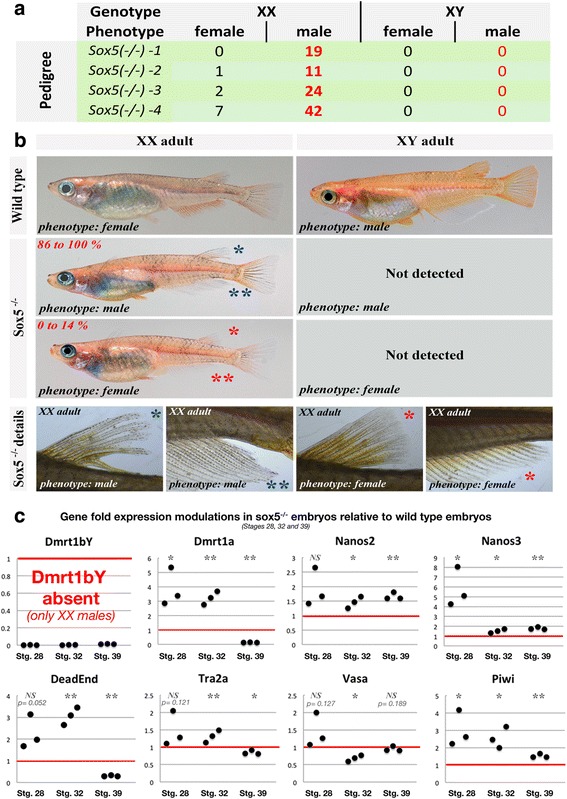
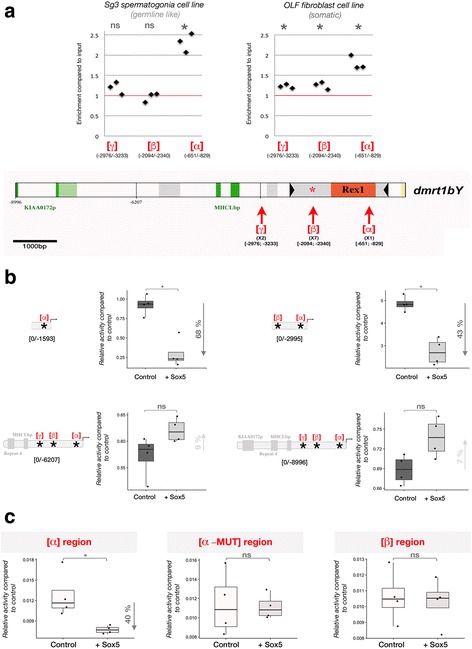
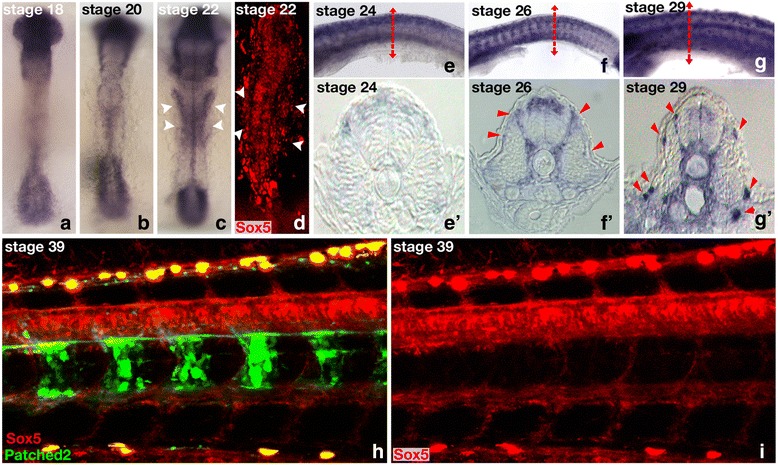
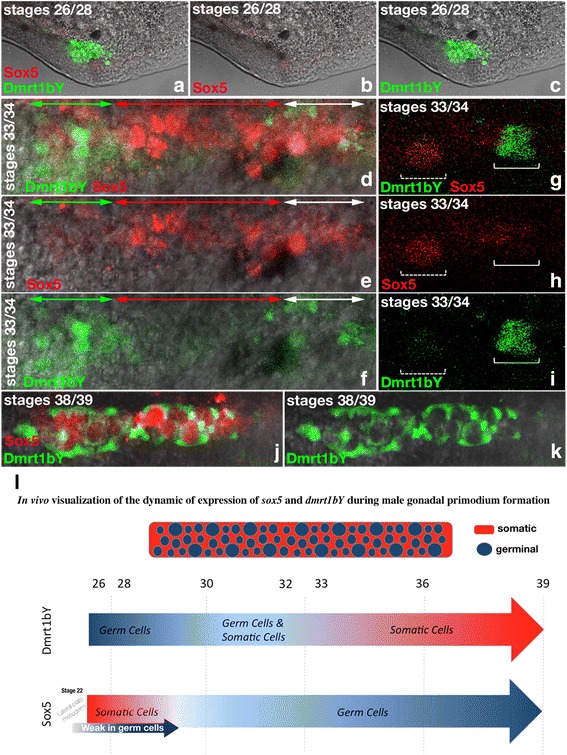
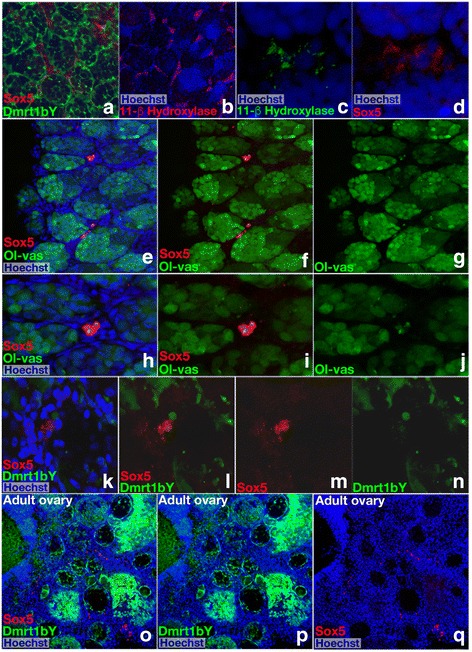
We now show that a second TE, Rex1, has been incorporated into Izanagi. The insertion of Rex1 brought in a preformed regulatory element for the transcription factor Sox5, which here functions in establishing the temporal and cell-type-specific expression pattern of dmrt1bY. Mutant analysis demonstrates the importance of Sox5 in the gonadal development of medaka, and possibly in mice, in a dmrt1bY-independent manner. Moreover, Sox5 medaka mutants have complete female-to-male sex reversal.
Our work reveals an unexpected complexity in TE-mediated transcriptional rewiring, with the exaptation of a second TE into a network already rewired by a TE. We also show a dual role for Sox5 during sex determination: first, as an evolutionarily conserved regulator of germ-cell number in medaka, and second, by de novo regulation of dmrt1 transcriptional activity during primary sex determination due to exaptation of the Rex1 transposable element.
性别决定依赖于基因的层次结构网络,是进化中最具可塑性的过程之一。通过新功能或亚功能化,网络内性别决定基因的进化也需要重新布线调节景观以适应这些新基因功能。我们之前表明,在鱼类中,主雄性决定基因 dmrt1bY 的调控景观发生了深刻的重排,同时在性别决定网络中获得了主导地位。这种重排是由一个称为伊扎那吉(Izanagi)的转座元件(TE)的适应产生的,该转座元件被篡夺为沉默子,在 dmrt1bY 基因完成性别决定功能后将其关闭。
我们现在表明,第二个 TE Rex1 已被整合到伊扎那吉中。Rex1 的插入带来了转录因子 Sox5 的预先形成的调节元件,该元件在此作用是建立 dmrt1bY 的时空和细胞类型特异性表达模式。突变分析表明 Sox5 在鱼类性腺发育中的重要性,并且可能在 dmrt1bY 独立的情况下在小鼠中也是如此。此外,Sox5 鱼类突变体完全发生雌性到雄性的性别反转。
我们的工作揭示了 TE 介导的转录重排的意外复杂性,即第二个 TE 被适应到已经由 TE 重排的网络中。我们还表明 Sox5 在性别决定中具有双重作用:首先,作为鱼类生殖细胞数量的进化保守调节因子,其次,通过 Rex1 转座元件的适应,对 dmrt1 转录活性进行从头调控,从而在主要性别决定期间发挥作用。