The University of the Sunshine Coast, Maroochydore DC, QLD, 4558, Australia.
Diversity Arrays Technology Pty Ltd, Kirinari St, Bruce, ACT, 2617, Australia.
BMC Genomics. 2018 Jan 30;19(1):107. doi: 10.1186/s12864-018-4493-4.
Genomic prediction using Diversity Arrays Technology (DArT) genotype by sequencing platform has not been reported in yellowtail kingfish (Seriola lalandi). The principal aim of this study was to address this knowledge gap and to assess predictive ability of genomic Best Linear Unbiased Prediction (gBLUP) for traits of commercial importance in a yellowtail kingfish population comprising 752 individuals that had DNA sequence and phenotypic records for growth traits (body weight, fork length and condition index). The gBLUP method was used due to its computational efficiency and it showed similar predictive performance to other approaches, especially for traits whose variation is of polygenic nature, such as body traits analysed in this study. The accuracy or predictive ability of the gBLUP model was estimated for three growth traits: body weight, folk length and condition index.
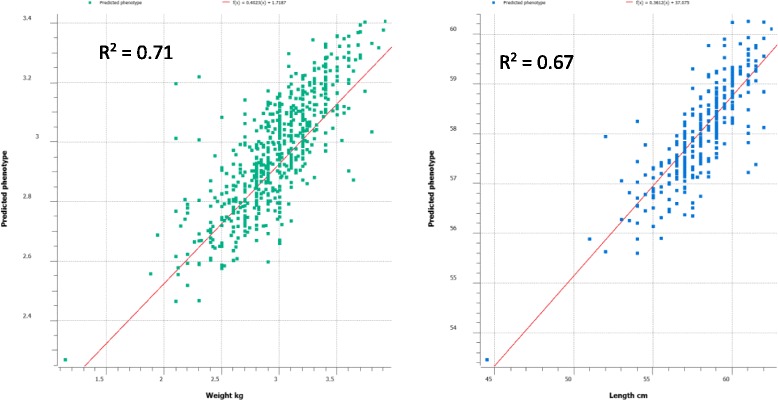
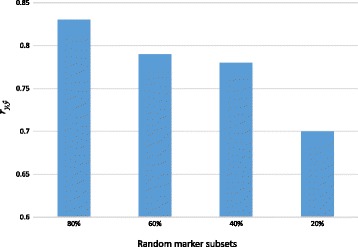
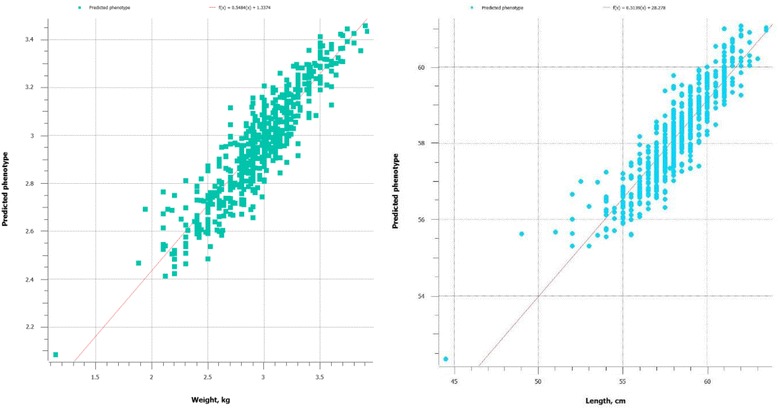
The prediction accuracy was moderate to high (0.44 to 0.69) for growth-related traits. The predictive ability for body weight increased by 17.0% (from 0.69 to 0.83) when missing genotype was imputed. Within population prediction using five-fold across validation approach showed that the gBLUP model performed well for growth traits (weight, length and condition factor), with the coefficient of determination (R) from linear regression analysis ranging from 0.49 to 0.71.
Collectively our results demonstrated, for the first time in yellowtail kingfish, the potential application of genomic selection for growth-related traits in the future breeding program for this species, S. lalandi.
使用多样性数组技术(DArT)测序平台进行基因组预测尚未在黄鳍金枪鱼(Seriola lalandi)中报道。本研究的主要目的是解决这一知识空白,并评估基因组最佳线性无偏预测(gBLUP)对一个包含 752 个个体的黄鳍金枪鱼群体中商业重要性状的预测能力,这些个体具有生长性状(体重、叉长和条件指数)的 DNA 序列和表型记录。gBLUP 方法由于其计算效率而被使用,并且与其他方法相比表现出相似的预测性能,特别是对于那些变异是多基因性质的性状,如本研究中分析的身体性状。gBLUP 模型的准确性或预测能力被估计为三个生长性状:体重、叉长和条件指数。
生长相关性状的预测准确性为中等至高度(0.44 至 0.69)。当缺失基因型被推断时,体重的预测能力增加了 17.0%(从 0.69 增加到 0.83)。使用五重交叉验证的群体内预测表明,gBLUP 模型对生长性状(体重、长度和条件因子)表现良好,线性回归分析的决定系数(R)范围从 0.49 到 0.71。
总的来说,我们的结果首次在黄鳍金枪鱼中证明了基因组选择在该物种未来的繁殖计划中对生长相关性状的潜在应用,S. lalandi。