Huang Ying, Yan Wen, Jia Yifan, Xie Qingfang, Lei Yuexiu, Chen Zepeng, Zhou Yanjie, Xiao Zheman
Department of Neurology, Renmin Hospital of Wuhan University, Wuhan, Hubei, 430060, China.
Department of Pain, Renmin Hospital of Wuhan University, Wuhan, Hube, 430060, China.
J Headache Pain. 2025 Apr 28;26(1):92. doi: 10.1186/s10194-025-02002-6.
Migraine has been linked to a heightened risk of cardiovascular disease, and acute treatment drugs, such as triptans, might increase this risk. This study aimed to determine whether the elevated cardiovascular risk is primarily attributable to the underlying migraine condition or the treatment modalities utilized. Additionally, we investigated the effects of managing traditional cardiovascular risk factors and the influence of healthy lifestyle scores on this association.
This population-based investigation leveraged data from the UK Biobank, encompassing participants recruited between 2006 and 2010, to examine the association between migraine and the long-term risk of atherosclerotic cardiovascular disease and its subtypes. Cox proportional hazard models were employed to conduct this analysis. Furthermore, the study evaluated the relative importance of migraine in predicting atherosclerotic cardiovascular disease by calculating the R² values of the Cox models. Additionally, multiplicative and additive interaction analyses were conducted to examine whether the association between migraine and cardiovascular disease varies based on the degree of risk factor control and lifestyle scores.
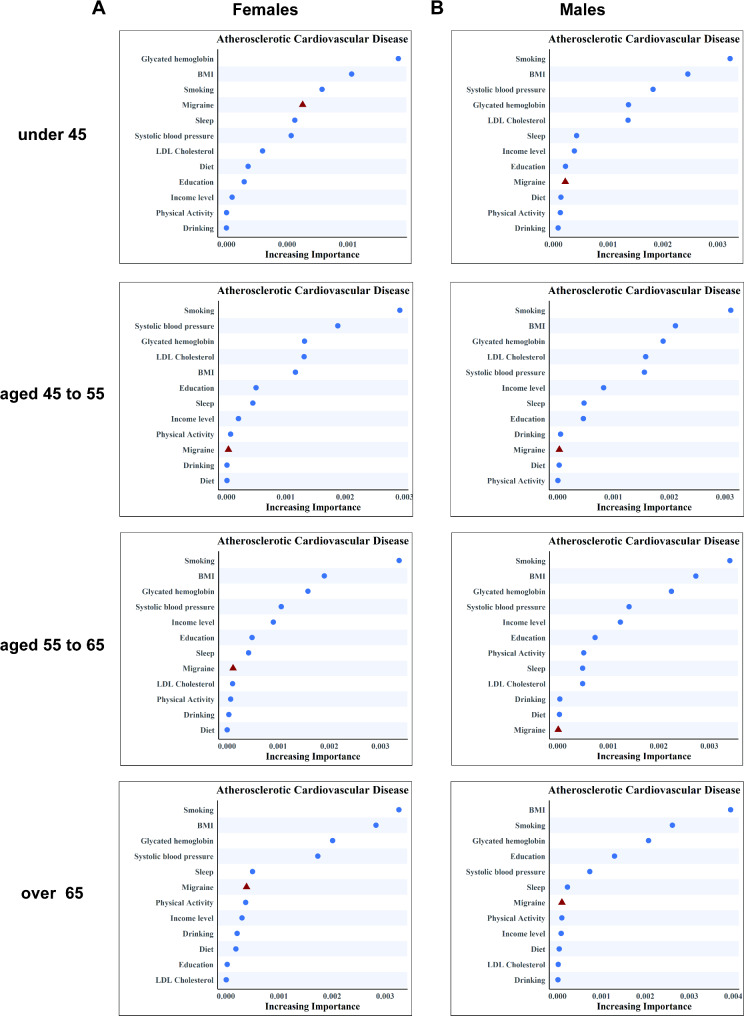
Across an average follow-up span of 12.9 years, a total of 24,038 cardiovascular events were documented, comprising 12,451 cases of coronary heart disease, 3,608 cases of ischemic stroke, and 4,493 cases of peripheral artery disease. In a thoroughly adjusted analysis, individuals with migraine demonstrated an increased risk of atherosclerotic cardiovascular disease, with a hazard ratio of 1.12 (95% confidence interval: 1.05 to 1.20) compared to those without migraine, indicating a significant trend (P< 0.001). Among female participants under 45 years of age, migraine emerged as a stronger predictor of ASCVD risk than certain lifestyle factors. Furthermore, a significant interaction between migraine and an unhealthy lifestyle was observed in ASCVD risk, evident at both additive and multiplicative levels (P for additive interaction = 0.016; P for multiplicative interaction = 0.041). However, the interactions between migraine and the degree of traditional risk factor control did not reach statistical significance. Additionally, the acute treatment of migraine, including the use of triptans, was not significantly associated with ASCVD risk.
A significant interaction exists between unhealthy lifestyles and migraine, where their combined effects may contribute to an elevated risk of cardiovascular diseases, potentially amplifying the impact of each factor. Developing effective lifestyle intervention strategies tailored for migraine patients could help improve their long-term cardiovascular health, emphasizing the importance of comprehensive risk management.
偏头痛与心血管疾病风险升高有关,而曲坦类等急性治疗药物可能会增加这种风险。本研究旨在确定心血管风险升高主要是归因于潜在的偏头痛状况还是所采用的治疗方式。此外,我们调查了管理传统心血管危险因素的效果以及健康生活方式评分对这种关联的影响。
这项基于人群的调查利用了英国生物银行的数据,这些数据涵盖了2006年至2010年招募的参与者,以研究偏头痛与动脉粥样硬化性心血管疾病及其亚型的长期风险之间的关联。采用Cox比例风险模型进行此分析。此外,该研究通过计算Cox模型的R²值评估偏头痛在预测动脉粥样硬化性心血管疾病中的相对重要性。另外,进行了乘法和加法交互分析,以检查偏头痛与心血管疾病之间的关联是否因危险因素控制程度和生活方式评分而有所不同。
在平均12.9年的随访期内,共记录了24,038例心血管事件,包括12,451例冠心病、3,608例缺血性中风和4,493例外周动脉疾病。在一项经过充分调整的分析中,与无偏头痛者相比,偏头痛患者发生动脉粥样硬化性心血管疾病的风险增加,风险比为1.12(95%置信区间:1.05至1.20),显示出显著趋势(P<0.001)。在45岁以下的女性参与者中,偏头痛比某些生活方式因素更能预测ASCVD风险。此外,在ASCVD风险中观察到偏头痛与不健康生活方式之间存在显著交互作用,在加法和乘法水平上均明显(加法交互作用P = 0.016;乘法交互作用P = 0.041)。然而,偏头痛与传统危险因素控制程度之间的交互作用未达到统计学意义。此外,偏头痛的急性治疗,包括使用曲坦类药物,与ASCVD风险无显著关联。
不健康生活方式与偏头痛之间存在显著交互作用,它们的综合作用可能导致心血管疾病风险升高,可能会放大每个因素的影响。为偏头痛患者制定有效的生活方式干预策略有助于改善他们的长期心血管健康,强调了全面风险管理的重要性。
