Abdelaziz Khalid M, Khalil Ashraf A, Alsalhi Ibrahim Y, Almufarrij Ali J, Mojathel Ahmed Y
Department of Restorative Dental Sciences, College of Dentistry, King Khalid University, Abha, Saudi Arabia.
Department of Crown and Bridge, Faculty of Dentistry, Tanta University, Tanta, Egypt.
J Int Soc Prev Community Dent. 2017 Nov-Dec;7(6):344-350. doi: 10.4103/jispcd.JISPCD_382_17. Epub 2017 Dec 29.
To assess the effect of root tilt on the fracture resistance and failure pattern of endodontically-treated premolars restored with different post-core systems.
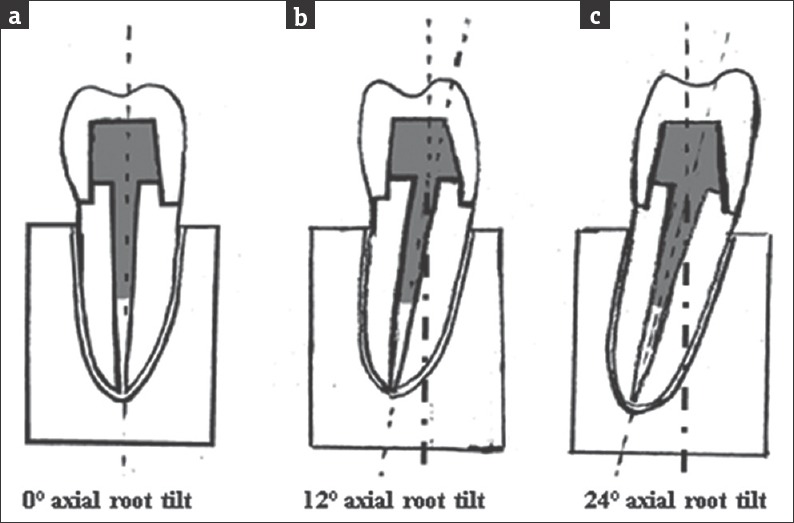
Ninety endodontically-treated premolars were mounted in acrylic blocks with 0°, 12°, and 24° axial root tilt. Teeth in each group were restored in three subgroups with cast post-core, readymade metal posts and composite cores, and fiber post and composite cores. Crowns of all teeth were prepared coinciding with the long axis of the acrylic blocks to receive all-ceramic crowns. All restored teeth were stressed to record the maximum load at failure and the associated failure pattern. The collected data were statistically analyzed using two-way ANOVA, Tukey's, and Kruskal-Wallis tests at α = 0.05 on past software to detect any differences between subgroups.
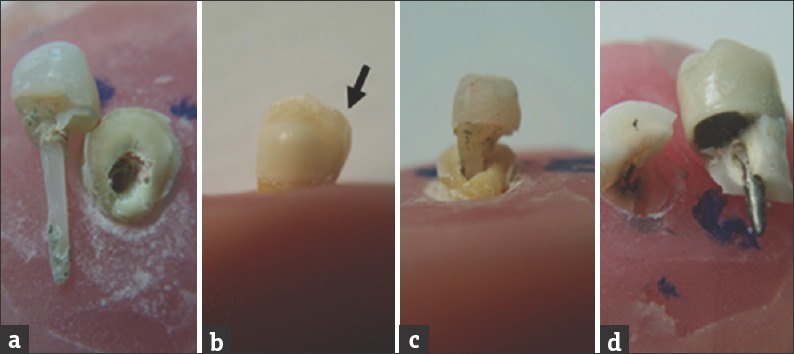
Analysis of the collected data indicated significant differences between the tested subgroups (ANOVA, = 3.86). Further analysis showed significant difference between all test subgroups and the control (Tukey's, < 0.05). In general, teeth with 0° tilt seemed more resistant to fracture than the tilted ones. For all groups, teeth restored with fiber post and composite cores (SG3) were more resistant to fracture compared to other post-core systems (SG1 and SG2) (Tukey's, < 0.05). The root fracture was the most commonly seen mode of failure.
Root tilting usually affects the fracture resistance of teeth restored with post-core systems. The fiber post and composite cores seemed to be the best choice to restore teeth with different root tilting possibilities.
评估牙根倾斜对采用不同桩核系统修复的根管治疗后前磨牙抗折性及失败模式的影响。
90颗根管治疗后的前磨牙以0°、12°和24°的轴向牙根倾斜度固定于丙烯酸树脂块中。每组牙齿再分为三个亚组,分别采用铸造桩核、预成金属桩与复合树脂核以及纤维桩与复合树脂核进行修复。所有牙齿的牙冠按照丙烯酸树脂块的长轴进行制备,以安装全瓷牙冠。对所有修复后的牙齿施加应力,记录其破坏时的最大载荷及相关的失败模式。使用双因素方差分析、Tukey检验和Kruskal-Wallis检验对收集的数据进行统计学分析,在α = 0.05的水平下,通过统计软件检测各亚组之间的差异。
对收集数据的分析表明,各测试亚组之间存在显著差异(方差分析,F = 3.86)。进一步分析显示,所有测试亚组与对照组之间均存在显著差异(Tukey检验,P < 0.05)。总体而言,0°倾斜的牙齿似乎比倾斜的牙齿更抗折。对于所有组,与其他桩核系统(SG1和SG2)相比,采用纤维桩与复合树脂核修复的牙齿(SG3)更抗折(Tukey检验,P < 0.05)。牙根折断是最常见的失败模式。
牙根倾斜通常会影响采用桩核系统修复的牙齿的抗折性。纤维桩与复合树脂核似乎是修复具有不同牙根倾斜可能性牙齿的最佳选择。