Salas Ariel A, Woodfin Taylor, Phillips Vivien, Peralta-Carcelen Myriam, Carlo Waldemar A, Ambalavanan Namasivayam
Department of Pediatrics, University of Alabama at Birmingham, Birmingham, AL, USA.
Neonatology. 2018;113(3):256-262. doi: 10.1159/000484399. Epub 2018 Jan 24.
Many extremely preterm infants have low vitamin D concentrations at birth, but early childhood outcomes after vitamin D supplementation have not been reported.
To determine a dose-response relationship between increasing doses of enteral vitamin D in the first 28 days after birth and cognitive scores at 2 years of age.
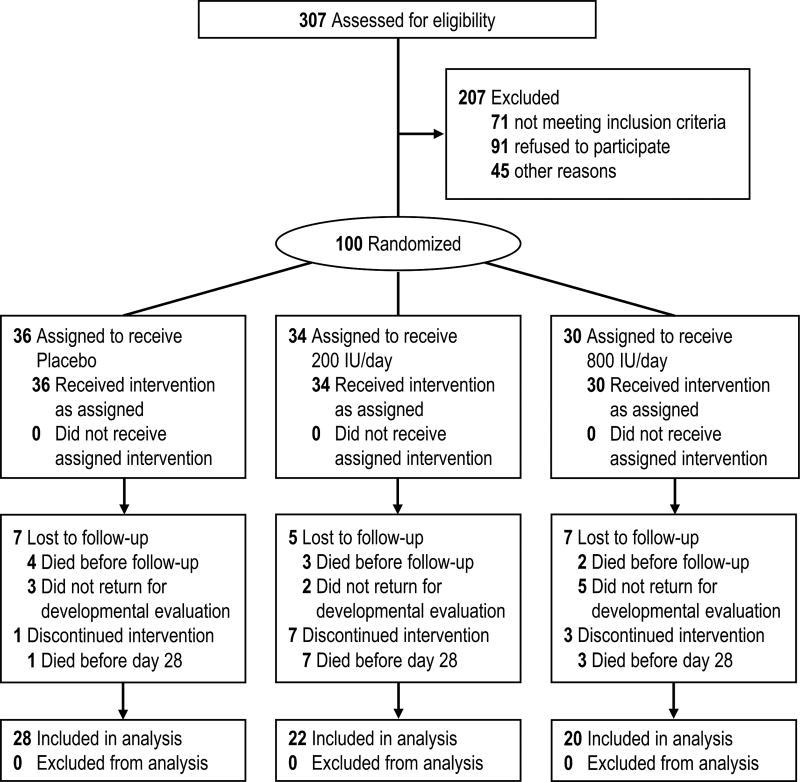
In this phase II double-blind dose-response randomized trial, infants with gestational ages between 23 and 27 weeks were randomly assigned to receive placebo or a vitamin D dose of 200 or 800 IU/day from day 1 of enteral feeding to postnatal day 28. The primary outcome of this follow-up study was Bayley III cognitive score at 22-26 months of age.
Seventy of 80 survivors had a follow-up evaluation at 2 years of age (88%). There were no significant differences in cognitive scores between supplementation groups (p = 0.47). Cognitive scores did not differ between the higher vitamin D dose group and the placebo group (median difference favoring the 800 IU group: +5 points; 95% CI: -5 to 15; p = 0.23). The linear trend between increasing doses of vitamin D and reduction of neurodevelopmental impairment (placebo group: 54%; 200 IU group: 43%; 800 IU group: 30%; p = 0.08) or language impairment (placebo group: 64%; 200 IU group: 57%; 800 IU group: 45%; p = 0.15) was not statistically significant. Respiratory outcomes at 2 years of age (need for supplemental oxygen or asthma medications) did not differ between groups.
In extremely preterm infants, early vitamin D supplementation did not significantly improve cognitive scores. Though underpowered for clinically meaningful differences in early childhood outcomes, this trial may help determine dosing for further investigation of vitamin D supplementation.
许多极早产儿出生时维生素D浓度较低,但维生素D补充后的幼儿期结局尚未见报道。
确定出生后前28天肠内维生素D剂量增加与2岁时认知评分之间的剂量反应关系。
在这项II期双盲剂量反应随机试验中,孕龄在23至27周之间的婴儿从肠内喂养第1天至出生后第28天被随机分配接受安慰剂或200或800 IU/天的维生素D剂量。这项随访研究的主要结局是22至26个月龄时的贝利III认知评分。
80名幸存者中有70名在2岁时进行了随访评估(88%)。补充组之间的认知评分无显著差异(p = 0.47)。较高维生素D剂量组与安慰剂组的认知评分无差异(有利于800 IU组的中位数差异:+5分;95% CI:-5至15;p = 0.23)。维生素D剂量增加与神经发育障碍减少(安慰剂组:54%;200 IU组:43%;800 IU组:30%;p = 0.08)或语言障碍(安慰剂组:64%;200 IU组:57%;800 IU组:45%;p = 0.15)之间的线性趋势无统计学意义。2岁时的呼吸结局(补充氧气或哮喘药物的需求)在各组之间无差异。
在极早产儿中,早期补充维生素D并不能显著提高认知评分。尽管该试验在幼儿期结局的临床意义差异方面的检验效能不足,但可能有助于确定剂量以便进一步研究维生素D补充。