Department of Respiratory Disease, The Second Affiliated Hospital, Zhejiang University College of Medicine, Hangzhou, Zhejiang 120070, P.R. China.
Department of Respiratory Disease, The First Hospital of Jiaxing, Jiaxing, Zhejiang 320090, P.R. China.
Mol Med Rep. 2018 Apr;17(4):4899-4908. doi: 10.3892/mmr.2018.8535. Epub 2018 Feb 1.
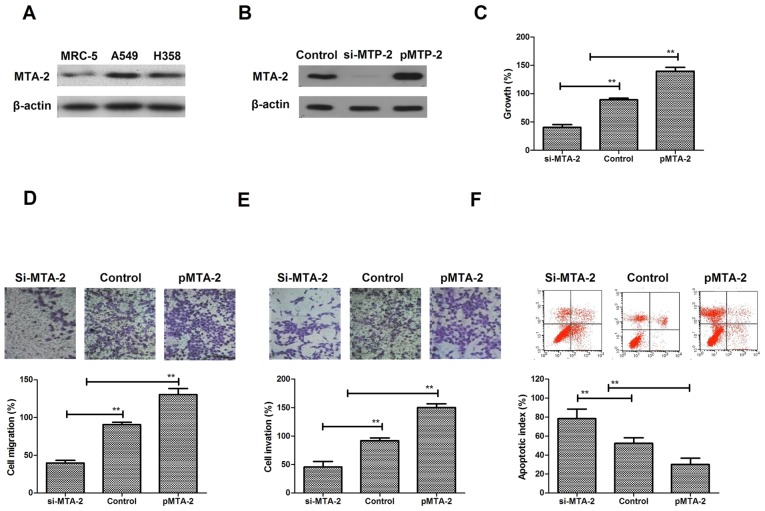
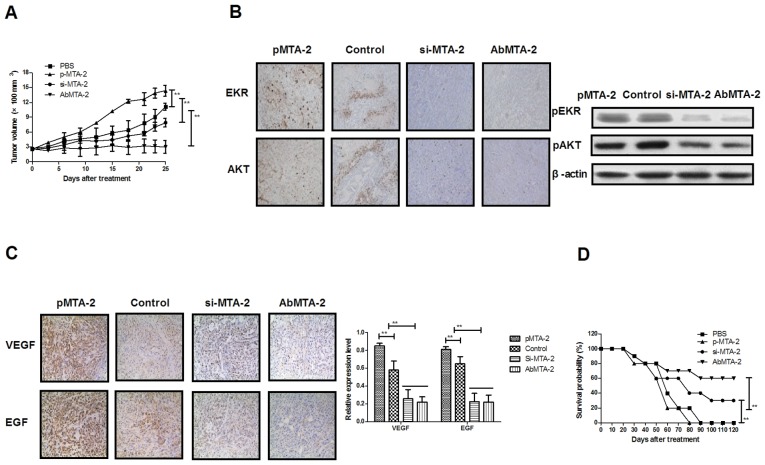
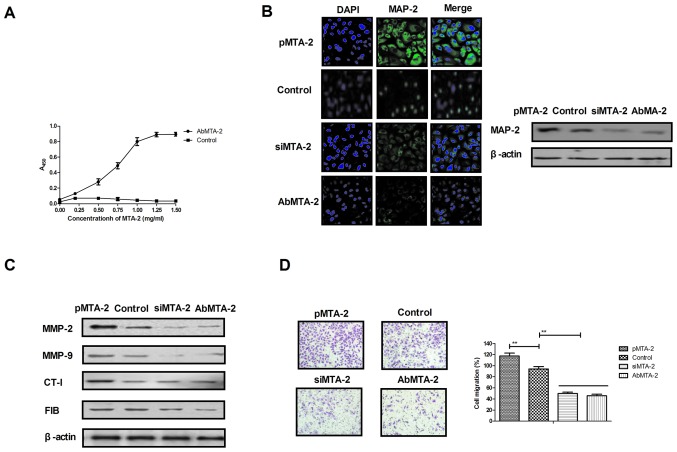
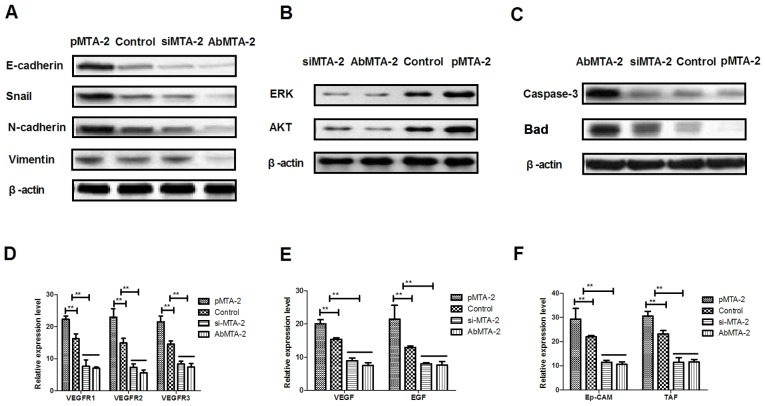
Non-small cell lung carcinoma (NSCLC) is the most common cause of cancer‑associated mortality in the world and accounts for ~85% of human lung cancers. Metastasis‑associated protein 2 (MTA2) is a component of the histone deacetylase complex and serves a role in tumor progression; however, the mechanism through which MTA2 is involved in the progression of NSCLC remains unclear. The aim of the present study was to investigate the expression and function of MTA2 and the MTA2‑mediated signaling pathway in NSCLC cells. Expression of MTA2 and its target genes was analyzed in MTA2‑overexpressing and anti‑MTA2 antibody (AbMTA2)‑treated NSCLC cells, as well as growth, migration, invasion and apoptotic‑resistance. The inhibitory effects on tumor formation were analyzed using AbMTA2‑treated NSCLC cells and in a mouse model. Histological assessment was conducted to analyze the expressions levels of extracellular signal‑regulated kinase (ERK), RAC‑α serine/threonine protein kinase (AKT) and vascular endothelial growth factor (VEGF) in experimental tumors. Results of the present study demonstrated that MTA2 was overexpressed in NSCLC cells. The growth, migration and invasion of NSCLC cells were markedly inhibited by AbMTA2. In addition, it was observed that the ERK/AKT and VEGF signaling pathways were both upregulated in MTA2‑overexpressing NSCLC cells, and downregulated following silencing of MTA2 activation. ERK and AKT phosphorylation levels were downregulated in NSCLC cells and tumors following MTA2 silencing. The in vivo study demonstrated that tumor growth was markedly inhibited following siRNA‑MTA2 treatment. In conclusion, the results of the present study suggested that MTA2 silencing may significantly inhibit the growth and aggressiveness of NSCLC cells. Results from the present study indicated that the mechanism underlying the MTA2‑mediated invasive potential of NSCLC cells involved the ERK/AKT and VEGF signaling pathways, which may be a potential therapeutic target for the treatment of NSCLC.
非小细胞肺癌(NSCLC)是全球癌症相关死亡的最常见原因,约占人类肺癌的 85%。转移相关蛋白 2(MTA2)是组蛋白去乙酰化酶复合物的一个组成部分,在肿瘤进展中发挥作用;然而,MTA2 参与 NSCLC 进展的机制尚不清楚。本研究旨在探讨 MTA2 及其在 NSCLC 细胞中的靶基因的表达和功能,以及 MTA2 介导的信号通路。在过表达 MTA2 和抗 MTA2 抗体(AbMTA2)处理的 NSCLC 细胞中分析 MTA2 的表达及其靶基因的表达,以及生长、迁移、侵袭和抗凋亡能力。用 AbMTA2 处理的 NSCLC 细胞和小鼠模型分析对肿瘤形成的抑制作用。对实验性肿瘤进行组织学评估,以分析细胞外信号调节激酶(ERK)、RAC-α 丝氨酸/苏氨酸蛋白激酶(AKT)和血管内皮生长因子(VEGF)的表达水平。本研究结果表明,MTA2 在 NSCLC 细胞中过表达。AbMTA2 显著抑制 NSCLC 细胞的生长、迁移和侵袭。此外,观察到在过表达 MTA2 的 NSCLC 细胞中 ERK/AKT 和 VEGF 信号通路均被上调,而在 MTA2 激活沉默后被下调。ERK 和 AKT 磷酸化水平在 MTA2 沉默的 NSCLC 细胞和肿瘤中均下调。体内研究表明,siRNA-MTA2 治疗后肿瘤生长明显受到抑制。综上所述,MTA2 沉默可能显著抑制 NSCLC 细胞的生长和侵袭能力。本研究结果表明,MTA2 介导的 NSCLC 细胞侵袭潜能的机制涉及 ERK/AKT 和 VEGF 信号通路,这可能是治疗 NSCLC 的潜在治疗靶点。