Zhu Xun, Smith Rachel A, Parrott Roxanne L
Communication Arts & Sciences, Pennsylvania State University, 316 Sparks Building, University Park, PA 16802.
Communication Arts & Sciences, Pennsylvania State University, 216 Sparks Building, University Park, PA 16802, (814) 865-4201.
J Appl Commun Res. 2017;45(2):179-198. doi: 10.1080/00909882.2017.1288292. Epub 2017 Mar 22.
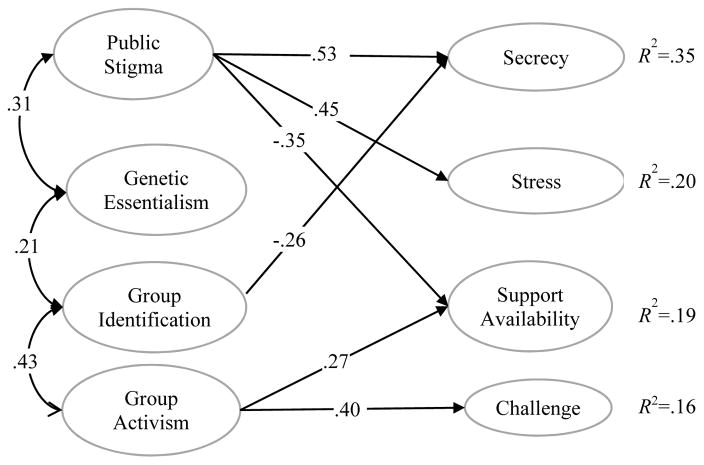
People affected by rare diseases often have limited coping resources and sometimes face stigma. They build communities with others who share their conditions, but not all members may benefit from these communities. This study investigated how adults with a rare genetic health condition (Alpha-1 antitrypsin deficiency; AATD) think about both the Alpha-1 community and public stigma about AATD, and how these cognitions were associated with their communication responses and well-being. The results showed that people with AATD encountered stigmatization from various sources, including family, employers, healthcare providers, and insurance companies. Stronger public stigma predicted more secrecy, more stress, and less available support. Stronger group identification with the Alpha-1 community predicted less secrecy; stronger group activism predicted more available support and more communication to challenge stigmatizers. Post-hoc analyses showed significant interactions between public stigma and group cognitions on communication to challenge stigmatizers. Practical implications for bolstering communities to improve the well-being of people with rare diseases were discussed.
受罕见病影响的人群往往应对资源有限,有时还会面临污名化。他们与其他患有相同病症的人建立社群,但并非所有成员都能从这些社群中受益。本研究调查了患有罕见基因健康状况(α-1抗胰蛋白酶缺乏症;AATD)的成年人如何看待α-1社群以及公众对AATD的污名,以及这些认知如何与他们的沟通反应和幸福感相关联。结果表明,患有AATD的人遭受来自各种来源的污名化,包括家人、雇主、医疗服务提供者和保险公司。更强的公众污名预示着更多的隐瞒、更多的压力和更少的可用支持。对α-1社群更强的群体认同感预示着更少的隐瞒;更强的群体行动主义预示着更多的可用支持以及更多与挑战污名者的沟通。事后分析表明,公众污名与群体认知在与挑战污名者的沟通方面存在显著交互作用。讨论了加强社群以改善罕见病患者幸福感的实际意义。