PlantStressLab, Department of Agricultural, Forestry, and Food Sciences, University of Turin, Grugliasco, Italy.
Laboratory of Growth Regulators, Palacký University & Institute of Experimental Botany AS CR, Olomouc, Czech Republic.
J Exp Bot. 2018 Apr 23;69(9):2391-2401. doi: 10.1093/jxb/ery033.
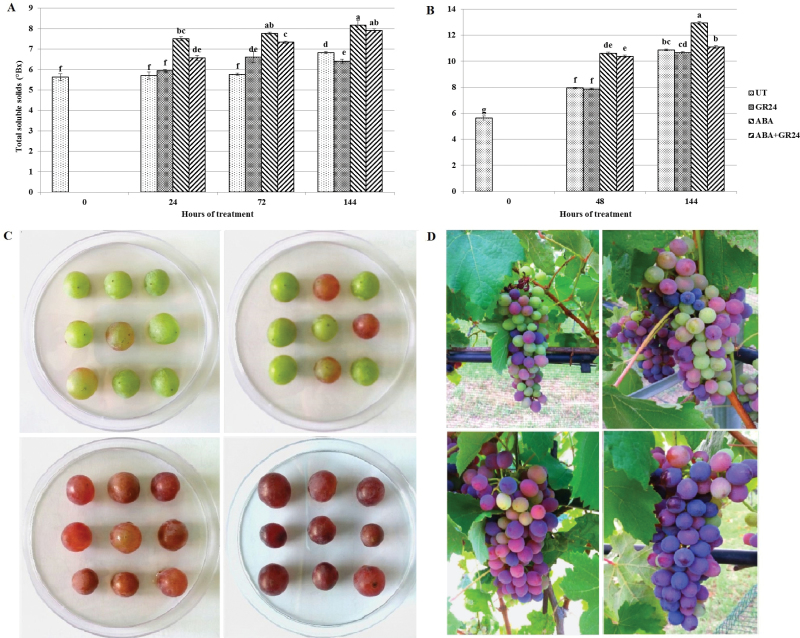
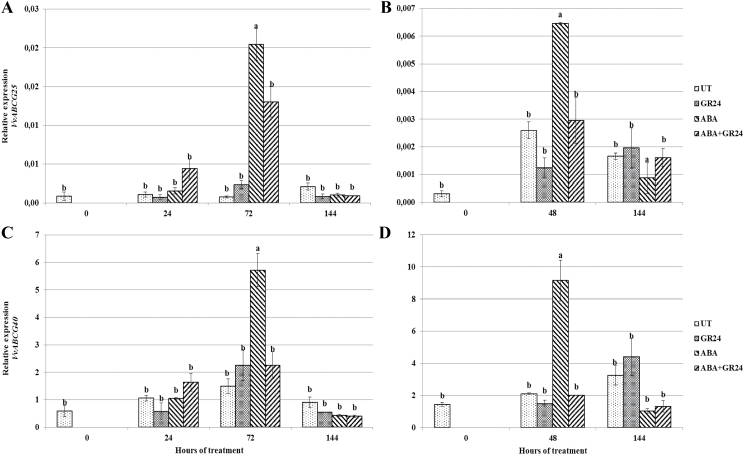
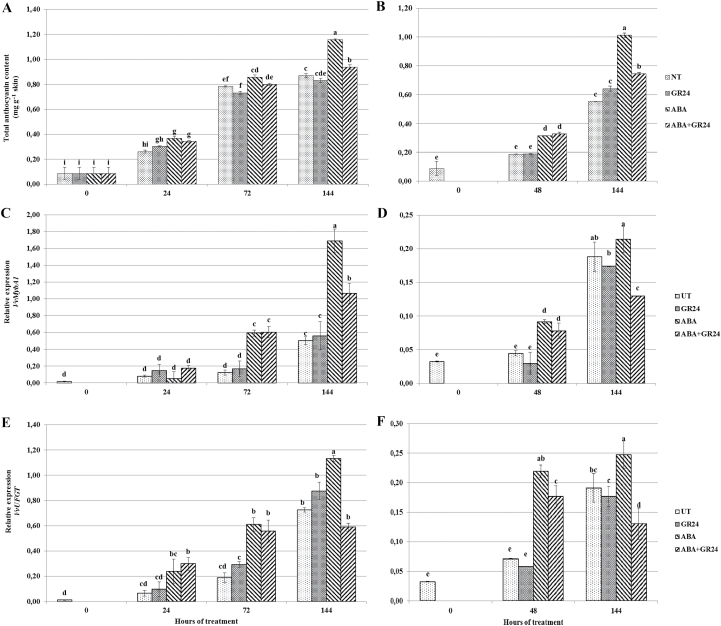
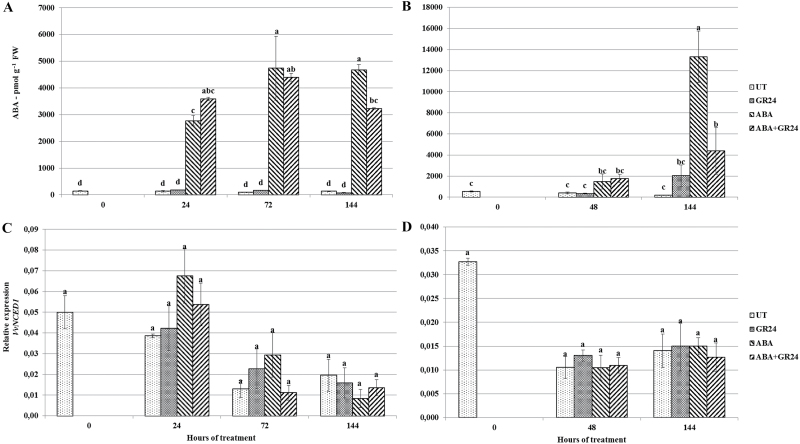
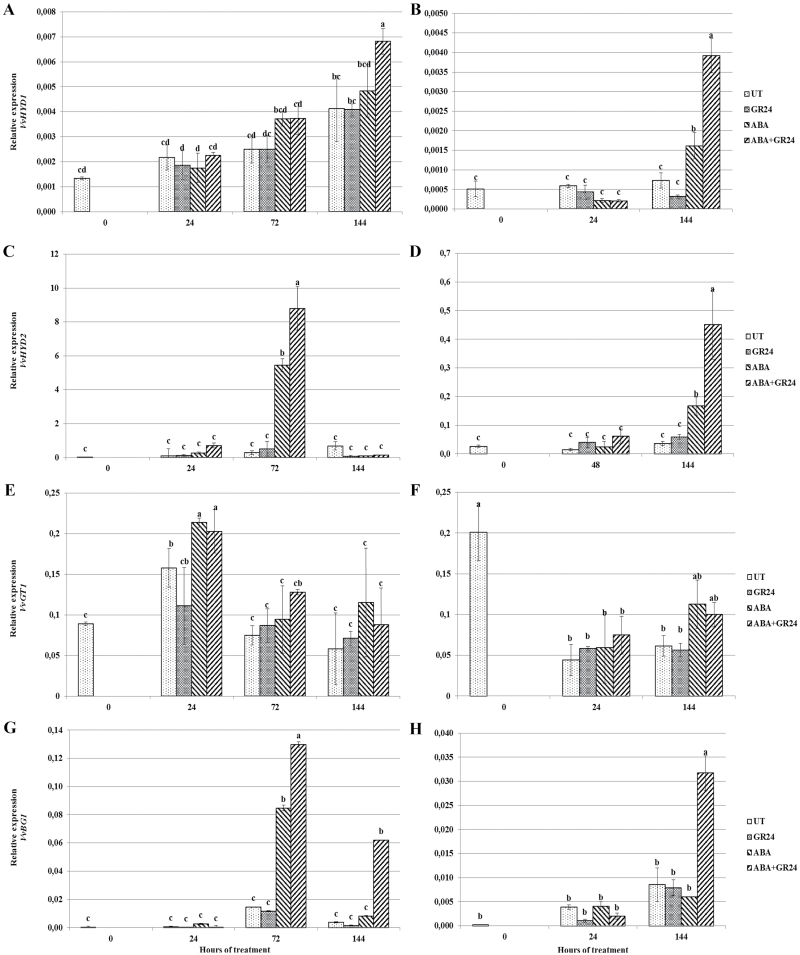
Besides signalling to soil organisms, strigolactones (SLs) control above- and below-ground morphology, in particular shoot branching. Furthermore, SLs interact with stress responses, possibly thanks to a crosstalk with the abscisic acid (ABA) signal. In grapevine (Vitis vinifera L.), ABA drives the accumulation of anthocyanins over the ripening season. In this study, we investigated the effects of treatment with a synthetic strigolactone analogue, GR24, on anthocyanin accumulation in grape berries, in the presence or absence of exogenous ABA treatment. Experiments were performed both on severed, incubated berries, and on berries attached to the vine. Furthermore, we analysed the corresponding transcript concentrations of genes involved in anthocyanin biosynthesis, and in ABA biosynthesis, metabolism, and membrane transport. During the experiment time courses, berries showed the expected increase in soluble sugars and anthocyanins. GR24 treatment had no or little effect on anthocyanin accumulation, or on gene expression levels. Exogenous ABA treatment activated soluble sugar and anthocyanin accumulation, and enhanced expression of anthocyanin and ABA biosynthetic genes, and that of genes involved in ABA hydroxylation and membrane transport. Co-treatment of GR24 with ABA delayed anthocyanin accumulation, decreased expression of anthocyanin biosynthetic genes, and negatively affected ABA concentration. GR24 also enhanced the ABA-induced activation of ABA hydroxylase genes, while it down-regulated the ABA-induced activation of ABA transport genes. Our results show that GR24 affects the ABA-induced activation of anthocyanin biosynthesis in this non-climacteric fruit. We discuss possible mechanisms underlying this effect, and the potential role of SLs in ripening of non-ABA-treated berries.
除了向土壤生物发出信号外,独脚金内酯(SLs)还控制地上和地下形态,特别是分枝。此外,SLs 与应激反应相互作用,可能是由于与脱落酸(ABA)信号的串扰。在葡萄(Vitis vinifera L.)中,ABA 驱动成熟季节中花色苷的积累。在这项研究中,我们研究了用合成独脚金内酯类似物 GR24 处理对葡萄浆果中花色苷积累的影响,同时存在或不存在外源 ABA 处理。实验在切断、孵育的浆果和附着在藤上的浆果上进行。此外,我们分析了参与花色苷生物合成以及 ABA 生物合成、代谢和膜转运的基因的相应转录浓度。在实验过程中,浆果显示出预期的可溶性糖和花色苷增加。GR24 处理对花色苷积累或基因表达水平没有或几乎没有影响。外源 ABA 处理激活了可溶性糖和花色苷的积累,并增强了花色苷和 ABA 生物合成基因的表达,以及涉及 ABA 羟化和膜转运的基因的表达。GR24 与 ABA 共同处理延迟了花色苷的积累,降低了花色苷生物合成基因的表达,并对 ABA 浓度产生负面影响。GR24 还增强了 ABA 诱导的 ABA 羟化酶基因的激活,同时下调了 ABA 诱导的 ABA 转运基因的激活。我们的结果表明,GR24 影响了这种非跃变型果实中 ABA 诱导的花色苷生物合成的激活。我们讨论了这种效应的可能机制,以及 SLs 在未用 ABA 处理的浆果成熟中的潜在作用。