Sheaff Rod, Sherriff Ian, Hennessy Catherine Hagan
School of Government, Plymouth University, Drake Circus, Plymouth, PL4 8AA, UK.
Academic Partnership Lead for Dementia, Plymouth University Peninsula Schools of Medicine and Dentistry, Plymouth University, Drake Circus, Plymouth, PL4 8AA, UK.
BMC Health Serv Res. 2018 Feb 5;18(1):83. doi: 10.1186/s12913-018-2894-3.
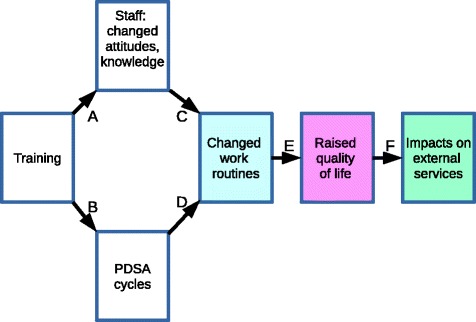
Access times for, the costs and overload of hospital services are an increasingly salient issue for healthcare managers in many countries. Rising demand for hospital care has been attributed partly to unplanned admissions for older people, and among these partly to the increasing prevalence of dementia. The paper makes a preliminary evaluation of the logic model of a Dementia Learning Community (DLC) intended to reduce unplanned hospital admissions from care homes of people with dementia. A dementia champion in each DLC care home trained other staff in dementia awareness and change management with the aims of changing work routines, improving quality of life, and reducing demands on external services.
Controlled mixed methods realistic evaluation comparing 13 intervention homes with 10 controls in England during 2013-15. Each link in the assumed logic model was tested to find whether that link appeared to exist in the DLC sites, and if so whether its effects appeared greater there than in control sites, in terms of selected indicators of quality of life (DCM Well/Ill-Being, QUALID, end-of-life planning); and impacts on ambulance call-outs and hospital admissions.
The training was implemented as planned, and triggered cycles of Plan-Do-Study-Act activity in all the intervention care homes. Residents' well-being scores, measured by dementia care mapping, improved markedly in half of the intervention homes but not in the other half, where indeed some scores deteriorated markedly. Most other care quality indicators studied did not significantly improve during the study period. Neither did ambulance call-out or emergency hospital admission rates.
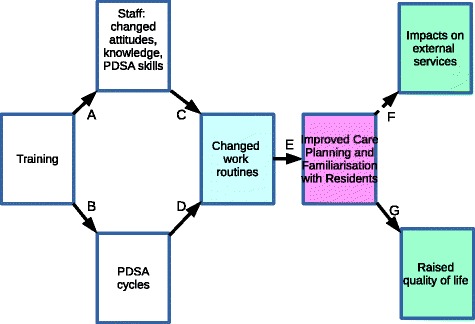
PDSA cycles appeared to be the more 'active ingredient' in this intervention. The reasons why they impacted on well-being in half of the intervention sites, and not the others, require further research. A larger, longer study would be necessary to measure definitively any impacts on unplanned hospital admissions. Our evidence suggested revising the DLC logic model to include care planning and staff familiarisation with residents' personal histories and needs as steps towards improving residents' quality of life.
在许多国家,医院服务的就诊时间、成本和负担过重问题对于医疗保健管理人员而言日益突出。医院护理需求的增加部分归因于老年人的非计划住院,其中部分原因是痴呆症患病率的上升。本文对痴呆症学习社区(DLC)的逻辑模型进行了初步评估,该社区旨在减少痴呆症患者护理院的非计划住院情况。每个DLC护理院的痴呆症倡导者对其他工作人员进行痴呆症认知和变革管理培训,目的是改变工作流程、提高生活质量并减少对外部服务的需求。
在2013 - 15年期间,采用对照混合方法进行现实评估,比较了英格兰的13个干预护理院和10个对照护理院。对假设逻辑模型中的每个环节进行测试,以确定该环节是否在DLC场所中存在,如果存在,则根据选定的生活质量指标(DCM健康/幸福感、QUALID、临终规划)来判断其效果在DLC场所中是否比在对照场所中更显著;以及对救护车出诊和住院情况的影响。
培训按计划实施,并在所有干预护理院中引发了计划 - 实施 - 研究 - 行动活动的循环。通过痴呆症护理映射测量的居民幸福感得分,在一半的干预护理院中显著提高,但在另一半护理院中则没有,实际上有些得分还显著下降。在研究期间,所研究的大多数其他护理质量指标没有显著改善。救护车出诊率或急诊住院率也没有改善。
计划 - 实施 - 研究 - 行动循环似乎是该干预措施中更“有效的要素”。它们在一半的干预场所中对幸福感产生影响而在其他场所没有产生影响的原因需要进一步研究。需要进行更大规模、更长时间的研究来明确衡量对非计划住院的任何影响。我们的证据表明,应修订DLC逻辑模型,将护理规划以及工作人员熟悉居民的个人历史和需求纳入其中,作为提高居民生活质量的步骤。