Li Jing, Huang YingYing, Deng XiaoJun, Luo ManLing, Wang XueFei, Hu HaiYan, Liu CiDi, Zhong Mei
Department of Obstetrics and Gynecology, Nanfang Hospital, Southern Medical University, Guangzhou, Guangdong, People's Republic of China.
Onco Targets Ther. 2018 Jan 18;11:427-440. doi: 10.2147/OTT.S149908. eCollection 2018.
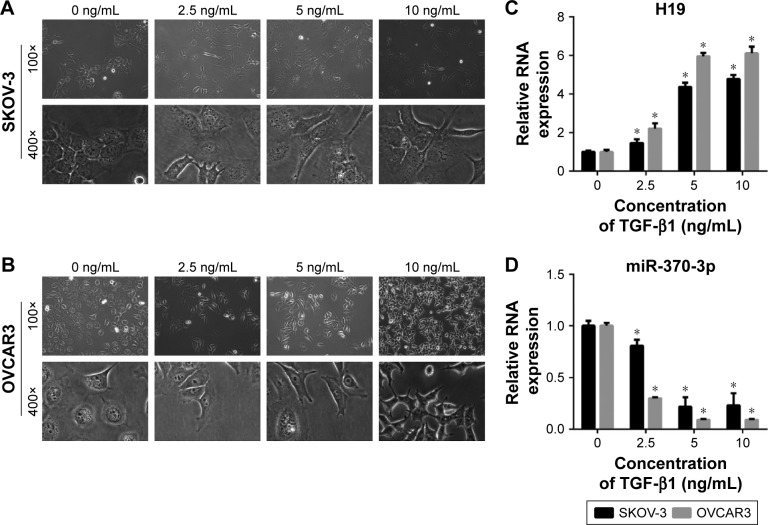
Ovarian cancer is a gynecological malignant tumor with a high mortality rate among women, owing to metastatic progression and recurrence. Acquisition of invasiveness is accompanied by the loss of epithelial features and a gain of a mesenchymal phenotype, a process known as epithelial-mesenchymal transition (EMT). Transforming growth factor-β (TGF-β) has been implicated in the regulation of EMT. In the present study, we aimed to investigate the role of long noncoding RNA H19 and microRNA-370 (miR-370-3p) in TGF-β-induced EMT. Ovarian cancer cell lines SKOV-3 and OVCAR3 were incubated with different concentrations of TGF-β, and the results showed that TGF-β treatment upregulated H19 and downregulated miR-370-3p. In addition, an H19 knockdown or miR-370-3p overexpression suppressed TGF-β-induced EMT, while H19 overexpression or a miR-370-3p knockdown promoted TGF-β-induced EMT. Mechanistically, H19 could directly bind to miR-370-3p and effectively act as its competing endogenous RNA. Furthermore, we demonstrated that this activity of H19 was involved in its promotion of TGF-β-induced EMT. Thus, our results may provide novel insights into the process of TGF-β-induced EMT.
卵巢癌是一种在女性中死亡率很高的妇科恶性肿瘤,原因在于其转移进展和复发。侵袭性的获得伴随着上皮特征的丧失和间充质表型的获得,这一过程称为上皮-间充质转化(EMT)。转化生长因子-β(TGF-β)已被证明参与EMT的调控。在本研究中,我们旨在探讨长链非编码RNA H19和微小RNA-370(miR-370-3p)在TGF-β诱导的EMT中的作用。用不同浓度的TGF-β处理卵巢癌细胞系SKOV-3和OVCAR3,结果显示TGF-β处理上调了H19并下调了miR-370-3p。此外,敲低H19或过表达miR-370-3p可抑制TGF-β诱导的EMT,而过表达H19或敲低miR-370-3p则促进TGF-β诱导的EMT。机制上,H19可直接与miR-370-3p结合,并有效地作为其竞争性内源性RNA发挥作用。此外,我们证明了H19的这种活性参与了其对TGF-β诱导的EMT的促进作用。因此,我们的结果可能为TGF-β诱导的EMT过程提供新的见解。