Raghavan Neha S, Chen Hao, Schipma Matthew, Luo Wendy, Chung Sarah, Wang Lei, Redei Eva E
The Asher Center for the Study & Treatment of Depressive Disorders, Feinberg School of Medicine, Northwestern University, Chicago, IL, United States.
Department of Psychiatry and Behavioral Sciences, Feinberg School of Medicine, Northwestern University, Chicago, IL, United States.
Front Endocrinol (Lausanne). 2018 Jan 22;8:373. doi: 10.3389/fendo.2017.00373. eCollection 2017.
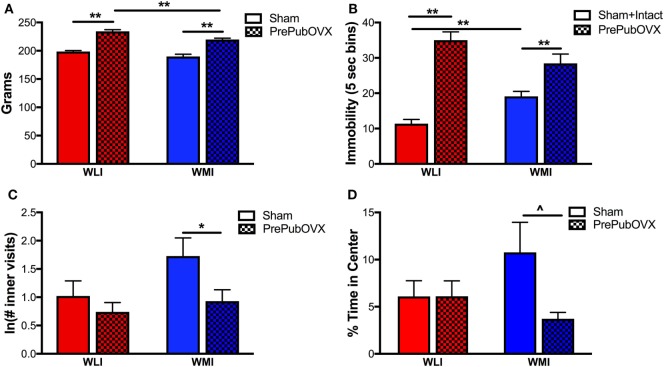
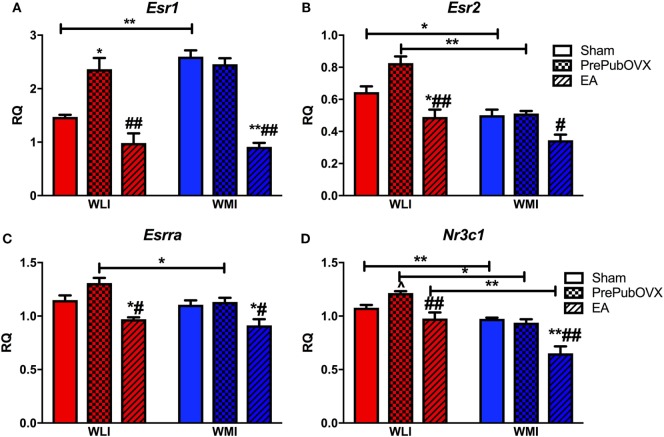
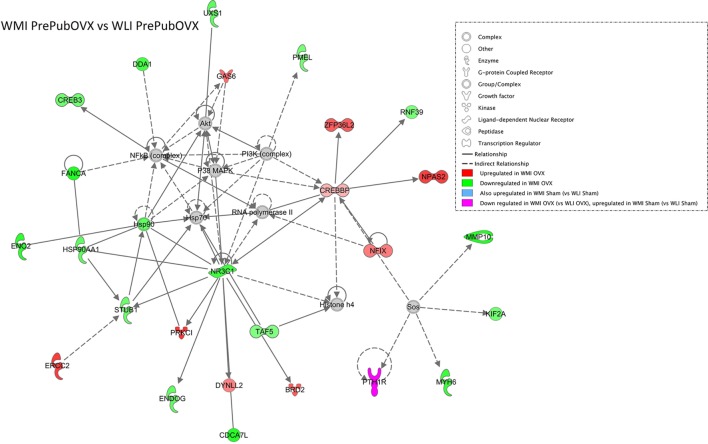
Major depressive disorder (MDD) is a debilitating illness that affects twice as many women than men postpuberty. This female bias is thought to be caused by greater heritability of MDD in women and increased vulnerability induced by female sex hormones. We tested this hypothesis by removing the ovaries from prepubertal Wistar Kyoto (WKY) more immobile (WMI) females, a genetic animal model of depression, and its genetically close control, the WKY less immobile (WLI). In adulthood, prepubertally ovariectomized (PrePubOVX) animals and their Sham-operated controls were tested for depression- and anxiety-like behaviors, using the routinely employed forced swim and open field tests, respectively, and RNA-sequencing was performed on their hippocampal RNA. Our results confirmed that the behavioral and hippocampal expression changes that occur after prepubertal ovariectomy are the consequences of an interaction between genetic predisposition to depressive behavior and ovarian hormone-regulated processes. Lack of ovarian hormones during and after puberty in the WLIs led to increased depression-like behavior. In WMIs, both depression- and anxiety-like behaviors worsened by prepubertal ovariectomy. The unbiased exploration of the hippocampal transcriptome identified sets of differentially expressed genes (DEGs) between the strains and treatment groups. The relatively small number of hippocampal DEGs resulting from the genetic differences between the strains confirmed the genetic relatedness of these strains. Nevertheless, the differences in DEGs between the strains in response to prepubertal ovariectomy identified different molecular processes, including the importance of glucocorticoid receptor-mediated mechanisms, that may be causative of the increased depression-like behavior in the presence or absence of genetic predisposition. This study contributes to the understanding of hormonal maturation-induced changes in affective behaviors and the hippocampal transcriptome as it relates to genetic predisposition to depression.
重度抑郁症(MDD)是一种使人衰弱的疾病,在青春期后女性患者的数量是男性的两倍。这种女性偏向被认为是由女性中MDD更高的遗传力以及女性性激素诱导的易感性增加所导致的。我们通过切除青春期前的Wistar Kyoto(WKY)多动较少(WMI)雌性大鼠(一种抑郁症的遗传动物模型)及其遗传关系密切的对照WKY多动较多(WLI)大鼠的卵巢来验证这一假设。成年后,分别使用常规的强迫游泳和旷场试验,对青春期前卵巢切除(PrePubOVX)的动物及其假手术对照组进行抑郁样和焦虑样行为测试,并对其海马RNA进行RNA测序。我们的结果证实,青春期前卵巢切除后出现的行为和海马表达变化是抑郁行为的遗传易感性与卵巢激素调节过程之间相互作用的结果。WLI大鼠在青春期期间及之后缺乏卵巢激素会导致抑郁样行为增加。在WMI大鼠中,青春期前卵巢切除会使抑郁样和焦虑样行为都恶化。对海马转录组的无偏倚探索确定了品系和治疗组之间的差异表达基因(DEG)集。由品系间遗传差异导致的相对较少数量的海马DEG证实了这些品系的遗传相关性。然而,品系间对青春期前卵巢切除反应的DEG差异确定了不同的分子过程,包括糖皮质激素受体介导机制的重要性,这可能是在有或没有遗传易感性的情况下抑郁样行为增加的原因。这项研究有助于理解激素成熟诱导的情感行为变化以及海马转录组与抑郁症遗传易感性的关系。