Hester Eric R, Harpenslager Sarah F, van Diggelen Josepha M H, Lamers Leon L, Jetten Mike S M, Lüke Claudia, Lücker Sebastian, Welte Cornelia U
Department of Microbiology, Radboud University, Nijmegen, The Netherlands.
Department of Aquatic Ecology and Environmental Biology, Radboud University, Nijmegen, The Netherlands.
mSystems. 2018 Jan 30;3(1). doi: 10.1128/mSystems.00214-17. eCollection 2018 Jan-Feb.
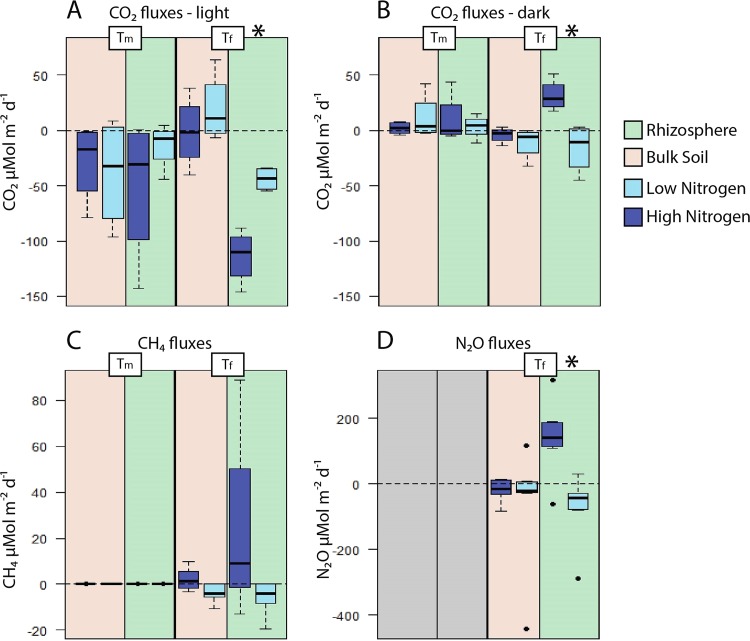
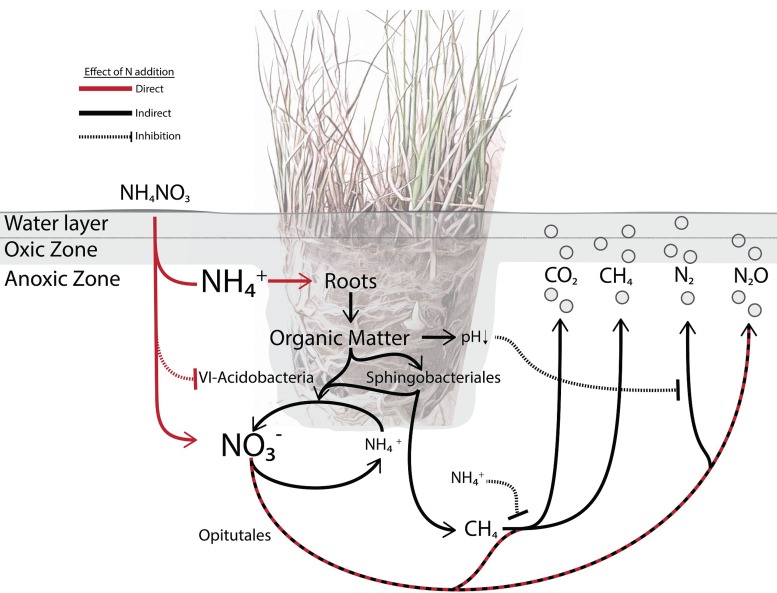
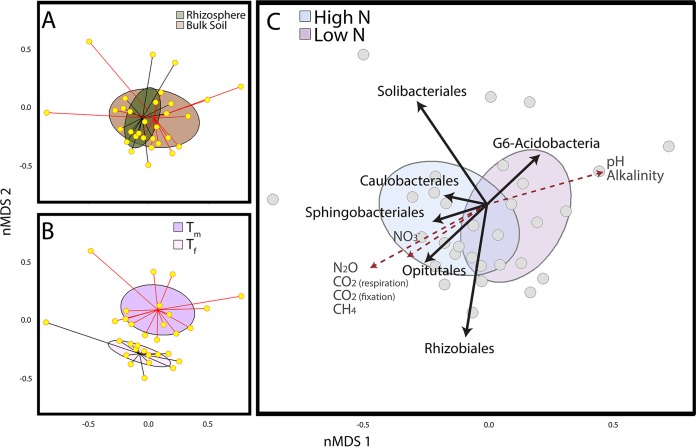
Wetland ecosystems are important reservoirs of biodiversity and significantly contribute to emissions of the greenhouse gases CO, NO, and CH. High anthropogenic nitrogen (N) inputs from agriculture and fossil fuel combustion have been recognized as a severe threat to biodiversity and ecosystem functioning, such as control of greenhouse gas emissions. Therefore, it is important to understand how increased N input into pristine wetlands affects the composition and activity of microorganisms, especially in interaction with dominant wetland plants. In a series of incubations analyzed over 90 days, we disentangled the effects of N fertilization on the microbial community in bulk soil and the rhizosphere of , a common and abundant graminoid wetland plant. We observed an increase in greenhouse gas emissions when N is increased in incubations with , changing the system from a greenhouse gas sink to a source. Using 16S rRNA gene amplicon sequencing, we determined that the bacterial orders , subgroup 6 , and significantly responded to high N availability. Based on metagenomic data, we hypothesize that these groups are contributing to the increased greenhouse gas emissions. These results indicated that increased N input leads to shifts in microbial activity within the rhizosphere, altering N cycling dynamics. Our study provides a framework for connecting environmental conditions of wetland bulk and rhizosphere soil to the structure and metabolic output of microbial communities. Microorganisms living within the rhizospheres of wetland plants significantly contribute to greenhouse gas emissions. Understanding how microbes produce these gases under conditions that have been imposed by human activities (i.e., nitrogen pollution) is important to the development of future management strategies. Our results illustrate that within the rhizosphere of the wetland plant , physiological differences associated with nitrogen availability can influence microbial activity linked to greenhouse gas production. By pairing taxonomic information and environmental conditions like nitrogen availability with functional outputs of a system such as greenhouse gas fluxes, we present a framework to link certain taxa to both nitrogen load and greenhouse gas production. We view this type of combined information as essential in moving forward in our understanding of complex systems such as rhizosphere microbial communities.
湿地生态系统是生物多样性的重要储存库,对温室气体一氧化碳、一氧化氮和甲烷的排放有显著贡献。农业和化石燃料燃烧带来的大量人为氮输入已被视为对生物多样性和生态系统功能的严重威胁,比如对温室气体排放的控制。因此,了解原始湿地中增加的氮输入如何影响微生物的组成和活性,尤其是与优势湿地植物相互作用时的情况,非常重要。在一系列为期90多天的培养实验中,我们剖析了氮肥对一种常见且数量众多的禾本科湿地植物根际和土体土壤中微生物群落的影响。我们观察到,在与该植物共同培养时增加氮含量会导致温室气体排放增加,使系统从温室气体汇转变为源。通过16S rRNA基因扩增子测序,我们确定细菌目、第6亚组和对高氮有效性有显著响应。基于宏基因组数据,我们推测这些菌群导致了温室气体排放增加。这些结果表明,增加氮输入会导致根际微生物活性发生变化,改变氮循环动态。我们的研究提供了一个框架,用于将湿地土体和根际土壤的环境条件与微生物群落的结构和代谢输出联系起来。生活在湿地植物根际的微生物对温室气体排放有显著贡献。了解微生物在人类活动(即氮污染)造成的条件下如何产生这些气体,对未来管理策略的制定很重要。我们的结果表明,在湿地植物的根际内,与氮有效性相关的生理差异会影响与温室气体产生相关的微生物活性。通过将分类信息和诸如氮有效性等环境条件与温室气体通量等系统功能输出相结合,我们提出了一个框架,将某些分类群与氮负荷和温室气体产生联系起来。我们认为这种综合信息对于推进我们对根际微生物群落等复杂系统的理解至关重要。