Nakano Yasuhiro, Nakao Sachie, Sumiyoshi Hideaki, Mikami Kenichiro, Tanno Yuri, Sueoka Minako, Kasahara Daigo, Kimura Hiroshi, Moro Tadashi, Kamiya Akihide, Hozumi Katsuto, Inagaki Yutaka
Center for Matrix Biology and Medicine Graduate School of Medicine, Tokai University Isehara Japan.
Department of Regenerative Medicine, Tokai University School of Medicine Isehara Japan.
Hepatol Commun. 2017 Mar 27;1(3):215-229. doi: 10.1002/hep4.1026. eCollection 2017 May.
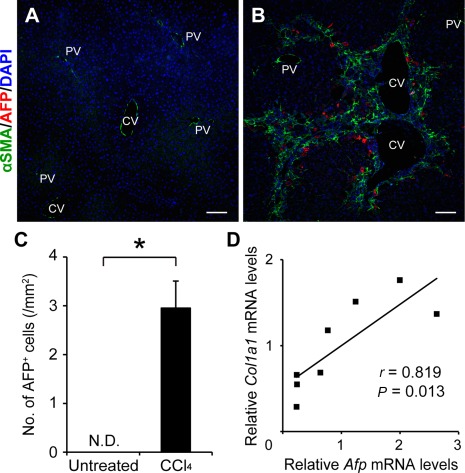
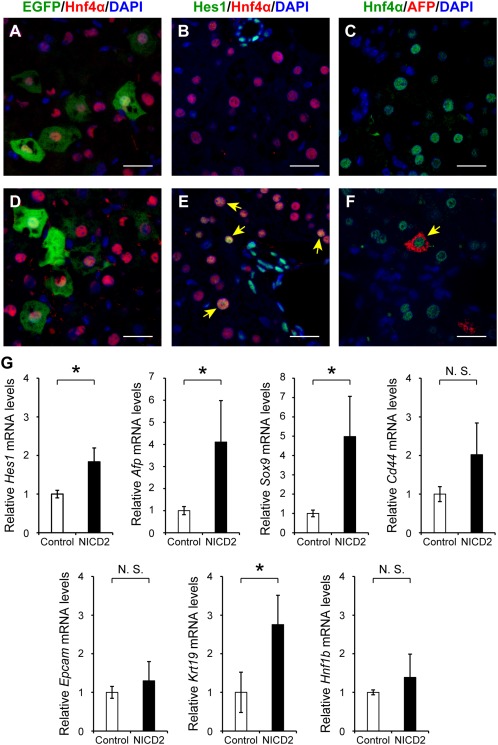
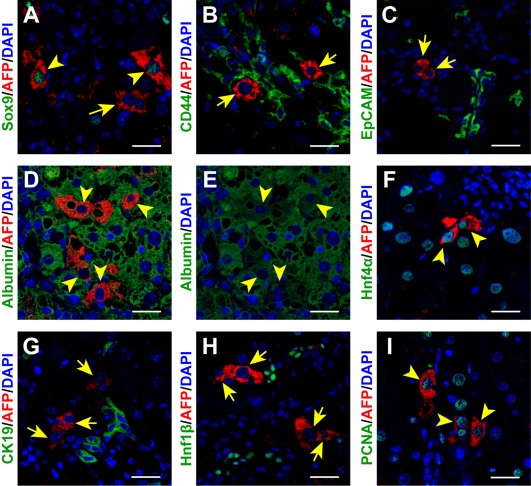
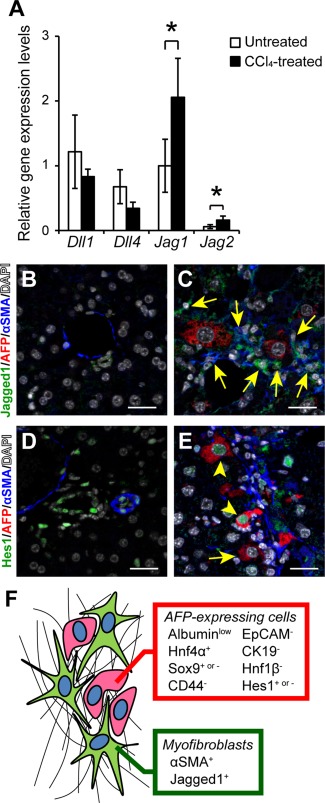
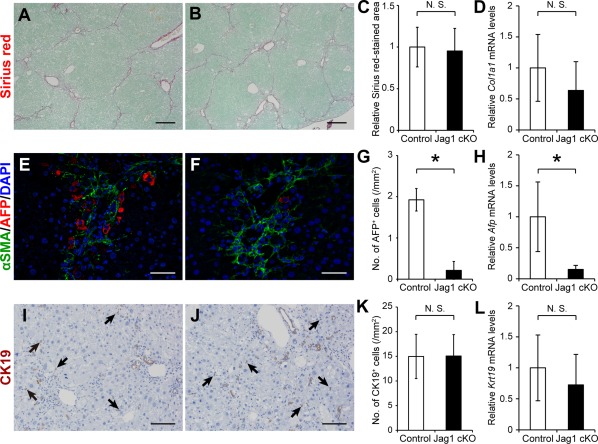
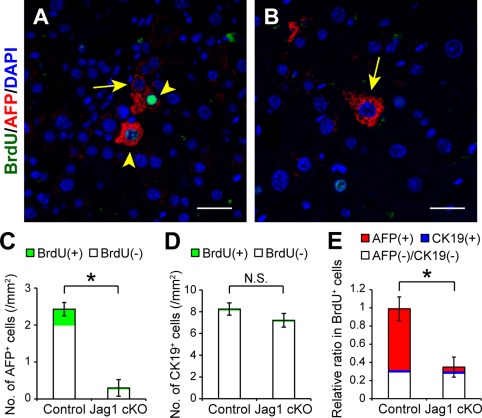
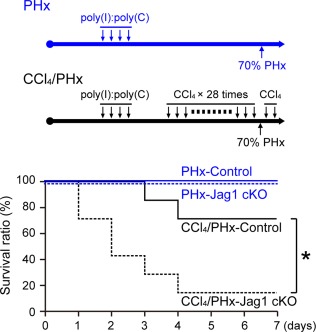
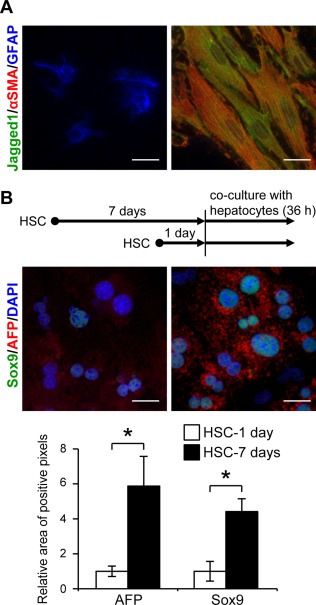
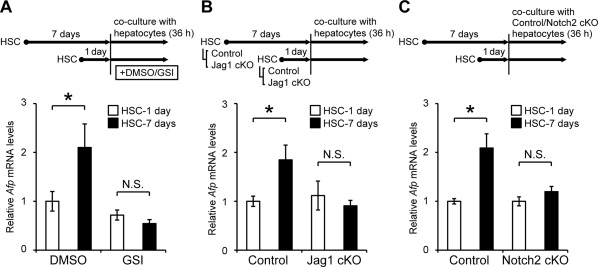
The liver is well known to possess high regenerative capacity in response to partial resection or tissue injury. However, liver regeneration is often impaired in the case of advanced liver fibrosis/cirrhosis when mature hepatocytes can hardly self-proliferate. Hepatic progenitor cells have been implicated as a source of hepatocytes in regeneration of the fibrotic liver. Although alpha-fetoprotein (AFP) is known as a clinical marker of progenitor cell induction in injured/fibrotic adult liver, the origin and features of such AFP-producing cells are not fully understood. Here, we demonstrate a unique and distinct AFP-expressing cell population that is induced by the Jagged1/Notch2 signal in murine fibrotic liver. Following repeated carbon tetrachloride injections, a significant number of AFP-positive cells with high proliferative ability were observed along the fibrous septa depending on the extent of liver fibrosis. These AFP-positive cells exhibited features of immature hepatocytes that were stained positively for hepatocyte-lineage markers, such as albumin and hepatocyte nuclear factor 4 alpha, and a stem/progenitor cell marker Sox9. A combination of immunohistological examination of fibrotic liver tissues and coculture experiments with primary hepatocytes and hepatic stellate cells indicated that increased Jagged1 expression in activated hepatic stellate cells stimulated Notch2 signaling and up-regulated AFP expression in adjacent hepatocytes. The mobilization and proliferation of AFP-positive cells in fibrotic liver were further enhanced after partial hepatectomy, which was significantly suppressed in Jagged1-conditional knockout mice. Finally, forced expression of the intracellular domain of Notch2 in normal liver induced a small number of AFP-expressing hepatocytes : Insight is provided into a novel pathophysiological role of Jagged1/Notch2 signaling in the induction of AFP-positive cells in fibrotic liver through the interaction between hepatocytes and activated hepatic stellate cells. ( 2017;1:215-229).
众所周知,肝脏在部分切除或组织损伤后具有很高的再生能力。然而,在晚期肝纤维化/肝硬化的情况下,当成熟肝细胞几乎无法自我增殖时,肝脏再生通常会受到损害。肝祖细胞被认为是纤维化肝脏再生中肝细胞的来源。尽管甲胎蛋白(AFP)是受损/纤维化成人肝脏中祖细胞诱导的临床标志物,但此类产生AFP的细胞的起源和特征尚未完全了解。在此,我们展示了在小鼠纤维化肝脏中由Jagged1/Notch2信号诱导产生的独特且不同的AFP表达细胞群。在反复注射四氯化碳后,根据肝纤维化程度,在纤维间隔中观察到大量具有高增殖能力的AFP阳性细胞。这些AFP阳性细胞表现出未成熟肝细胞的特征,对肝细胞谱系标志物如白蛋白和肝细胞核因子4α以及干细胞/祖细胞标志物Sox9呈阳性染色。纤维化肝组织的免疫组织学检查以及与原代肝细胞和肝星状细胞的共培养实验表明,活化肝星状细胞中Jagged1表达的增加刺激了Notch2信号传导,并上调了相邻肝细胞中AFP的表达。部分肝切除术后,纤维化肝脏中AFP阳性细胞的动员和增殖进一步增强,这在Jagged1条件性敲除小鼠中受到显著抑制。最后,在正常肝脏中强制表达Notch2的细胞内结构域诱导了少量表达AFP的肝细胞:通过肝细胞与活化肝星状细胞之间的相互作用,深入了解了Jagged1/Notch2信号传导在纤维化肝脏中诱导AFP阳性细胞的新病理生理作用。(2017;1:215 - 229)