Institute of Artificial Intelligence and Robotics, Xi'an Jiaotong Univeristy, 28 Xianning West Road Xi'an, 710049, P. R. China.
Center for the Study of Emotion and Attention, University of Florida, P.O. Box 112766, Gainesville, FL, USA.
J Neurosci Res. 2018 Jul;96(7):1159-1175. doi: 10.1002/jnr.24217. Epub 2018 Feb 6.
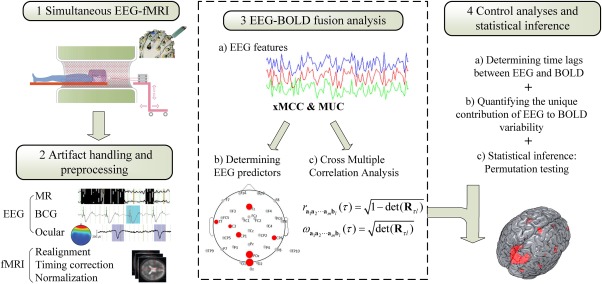
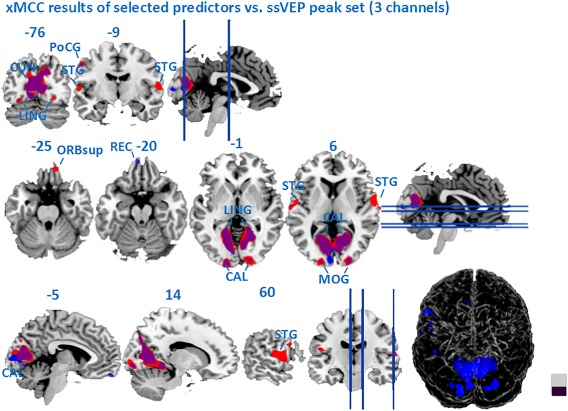
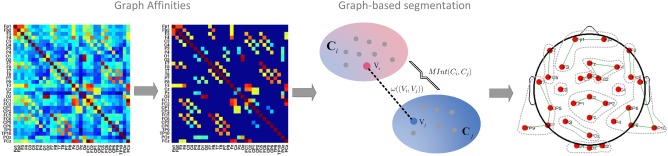
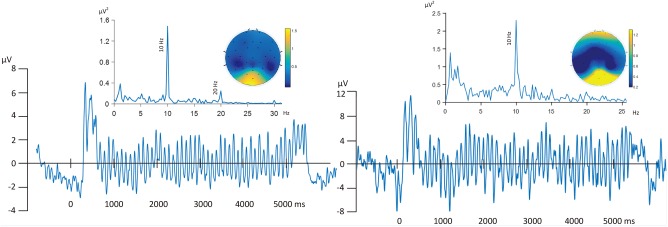
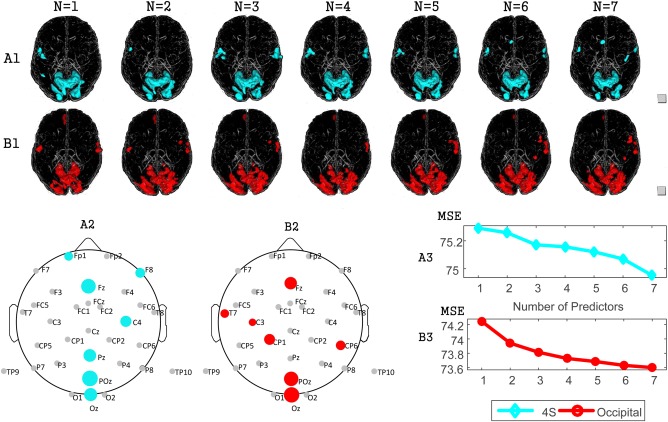
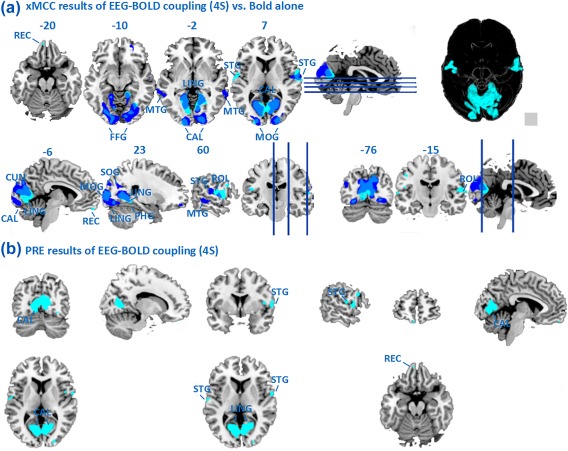
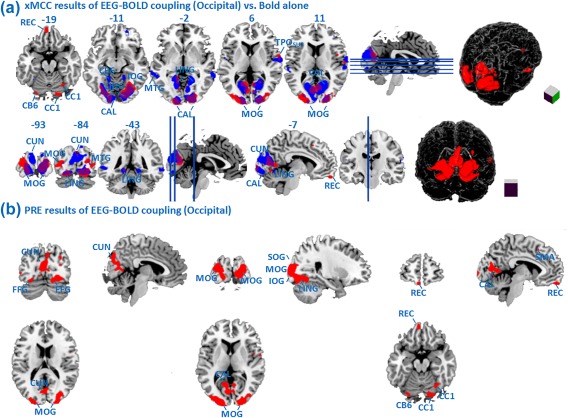
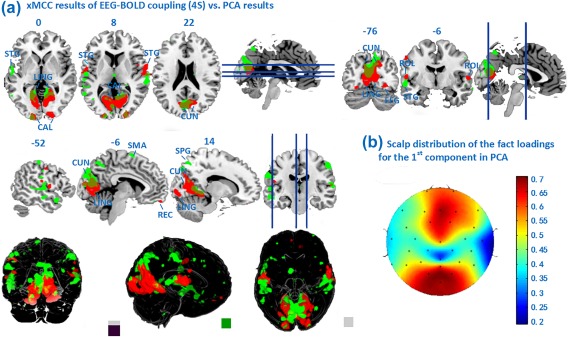
Over the past decade, the simultaneous recording of electroencephalogram (EEG) and functional magnetic resonance imaging (fMRI) data has garnered growing interest because it may provide an avenue towards combining the strengths of both imaging modalities. Given their pronounced differences in temporal and spatial statistics, the combination of EEG and fMRI data is however methodologically challenging. Here, we propose a novel screening approach that relies on a Cross Multivariate Correlation Coefficient (xMCC) framework. This approach accomplishes three tasks: (1) It provides a measure for testing multivariate correlation and multivariate uncorrelation of the two modalities; (2) it provides criterion for the selection of EEG features; (3) it performs a screening of relevant EEG information by grouping the EEG channels into clusters to improve efficiency and to reduce computational load when searching for the best predictors of the BOLD signal. The present report applies this approach to a data set with concurrent recordings of steady-state-visual evoked potentials (ssVEPs) and fMRI, recorded while observers viewed phase-reversing Gabor patches. We test the hypothesis that fluctuations in visuo-cortical mass potentials systematically covary with BOLD fluctuations not only in visual cortical, but also in anterior temporal and prefrontal areas. Results supported the hypothesis and showed that the xMCC-based analysis provides straightforward identification of neurophysiological plausible brain regions with EEG-fMRI covariance. Furthermore xMCC converged with other extant methods for EEG-fMRI analysis.
在过去的十年中,同时记录脑电图(EEG)和功能磁共振成像(fMRI)数据的方法越来越受到关注,因为它可能为结合两种成像模式的优势提供途径。然而,鉴于它们在时间和空间统计上的明显差异,EEG 和 fMRI 数据的组合在方法上具有挑战性。在这里,我们提出了一种新的筛选方法,该方法依赖于交叉多变量相关系数(xMCC)框架。该方法完成了三个任务:(1)它提供了一种用于测试两种模式的多变量相关性和多变量不相关性的度量;(2)它为 EEG 特征的选择提供了标准;(3)通过将 EEG 通道分组到集群中,对相关 EEG 信息进行筛选,以提高效率并减少搜索大脑中与血氧水平依赖信号相关的最佳预测器时的计算负荷。本报告将该方法应用于同时记录稳态视觉诱发电位(ssVEP)和 fMRI 的数据集,记录时观察者观察相位反转的 Gabor 补丁。我们测试了这样一个假设,即视皮质质量波动不仅与视觉皮质,而且与前颞叶和前额叶区域的 BOLD 波动系统相关。结果支持了这一假设,并表明基于 xMCC 的分析提供了一种简单的方法,可以确定与 EEG-fMRI 协方差相关的神经生理学上合理的大脑区域。此外,xMCC 与其他现有的 EEG-fMRI 分析方法一致。