Division of Community Health and Humanities, Faculty of Medicine, Memorial University of Newfoundland, St. John's, NL, Canada.
School of Public Health, Tianjin Medical University, Tianjin, China.
BMC Cancer. 2018 Feb 6;18(1):155. doi: 10.1186/s12885-018-4026-1.
The rs2282679 A>C polymorphism in the vitamin D binding protein gene is associated with lower circulating levels of vitamin D. We investigated associations of this SNP with colorectal cancer (CRC) risk and survival and whether the associations vary by dietary vitamin D intake and tumor molecular phenotype.
A population-based case-control study identified 637 incident CRC cases (including 489 participants with follow-up data on mortality end-points) and 489 matched controls. Germline DNA samples were genotyped with the Illumina Omni-Quad 1 Million chip in cases and the Affymetrix Axiom® myDesign™ Array in controls. Logistic regression examined the association between the rs2282679 polymorphism and CRC risk with inclusion of potential confounders. Kaplan-Meier curves and multivariable Cox models assessed the polymorphism relative to overall survival (OS) and disease-free survival (DFS).
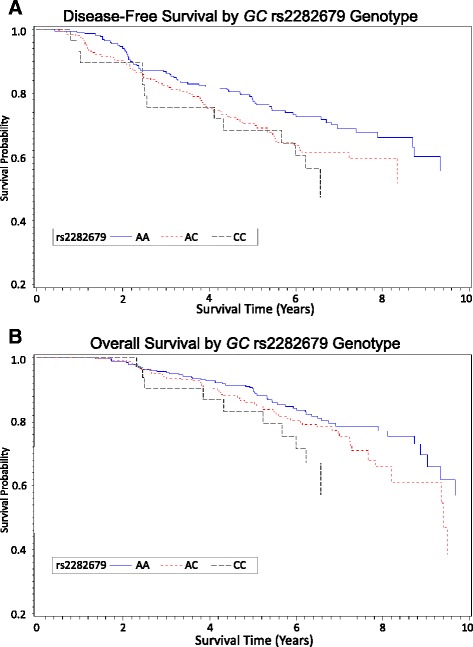
The rs2282679 polymorphism was not associated with overall CRC risk; there was evidence, however, of effect modification by total vitamin D intake (P = 0.019). Survival analyses showed that the C allele was correlated with poor DFS (per-allele HR, 1.36; 95%CI, 1.05-1.77). The association of rs2282679 on DFS was limited to BRAF wild-type tumors (HR, 1.58; 95%CI, 1.12-2.23). For OS, the C allele was associated with higher all-cause mortality among patients with higher levels of dietary vitamin D (HR, 2.11; 95%CI, 1.29-3.74), calcium (HR, 1.93; 95%CI, 1.08-3.46), milk (HR, 2.36; 95%CI, 1.26-4.44), and total dairy product intakes (HR, 2.03; 95%CI, 1.11-3.72).
The rs2282679 SNP was not associated with overall CRC risk, but may be associated with survival after cancer diagnosis. The association of this SNP on survival among CRC patients may differ according to dietary vitamin D and calcium intakes and according to tumor BRAF mutation status.
维生素 D 结合蛋白基因中的 rs2282679A>C 多态性与循环维生素 D 水平降低有关。我们研究了这种 SNP 与结直肠癌 (CRC) 风险和生存的关联,以及这些关联是否因饮食维生素 D 摄入和肿瘤分子表型而异。
一项基于人群的病例对照研究确定了 637 例新发 CRC 病例(包括 489 例有死亡终点随访数据的参与者)和 489 例匹配对照。在病例中使用 Illumina Omni-Quad 1 百万芯片进行种系 DNA 样本的基因分型,在对照中使用 Affymetrix Axiom® myDesign™ 阵列进行基因分型。逻辑回归检查了 rs2282679 多态性与 CRC 风险的关联,并纳入了潜在的混杂因素。Kaplan-Meier 曲线和多变量 Cox 模型评估了与总体生存 (OS) 和无病生存 (DFS) 相关的多态性。
rs2282679 多态性与总体 CRC 风险无关;然而,总维生素 D 摄入存在效应修饰的证据 (P=0.019)。生存分析显示,C 等位基因与较差的 DFS 相关(每个等位基因的 HR,1.36;95%CI,1.05-1.77)。rs2282679 对 DFS 的影响仅限于 BRAF 野生型肿瘤(HR,1.58;95%CI,1.12-2.23)。对于 OS,C 等位基因与较高水平饮食维生素 D(HR,2.11;95%CI,1.29-3.74)、钙(HR,1.93;95%CI,1.08-3.46)、牛奶(HR,2.36;95%CI,1.26-4.44)和总乳制品摄入量(HR,2.03;95%CI,1.11-3.72)的患者全因死亡率较高相关。
rs2282679 SNP 与总体 CRC 风险无关,但可能与癌症诊断后的生存有关。这种 SNP 对 CRC 患者生存的影响可能因饮食维生素 D 和钙摄入以及肿瘤 BRAF 突变状态而异。