Department of Biomedical Engineering, Vanderbilt University, Nashville, TN; Biophotonics Center, Vanderbilt University, Nashville, TN.
Department of Biomedical Engineering, Vanderbilt University, Nashville, TN; Department of Biological Engineering, Utah State University, Logan, UT.
Am J Obstet Gynecol. 2018 May;218(5):528.e1-528.e18. doi: 10.1016/j.ajog.2018.01.030. Epub 2018 Feb 2.
The cervix must undergo significant biochemical remodeling to allow for successful parturition. This process is not fully understood, especially in instances of spontaneous preterm birth. In vivo Raman spectroscopy is an optical technique that can be used to investigate the biochemical composition of tissue longitudinally and noninvasively in human beings, and has been utilized to measure physiology and disease states in a variety of medical applications.
The purpose of this study is to measure in vivo Raman spectra of the cervix throughout pregnancy in women, and to identify biochemical markers that change with the preparation for delivery and postpartum repair.
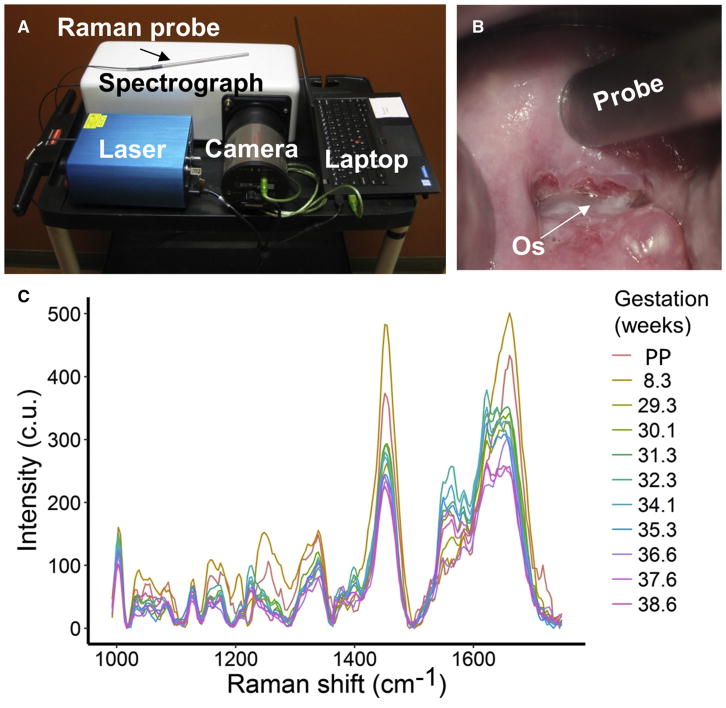
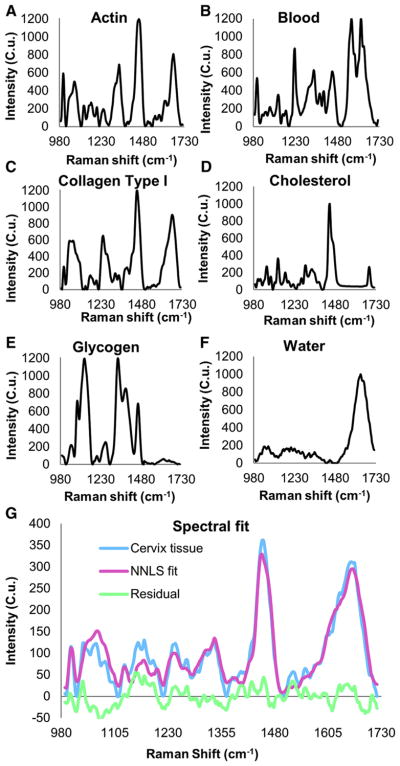
In all, 68 healthy pregnant women were recruited. Raman spectra were measured from the cervix of each patient monthly in the first and second trimesters, weekly in the third trimester, and at the 6-week postpartum visit. Raman spectra were measured using an in vivo Raman system with an optical fiber probe to excite the tissue with 785 nm light. A spectral model was developed to highlight spectral regions that undergo the most changes throughout pregnancy, which were subsequently used for identifying Raman peaks for further analysis. These peaks were analyzed longitudinally to determine if they underwent significant changes over the course of pregnancy (P < .05). Finally, 6 individual components that comprise key biochemical constituents of the human cervix were measured to extract their contributions in spectral changes throughout pregnancy using a linear combination method. Patient factors including body mass index and parity were included as variables in these analyses.
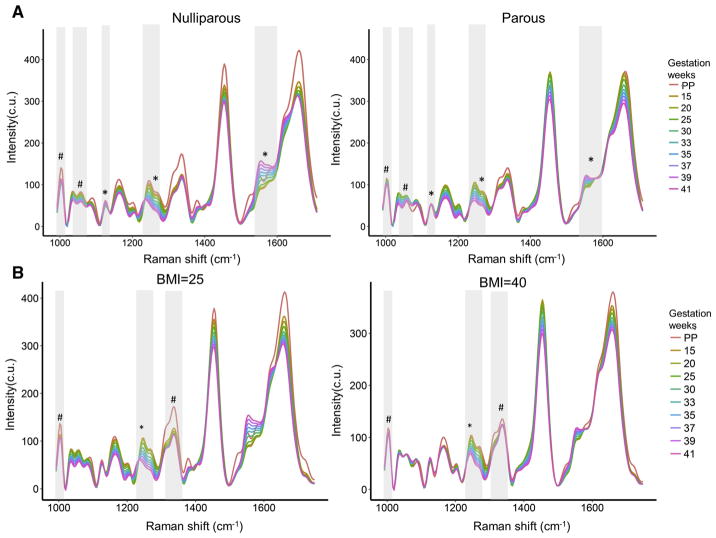
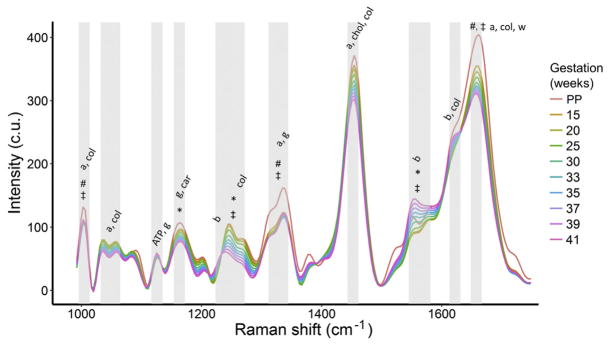
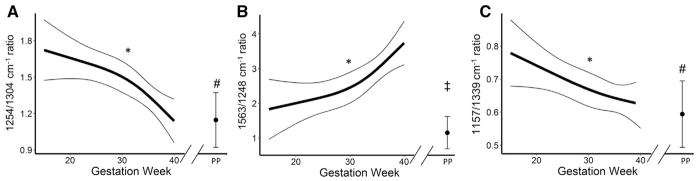
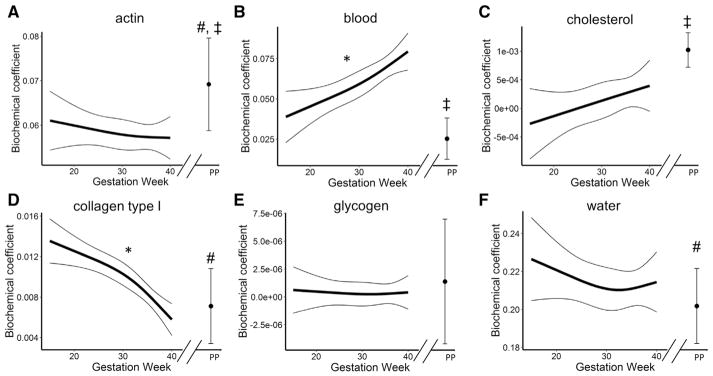
Raman peaks indicative of extracellular matrix proteins (1248 and 1254 cm) significantly decreased (P < .05), while peaks corresponding to blood (1233 and 1563 cm) significantly increased (P < .0005) in a linear manner throughout pregnancy. In the postpartum cervix, significant increases in peaks corresponding to actin (1003, 1339, and 1657 cm) and cholesterol (1447 cm) were observed when compared to late gestation, while signatures from blood significantly decreased. Postpartum actin signals were significantly higher than early pregnancy, whereas extracellular matrix proteins and water signals were significantly lower than early weeks of gestation. Parity had a significant effect on blood and extracellular matrix protein signals, with nulliparous patients having significant increases in blood signals throughout pregnancy, and higher extracellular matrix protein signals in early pregnancy compared to patients with prior pregnancies. Body mass index significantly affected actin signal contribution, with low body mass index patients showing decreasing actin contribution throughout pregnancy and high body mass index patients demonstrating increasing actin signals.
Raman spectroscopy was successfully used to biochemically monitor cervical remodeling in pregnant women during prenatal visits. This foundational study has demonstrated sensitivity to known biochemical dynamics that occur during cervical remodeling, and identified patient variables that have significant effects on Raman spectra throughout pregnancy. Raman spectroscopy has the potential to improve our understanding of cervical maturation, and be used as a noninvasive preterm birth risk assessment tool to reduce the incidence, morbidity, and mortality caused by preterm birth.
子宫颈必须经历显著的生化重塑,以确保成功分娩。这个过程还不完全清楚,尤其是在自发性早产的情况下。体内拉曼光谱是一种光学技术,可以用于在人体内对组织的生化成分进行纵向和非侵入性的研究,并且已经被用于测量各种医学应用中的生理和疾病状态。
本研究的目的是测量孕妇子宫颈的体内拉曼光谱,以确定与分娩准备和产后修复相关的生化标志物。
共招募了 68 名健康孕妇。在第一和第二孕期,每月对每位患者的子宫颈进行一次拉曼光谱测量,在第三孕期每周测量一次,在产后 6 周进行一次测量。使用体内拉曼系统和光纤探头测量拉曼光谱,用 785nm 光激发组织。开发了一种光谱模型来突出整个孕期变化最大的光谱区域,随后用于识别拉曼峰进行进一步分析。这些峰被纵向分析,以确定它们在整个孕期是否发生了显著变化(P<.05)。最后,测量了构成人宫颈关键生化成分的 6 个单个成分,以使用线性组合方法提取它们在整个孕期光谱变化中的贡献。在这些分析中,将患者的体重指数和产次等因素作为变量。
体外基质蛋白的拉曼峰(1248 和 1254cm)显著降低(P<.05),而与血液相对应的峰(1233 和 1563cm)则呈线性增加(P<.0005)。在产后子宫颈中,与晚期妊娠相比,与肌动蛋白(1003、1339 和 1657cm)和胆固醇(1447cm)相对应的峰显著增加,而与血液相对应的峰显著减少。产后肌动蛋白信号明显高于早期妊娠,而细胞外基质蛋白和水信号明显低于妊娠早期。产次对血液和细胞外基质蛋白信号有显著影响,初产妇在整个孕期血液信号显著增加,与既往妊娠相比,妊娠早期细胞外基质蛋白信号更高。体重指数显著影响肌动蛋白信号的贡献,低体重指数患者在整个孕期肌动蛋白的贡献逐渐减少,而高体重指数患者肌动蛋白信号逐渐增加。
拉曼光谱成功地用于监测孕妇产前就诊期间的子宫颈重塑。这项基础研究表明,该方法对宫颈重塑过程中发生的已知生化动态具有敏感性,并确定了对整个孕期拉曼光谱有显著影响的患者变量。拉曼光谱有可能提高我们对宫颈成熟的认识,并作为一种非侵入性的早产风险评估工具,以降低早产引起的发病率、发病率和死亡率。