Dunn Gillian
1City University of New York (CUNY) School of Public Health, 55 West 125th Street, New York, NY 10027 USA.
2Present Address: Hawaii Pacific University, 45-045 Kamehameha Hwy, Kaneohe, HI 96744 USA.
Confl Health. 2018 Jan 24;12:6. doi: 10.1186/s13031-018-0136-2. eCollection 2018.
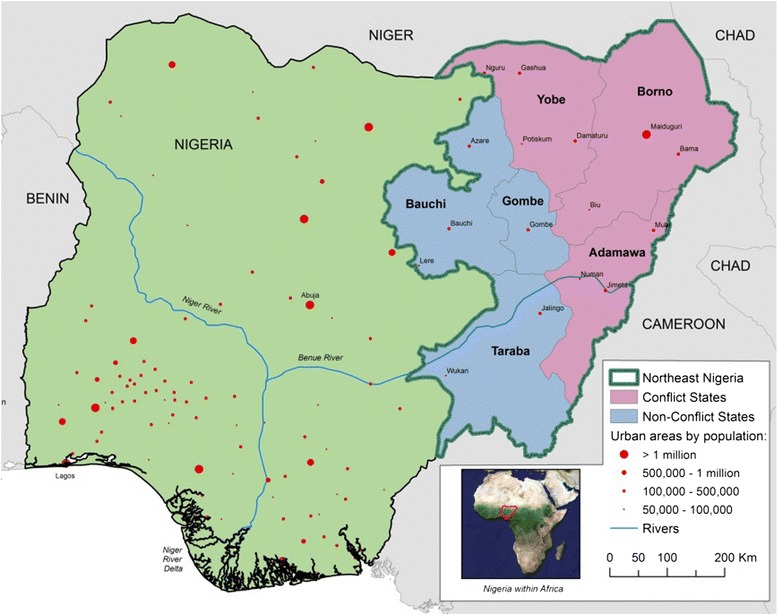
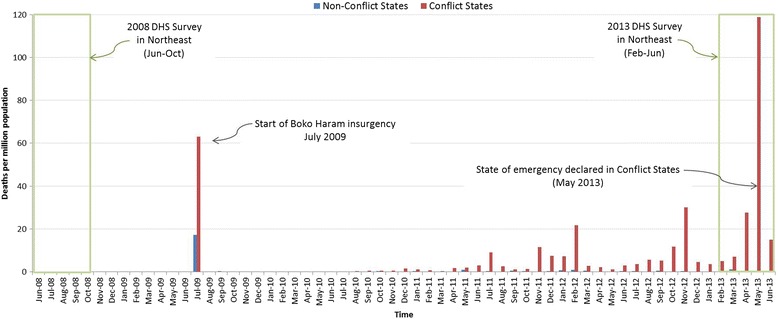
This research examines the relationship between violent conflict and childhood wasting in Northeast Nigeria, where residents have been subjected to fighting between the Nigerian government and Boko Haram - an extremist Islamist movement - since 2009.
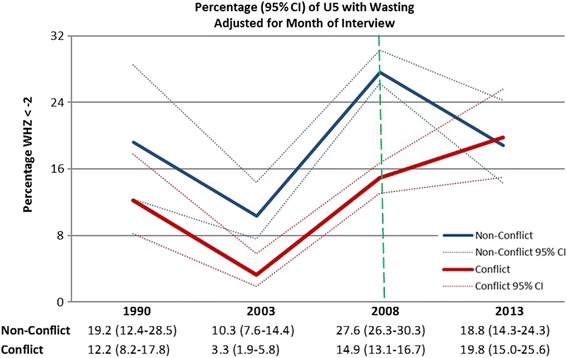
Using two Demographic and Health Surveys from before and after the Boko Haram insurgency started, a double-difference (difference-in-difference) approach is used to assess the impact of the conflict on mean weight-for-height z-scores and the likelihood of wasting.
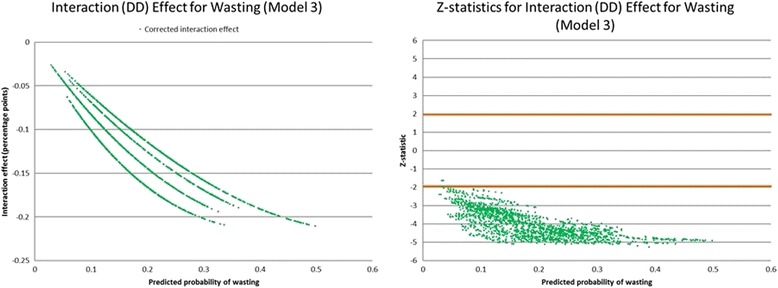
Results suggest that if children exposed to the conflict had not been exposed, their mean weight-for-height z-score would be 0.49 standard deviations higher ( < 0.001) than it is, increasing from - 0.74 to - 0.25. Additionally, the likelihood of wasting would be 13 percentage points lower (mean z-statistic - 4.2), bringing the proportion down from 23% to 10%.
Descriptive evidence suggests that poor child health outcomes in the conflict areas of Northeast Nigeria may be due to disruptions to social services and increased food insecurity in an already resource poor area. Although other unidentified factors may contribute to both conflict and wasting, the findings underscore the importance of appropriate programs and policies to support children in conflict zones.
本研究调查了尼日利亚东北部暴力冲突与儿童消瘦之间的关系,自2009年以来,该地区居民一直遭受尼日利亚政府与极端伊斯兰运动组织博科圣地之间的战斗。
利用博科圣地叛乱开始前后的两次人口与健康调查,采用双重差分法评估冲突对身高别体重Z评分均值以及消瘦可能性的影响。
结果表明,如果暴露于冲突中的儿童未经历冲突,其身高别体重Z评分均值将比实际高出0.49个标准差(<0.001),从-0.74升至-0.25。此外,消瘦的可能性将降低13个百分点(平均Z统计量为-4.2),使比例从23%降至10%。
描述性证据表明,尼日利亚东北部冲突地区儿童健康状况不佳可能是由于社会服务中断以及本就资源匮乏地区的粮食不安全状况加剧。尽管其他未明确的因素可能导致冲突和消瘦,但研究结果强调了制定适当方案和政策以支持冲突地区儿童的重要性。