1Center for Gene Diagnosis, Zhongnan Hospital of Wuhan University, Donghu Road 169, Wuhan, 430071 China.
2Department of Chemistry, Key Laboratory of Analytical Chemistry for Biology and Medicine (Ministry of Education), Wuhan University, Wuhan, 430071 China.
Clin Epigenetics. 2018 Jan 23;10:9. doi: 10.1186/s13148-018-0443-x. eCollection 2018.
Alterations in DNA methylation are demonstrated in atherosclerosis pathogenesis. However, changing rules of global DNA methylation and hydroxymethylation in peripheral blood leukocytes (PBLs) and different blood cell subtypes of coronary artery disease (CAD) patients are still inconclusive, and much less is known about mechanisms underlying.
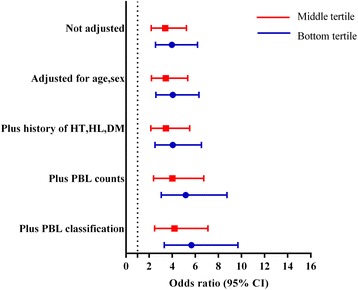
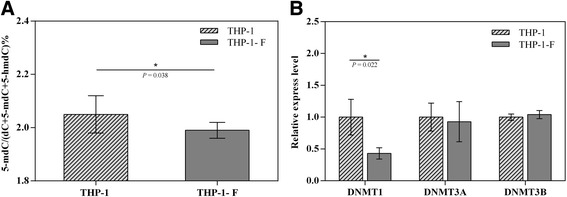
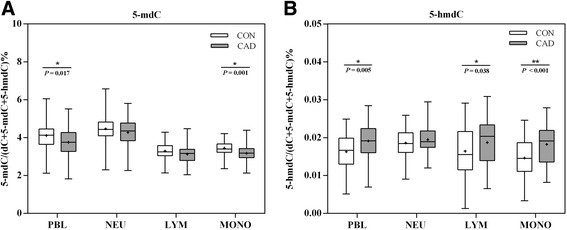
We recruited 265 CAD patients and 270 healthy controls with genomic DNA from PBLs, of which 50 patients and 50 controls were randomly chosen with DNA from isolated neutrophils, lymphocytes and monocytes, and RNA from PBLs. Genomic 5-methylcytosine (5-mC) and 5-hydroxymethylcytosine (5-hmC) contents were quantified by liquid chromatography-electrospray ionization-tandem mass spectrometry (LC-ESI-MS/MS) assay. Genomic 5-mC contents were negatively associated with the serum total cholesterol (TC) level ( = 0.010), age ( = 0.016), and PBL classifications ( = 0.023), explaining 6.8% individual variation in controls. Furthermore, genomic 5-mC contents were inversely associated with an increased risk of CAD (odds ratio (OR) = 0.325, 95% confidence interval (CI) = 0.237~0.445, = 2.62 × 10), independent of PBL counts and classifications, age, sex, histories of hyperlipidemia, hypertension, and diabetes. Within-individual analysis showed a general 5-mC decrease in PBL subtypes, but significant difference was found in monocytes only ( = 0.001), accompanied by increased 5-hmC ( = 3.212 × 10). In addition, coincident to the reduced expression in patients' PBLs, the expression level of DNMT1 was significantly lower ( = 0.022) in oxidized low-density lipoprotein (ox-LDL) stimulated THP-1-derived foam cells compared to THP-1 monocytes, with decreased genomic 5-mdC content ( = 0.038).
Global hypomethylation of blood cells defined dominantly by the monocyte DNA hypomethylation is independently associated with the risk of CAD in Chinese Han population. The importance of monocytes in atherosclerosis pathophysiology may demonstrate via an epigenetic pathway, but prospective studies are still needed to test the causality.
DNA 甲基化的改变在动脉粥样硬化发病机制中得到证实。然而,外周血白细胞(PBL)中整体 DNA 甲基化和羟甲基化的变化规律以及冠心病(CAD)患者不同的血细胞类型仍不确定,其潜在机制知之甚少。
我们招募了 265 名 CAD 患者和 270 名健康对照者,从 PBL 中提取基因组 DNA,其中 50 名患者和 50 名对照者随机选择从分离的中性粒细胞、淋巴细胞和单核细胞中提取 DNA,并从 PBL 中提取 RNA。采用液相色谱-电喷雾电离串联质谱(LC-ESI-MS/MS)测定基因组 5-甲基胞嘧啶(5-mC)和 5-羟甲基胞嘧啶(5-hmC)含量。基因组 5-mC 含量与血清总胆固醇(TC)水平呈负相关(=0.010)、年龄(=0.016)和 PBL 分类(=0.023),可解释对照组个体变异的 6.8%。此外,基因组 5-mC 含量与 CAD 风险增加呈负相关(比值比(OR)=0.325,95%置信区间(CI)=0.237~0.445,=2.62×10),与 PBL 计数和分类、年龄、性别、高脂血症、高血压和糖尿病史无关。个体内分析显示 PBL 亚型的 5-mC 普遍减少,但仅在单核细胞中存在显著差异(=0.001),同时伴有 5-hmC 增加(=3.212×10)。此外,与 PBL 中表达降低一致,氧化低密度脂蛋白(ox-LDL)刺激 THP-1 衍生泡沫细胞中 DNMT1 的表达水平明显低于 THP-1 单核细胞,基因组 5-mdC 含量降低(=0.038)。
中国汉族人群血细胞的整体低甲基化主要由单核细胞 DNA 低甲基化定义,与 CAD 风险独立相关。单核细胞在动脉粥样硬化病理生理学中的重要性可能通过表观遗传途径显示,但仍需要前瞻性研究来检验因果关系。