Krahenbühl Tathyane, Guimarães Roseane de Fátima, Barros Filho Antonio de Azevedo, Gonçalves Ezequiel Moreira
Universidade Federal de Goiás, Goiânia, GO, Brasil.
Universidade Estadual de Campinas, Campinas, SP, Brasil.
Rev Paul Pediatr. 2018 Apr-Jun;36(2):230-237. doi: 10.1590/1984-0462/;2018;36;2;00005. Epub 2018 Jan 15.
To perform a systematic review on the practice of physical activity and/or sports in health and its influence on bone geometry of healthy children and adolescents.
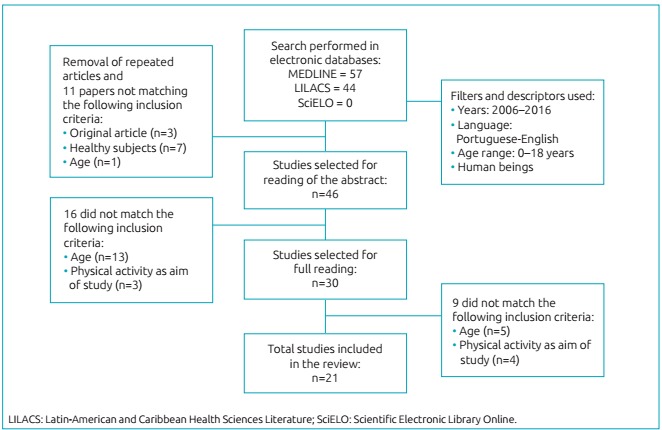
The method used as reference was the Preferred Reporting Items for Systematic Reviews and Meta-Analyses (PRISMA). Databases searched for articles published from 2006 to 2016, with "Bone geometry" AND (Sport* OR Exercise* OR "Physical Activity") as descriptors, were PubMed, BIREME/LILACS and SciELO.
After the selection, 21 articles were included. Most studies stated that practice of physical activity and/or sports was beneficial for bone geometry and bone mineral density. Only two studies presented values of bone parameters for control individuals better than those of swimmers. Physical activities and sports studied were: gymnastics (n=7), rhythmic gymnastics (n=2), tennis (n=1), soccer (n=3), capoeira (n=1), swimming (n=4), cycling (n=0), jumping activities (n=2), studies relating physical activity with isokinetic peak torque (n=1), physical activity measured by questionnaire (n=4), and additional physical education classes (n=2).
Among the sports and physical activities found, gymnastics, soccer, and more intense physical activity assessed by questionnaires were mentioned along with better results in bone geometry compared to the absence of physical activity, whereas swimming and jumping exercises did not influence it. Therefore, sports activities with weight bearing and those practiced more frequently and intensively are beneficial for bone geometry.
对健康领域中体育活动和/或运动的实践及其对健康儿童和青少年骨骼几何结构的影响进行系统评价。
作为参考使用的方法是系统评价与Meta分析的首选报告项目(PRISMA)。检索2006年至2016年发表的文章,以“骨骼几何结构”以及(运动或锻炼或“体育活动”)作为描述词的数据库有PubMed、BIREME/LILACS和SciELO。
筛选后纳入21篇文章。大多数研究表明,体育活动和/或运动的实践对骨骼几何结构和骨矿物质密度有益。只有两项研究呈现出对照组个体的骨骼参数值优于游泳运动员。所研究的体育活动和运动包括:体操(n = 7)、艺术体操(n = 2)、网球(n = 1)、足球(n = 3)、卡波耶拉舞(n = 1)、游泳(n = 4)、骑自行车(n = 0)、跳跃活动(n = 2)、将体育活动与等速峰值扭矩相关联的研究(n = 1)、通过问卷测量的体育活动(n = 4)以及额外的体育课(n = 2)。
在所发现的体育活动和运动中,与不进行体育活动相比,体操、足球以及问卷评估的更剧烈体育活动在骨骼几何结构方面有更好的结果,而游泳和跳跃运动则没有影响。因此,负重的体育活动以及更频繁、更剧烈进行的体育活动对骨骼几何结构有益。