Brown Grant D, Porter Aaron T, Oleson Jacob J, Hinman Jessica A
Department of Biostatistics, University of Iowa, Iowa City, Iowa 52242 USA.
Department of Applied Mathematics and Statistics, Colorado School of Mines, Golden, Colorado 80401 USA.
Spat Spatiotemporal Epidemiol. 2018 Feb;24:27-37. doi: 10.1016/j.sste.2017.11.001. Epub 2017 Nov 22.
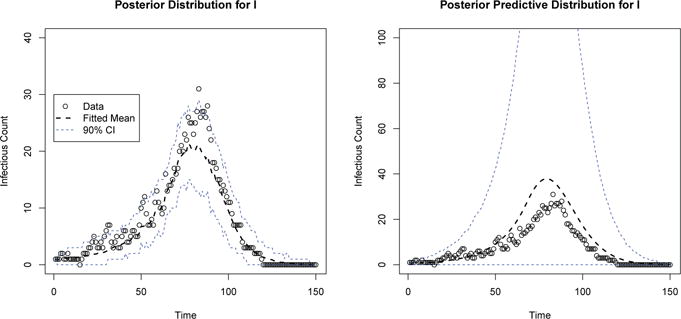
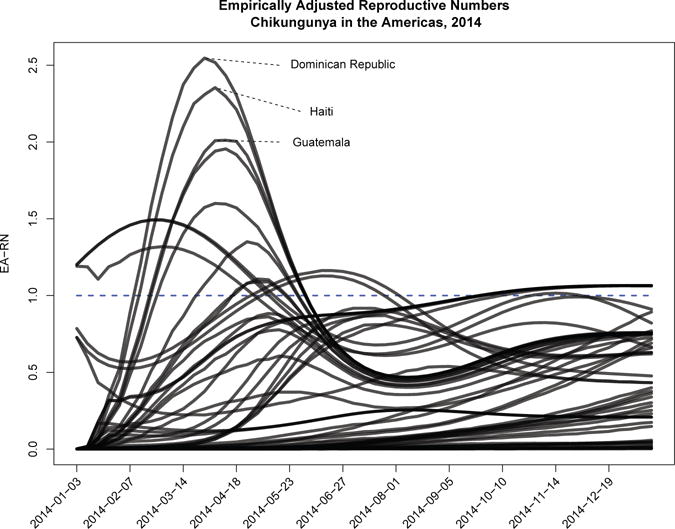
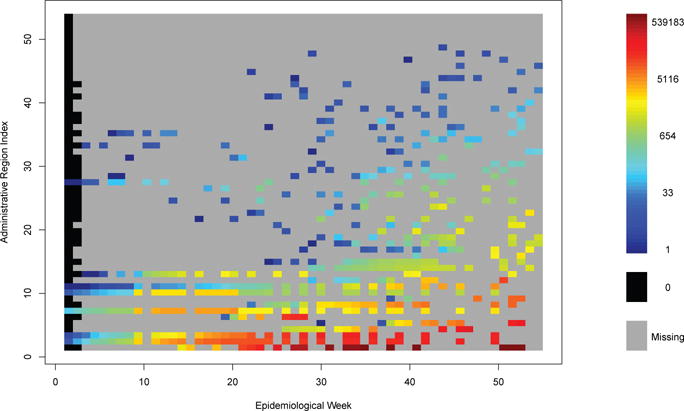
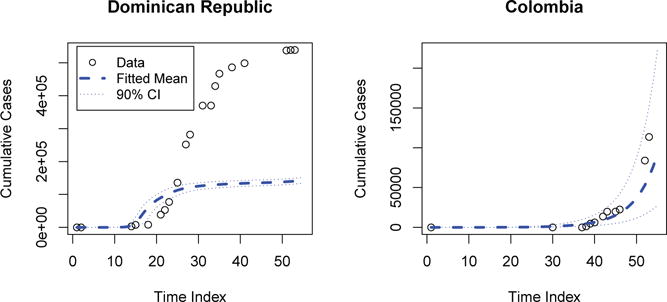
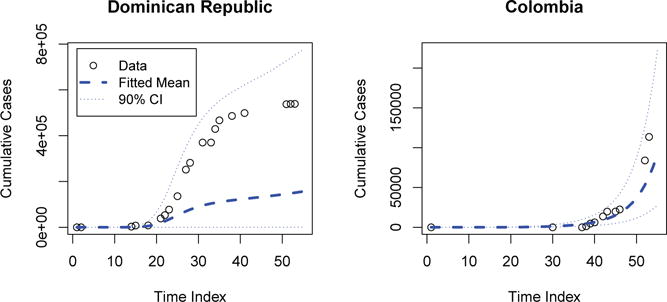
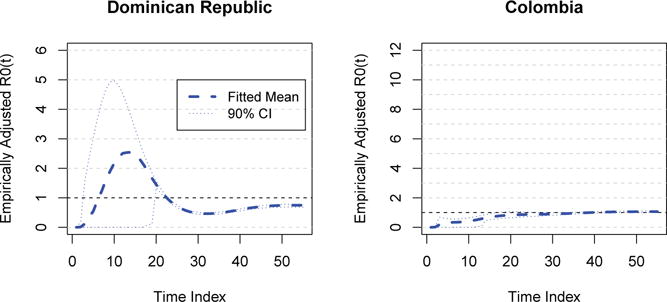
Approximate Bayesia n Computation (ABC) provides an attractive approach to estimation in complex Bayesian inferential problems for which evaluation of the kernel of the posterior distribution is impossible or computationally expensive. These highly parallelizable techniques have been successfully applied to many fields, particularly in cases where more traditional approaches such as Markov chain Monte Carlo (MCMC) are impractical. In this work, we demonstrate the application of approximate Bayesian inference to spatially heterogeneous Susceptible-Exposed-Infectious-Removed (SEIR) stochastic epidemic models. These models have a tractable posterior distribution, however MCMC techniques nevertheless become computationally infeasible for moderately sized problems. We discuss the practical implementation of these techniques via the open source ABSEIR package for R. The performance of ABC relative to traditional MCMC methods in a small problem is explored under simulation, as well as in the spatially heterogeneous context of the 2014 epidemic of Chikungunya in the Americas.
近似贝叶斯计算(ABC)为复杂贝叶斯推理问题的估计提供了一种有吸引力的方法,对于这些问题,后验分布的核评估是不可能的或计算成本很高。这些高度可并行化的技术已成功应用于许多领域,特别是在诸如马尔可夫链蒙特卡罗(MCMC)等更传统方法不实用的情况下。在这项工作中,我们展示了近似贝叶斯推理在空间异质的易感-暴露-感染-康复(SEIR)随机流行病模型中的应用。这些模型具有易于处理的后验分布,然而对于中等规模的问题,MCMC技术在计算上仍然不可行。我们通过用于R的开源ABSEIR包讨论这些技术的实际实现。在模拟中以及在2014年美洲基孔肯雅热疫情的空间异质背景下,探讨了ABC相对于传统MCMC方法在一个小问题中的性能。