Shen Lanxiao, Chen Shan, Zhu Xiaoyang, Han Ce, Zheng Xiaomin, Deng Zhenxiang, Zhou Yongqiang, Gong Changfei, Xie Congying, Jin Xiance
Department of Radiotherapy and Chemotherapy, The 1st Affiliated Hospital of Wenzhou Medical University, Wenzhou, China.
Elekta Instrument (Shanghai) Ltd, No. 1528 Century Avenue, Shanghai, China.
J Radiat Res. 2018 Mar 1;59(2):207-215. doi: 10.1093/jrr/rrx100.
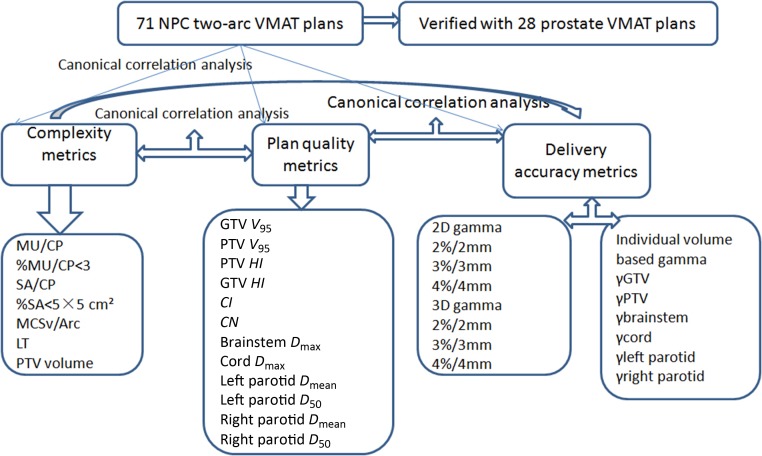
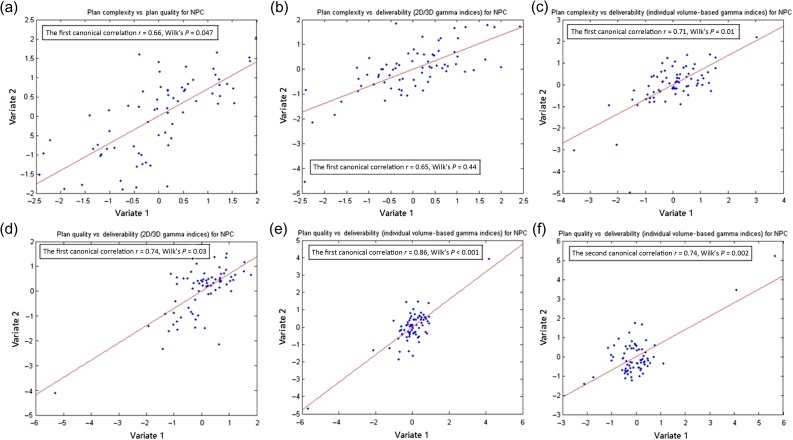
A multidimensional exploratory statistical method, canonical correlation analysis (CCA), was applied to evaluate the impact of complexity parameters on the plan quality and deliverability of volumetric-modulated arc therapy (VMAT) and to determine parameters in the generation of an ideal VMAT plan. Canonical correlations among complexity, quality and deliverability parameters of VMAT, as well as the contribution weights of different parameters were investigated with 71 two-arc VMAT nasopharyngeal cancer (NPC) patients, and further verified with 28 one-arc VMAT prostate cancer patients. The average MU and MU per control point (MU/CP) for two-arc VMAT plans were 702.6 ± 55.7 and 3.9 ± 0.3 versus 504.6 ± 99.2 and 5.6 ± 1.1 for one-arc VMAT plans, respectively. The individual volume-based 3D gamma passing rates of clinical target volume (γCTV) and planning target volume (γPTV) for NPC and prostate cancer patients were 85.7% ± 9.0% vs 92.6% ± 7.8%, and 88.0% ± 7.6% vs 91.2% ± 7.7%, respectively. Plan complexity parameters of NPC patients were correlated with plan quality (P = 0.047) and individual volume-based 3D gamma indices γ(IV) (P = 0.01), in which, MU/CP and segment area (SA) per control point (SA/CP) were weighted highly in correlation with γ(IV) , and SA/CP, percentage of CPs with SA < 5 × 5 cm2 (%SA < 5 × 5 cm2) and PTV volume were weighted highly in correlation with plan quality with coefficients of 0.98, 0.68 and -0.99, respectively. Further verification with one-arc VMAT plans demonstrated similar results. In conclusion, MU, SA-related parameters and PTV volume were found to have strong effects on the plan quality and deliverability.
应用一种多维探索性统计方法——典型相关分析(CCA),来评估复杂性参数对容积调强弧形放疗(VMAT)计划质量和可交付性的影响,并确定生成理想VMAT计划时的参数。利用71例两弧VMAT鼻咽癌(NPC)患者,研究了VMAT复杂性、质量和可交付性参数之间的典型相关性以及不同参数的贡献权重,并通过28例单弧VMAT前列腺癌患者进行了进一步验证。两弧VMAT计划的平均机器跳数(MU)和每个控制点的MU(MU/CP)分别为702.6±55.7和3.9±0.3,而单弧VMAT计划分别为504.6±99.2和5.6±1.1。NPC和前列腺癌患者临床靶区(γCTV)和计划靶区(γPTV)基于个体体积的3D伽马通过率分别为85.7%±9.0%对92.6%±7.8%,以及88.0%±7.6%对91.2%±7.7%。NPC患者的计划复杂性参数与计划质量(P = 0.047)和基于个体体积的3D伽马指数γ(IV)(P = 0.01)相关,其中,MU/CP和每个控制点的射野面积(SA)(SA/CP)与γ(IV)的相关性权重较高,而SA/CP、SA<5×5 cm2的控制点百分比(%SA<5×5 cm2)和PTV体积与计划质量的相关性权重较高,系数分别为0.98、0.68和 -0.99。单弧VMAT计划的进一步验证显示了类似结果。总之,发现MU、与SA相关的参数和PTV体积对计划质量和可交付性有强烈影响。