School of Human Sciences, The University of Western Australia, 35 Stirling Highway, Crawley, Perth, WA 6009, Australia.
Auckland University of Technology, Sports Performance Research Institute New Zealand (SPRINZ), Private Bag 92006, Auckland 1142, New Zealand.
Nutrients. 2018 Feb 6;10(2):176. doi: 10.3390/nu10020176.
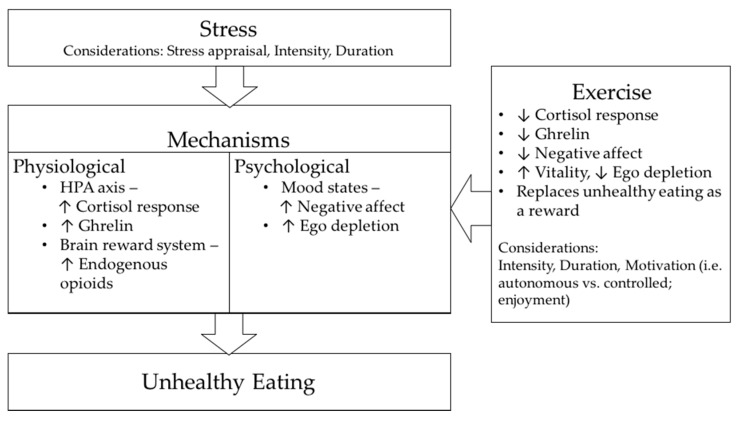
It is well established that both acute and chronic stress can be detrimental to health and wellbeing by directly increasing the risk of several chronic diseases and related health problems. In addition, stress may contribute to ill-health indirectly via its downstream effects on individuals' health-related behaviour, such as promoting the intake of unhealthy palatable foods high in fat and sugar content. This paper reviews (a) the research literature on stress-models; (b) recent research investigating stress-induced eating and (c) the potential physiological and psychological pathways contributing to stress-induced eating. Particular attention is given to (d) the role of physical exercise in attenuating acute stress, with exploration of potential mechanisms through which exercise may reduce unhealthy food and drink consumption subsequent to stressor exposure. Finally, exercise motivation is discussed as an important psychological influence over the capacity for physical exercise to attenuate unhealthy food and drink consumption after exposure to stressors. This paper aims to provide a better understanding of how physical exercise might alleviate stress-induced unhealthy food choices.
众所周知,急性和慢性压力都会直接增加罹患多种慢性疾病和相关健康问题的风险,从而对健康和幸福产生不利影响。此外,压力还可能通过对个体健康相关行为产生下游影响,例如促进摄入不健康的美味食物(高脂肪和高糖含量),间接地导致健康状况不佳。本文回顾了:(a)压力模型的研究文献;(b)最近研究压力诱导进食的文献;(c)导致压力诱导进食的潜在生理和心理途径。特别关注:(d)体育锻炼在减轻急性压力中的作用,探讨运动可能通过哪些潜在机制在压力源暴露后减少不健康的食物和饮料消费。最后,讨论了运动动机作为对锻炼减轻压力源暴露后不健康食物和饮料消费能力的重要心理影响。本文旨在更好地理解体育锻炼如何缓解压力诱导的不健康食物选择。