Neumeier William H, Goodner Emily, Biasini Fred, Dhurandhar Emily J, Menear Kristi S, Turan Bulent, Hunter Gary R
1Department of Psychology, University of Alabama at Birmingham, Birmingham, AL; 2Department of Human Studies, University of Alabama at Birmingham, Birmingham, AL; and 3Department of Kinesiology and Sports Management, Texas Tech University, Lubbock, TX.
Med Sci Sports Exerc. 2016 Sep;48(9):1803-9. doi: 10.1249/MSS.0000000000000961.
Mental work may promote caloric intake, whereas exercise may offset positive energy balance by decreasing energy intake and increasing energy expenditure.
This study aimed to replicate previous findings that mental work increases caloric intake compared with a rest condition and assess whether exercise after mental work can offset this effect.
Thirty-eight male and female university students were randomly assigned to mental work + rest (MW + R) or mental work + exercise (MW + E). Participants also completed a baseline rest (BR) visit consisting of no mental work or exercise. Visit order was counterbalanced. During the MW + R or MW + E visit, participants completed a 20-min mental task and either a 15-min rest (MW + R) or a 15-min interval exercise (MW + E). Each visit ended with an ad libitum pizza lunch. A two-way repeated-measures ANOVA was used to compare eating behavior between groups.
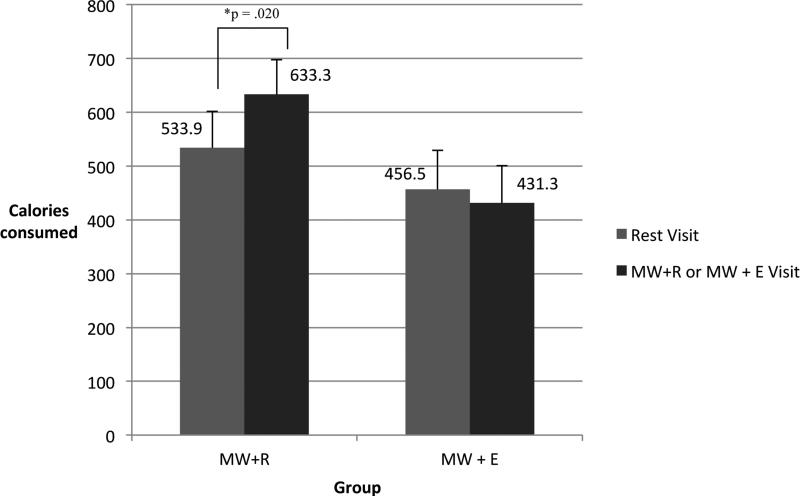
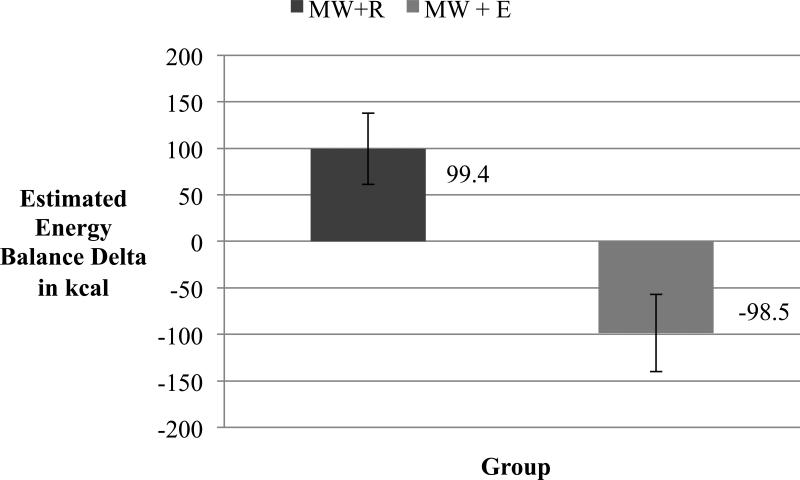
Participants in the MW + R condition consumed an average of 100 more kilocalories compared with BR (633.3 ± 72.9 and 533.9 ± 67.7, respectively, P = 0.02), and participants in MW + E consumed an average of 25 kcal less compared with BR (432.3 ± 69.2 and 456.5 ± 64.2, respectively, P > 0.05). When including the estimated energy expenditure of exercise in the MW + E conditions, participants were in negative energy balance by an average of 98.5 ± 41.5 kcal, resulting in a significant difference in energy balance between the two groups (P = 0.001).
An acute bout of interval exercise after mental work resulted in significantly decreased food consumption compared with a nonexercise condition. These results suggest that an acute bout of exercise may be used to offset positive energy balance induced by mental tasks.
脑力劳动可能会促进热量摄入,而运动可能通过减少能量摄入和增加能量消耗来抵消正能量平衡。
本研究旨在重复先前的研究结果,即与休息状态相比,脑力劳动会增加热量摄入,并评估脑力劳动后的运动是否能抵消这种影响。
38名男女大学生被随机分为脑力劳动+休息(MW+R)组或脑力劳动+运动(MW+E)组。参与者还完成了一次基线休息(BR)访问,期间没有脑力劳动或运动。访问顺序进行了平衡。在MW+R或MW+E访问期间,参与者完成了一项20分钟的脑力任务,然后进行15分钟的休息(MW+R)或15分钟的间歇运动(MW+E)。每次访问结束时都提供一顿自助披萨午餐。使用双向重复测量方差分析来比较两组之间的饮食行为。
与BR相比,MW+R组的参与者平均多摄入了100千卡热量(分别为633.3±72.9和533.9±67.7,P=0.02),而MW+E组的参与者与BR相比平均少摄入25千卡热量(分别为432.3±69.2和456.5±64.2,P>0.05)。当将MW+E组运动的估计能量消耗包括在内时,参与者的能量平衡平均为负98.5±41.5千卡,导致两组之间的能量平衡存在显著差异(P=0.001)。
与无运动条件相比,脑力劳动后的一次急性间歇运动导致食物摄入量显著减少。这些结果表明,一次急性运动可能用于抵消脑力任务引起的正能量平衡。