Qian Qing-Zeng, Cao Xiang-Ke, Liu Hai-Yan, Zheng Guo-Ying, Qian Qing-Qiang, Shen Fu-Hai
School of Public Health, North China University of Science and Technology, Tangshan 063000, P.R. China.
College of Life Sciences, North China University of Science and Technology, Tangshan 063000, P.R. China.
Oncotarget. 2017 Jul 1;9(1):1302-1310. doi: 10.18632/oncotarget.18921. eCollection 2018 Jan 2.
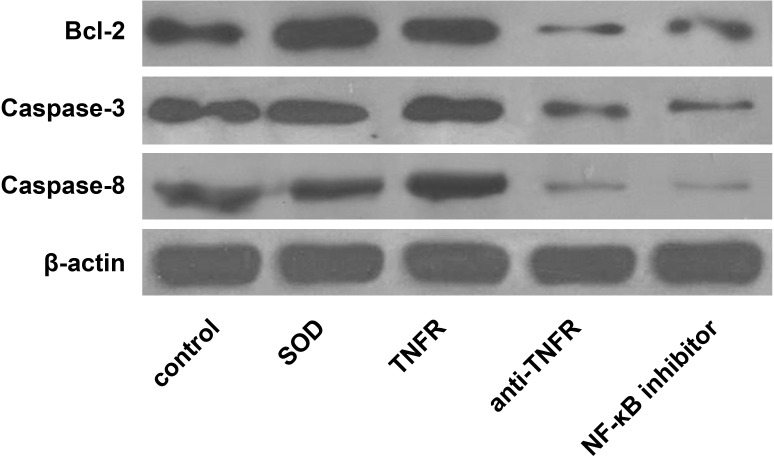
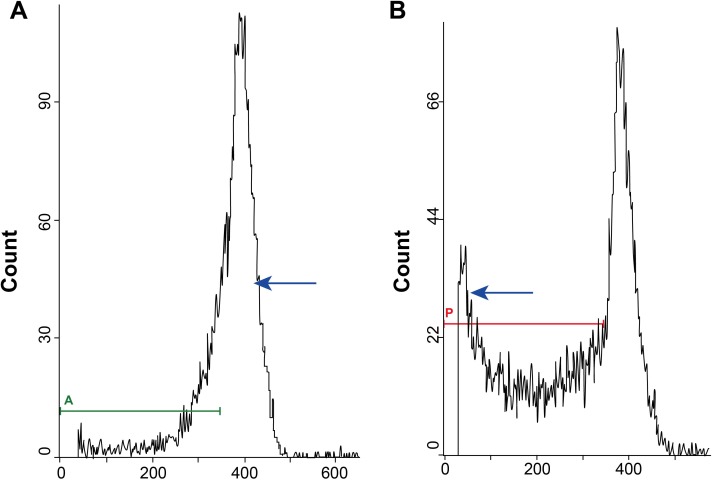
We explored the role of TNFR/TNF-α signalingin apoptosis among alveolar macrophages (AM) and its relevance to the development of coal workers' pneumoconiosis (CWP). Purified alveolar macrophages (AMs) were prepared from bronchoalveolar lavage fluid harvested from 366 CWP patients and 120 healthy subjects enrolled inthe study. The purified AMs were then divided into control, SOD, anti-TNFR, TNFR and NFkB inhibitor groups and analyzed for apoptosis usingflow cytometry (sub-diploid peak) and western blotting (Bcl-2, Caspase-3 and Caspase-8 expression). We found thatAM apoptosis washigher amongCWP patients than thehealthycontrols. Expression ofBcl-2, Caspase-3 and Caspase-8 was higher inAMs from CWP patientsthan in those from the controlsand correlated with increased AM apoptosis. Univariate and multivariate analyses suggested that CWP grade, initial exposure time, exposure time inyears, and CWP onset agewereall associated with altered levels of Bcl-2, Caspase-3 and Caspase-8. Inhibition of TNFR/TNF-α signaling usinganti-TNFR antibody, SOD or NFkB inhibitionreduced AM apoptosisand decreased Bcl-2, Caspase-3 and Caspase-8 expression. These data suggestinhibition of a TNFR/TNF-α signaling pathway is a potentiallyeffective means ofalleviating CWP by inhibiting AM apoptosis.
我们探讨了肿瘤坏死因子受体/肿瘤坏死因子-α(TNFR/TNF-α)信号通路在肺泡巨噬细胞(AM)凋亡中的作用及其与煤工尘肺(CWP)发病的相关性。从参与本研究的366例CWP患者和120例健康受试者收集的支气管肺泡灌洗液中制备纯化的肺泡巨噬细胞(AMs)。然后将纯化的AMs分为对照组、超氧化物歧化酶(SOD)组、抗TNFR组、TNFR组和核因子κB(NFkB)抑制剂组,并使用流式细胞术(亚二倍体峰)和蛋白质印迹法(检测Bcl-2、半胱天冬酶-3和半胱天冬酶-8的表达)分析细胞凋亡情况。我们发现,CWP患者的AM凋亡率高于健康对照组。CWP患者AMs中Bcl-2、半胱天冬酶-3和半胱天冬酶-8的表达高于对照组,且与AM凋亡增加相关。单因素和多因素分析表明,CWP分级、初次接触时间、接触年限和CWP发病年龄均与Bcl-2、半胱天冬酶-3和半胱天冬酶-8水平的改变有关。使用抗TNFR抗体、SOD或抑制NFkB抑制TNFR/TNF-α信号通路可减少AM凋亡,并降低Bcl-2、半胱天冬酶-3和半胱天冬酶-8的表达。这些数据表明,抑制TNFR/TNF-α信号通路可能是通过抑制AM凋亡来减轻CWP的有效手段。