Centre for the Evaluation of Vaccination (CEV), Vaccine & Infectious Disease Institute (VAXINFECTIO), Faculty of Medicine and Health Sciences, University of Antwerp, Universiteitsplein 1, Wilrijk (Antwerp), 2610, Belgium.
Multidisciplinary Breast Clinic, Unit Gynaecologic Oncology, Department of Obstetrics and Gynaecology, Antwerp University Hospital (UZA), Edegem, Belgium.
Eur J Clin Microbiol Infect Dis. 2018 May;37(5):859-869. doi: 10.1007/s10096-017-3179-1. Epub 2018 Feb 7.
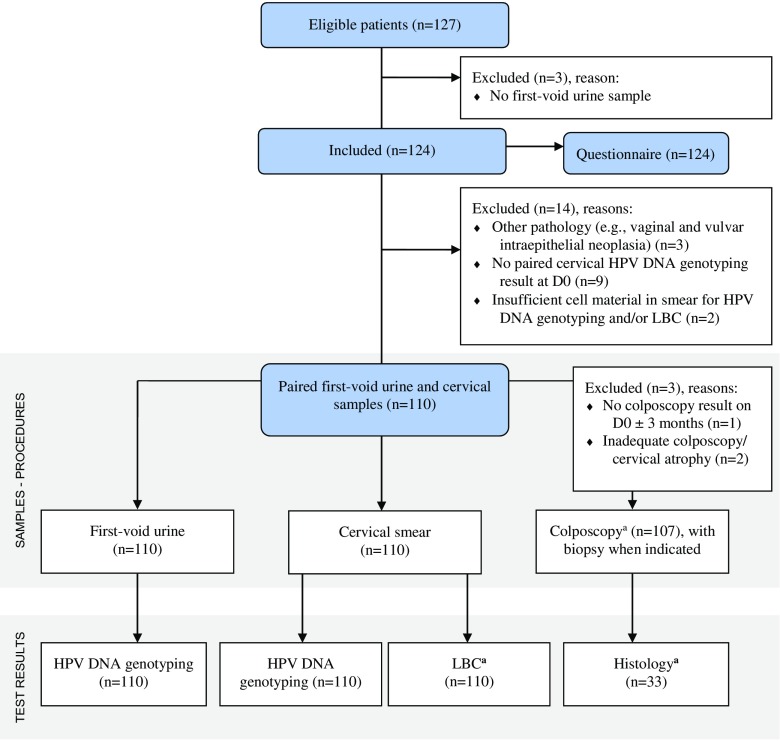
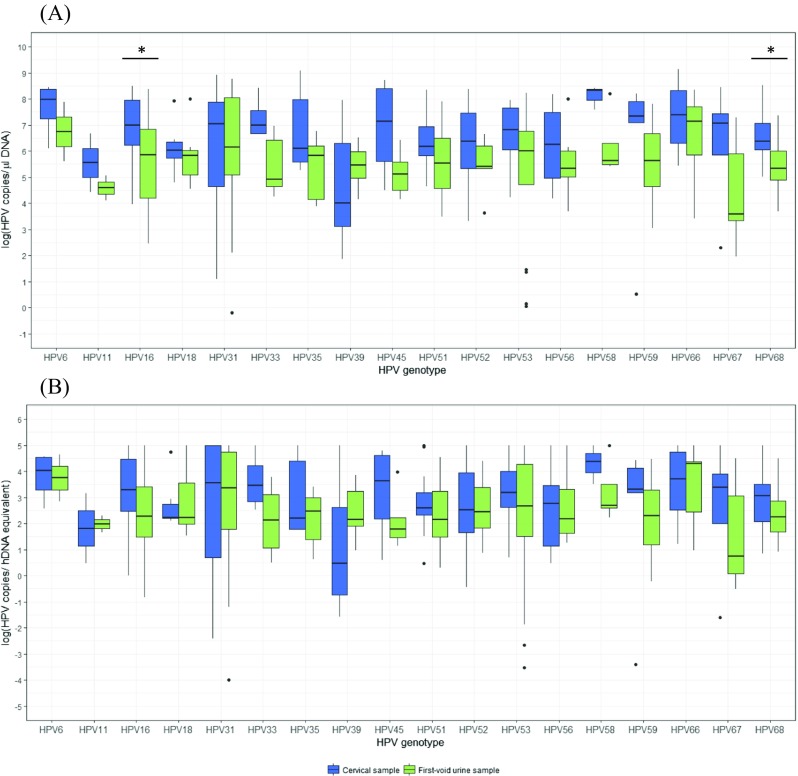
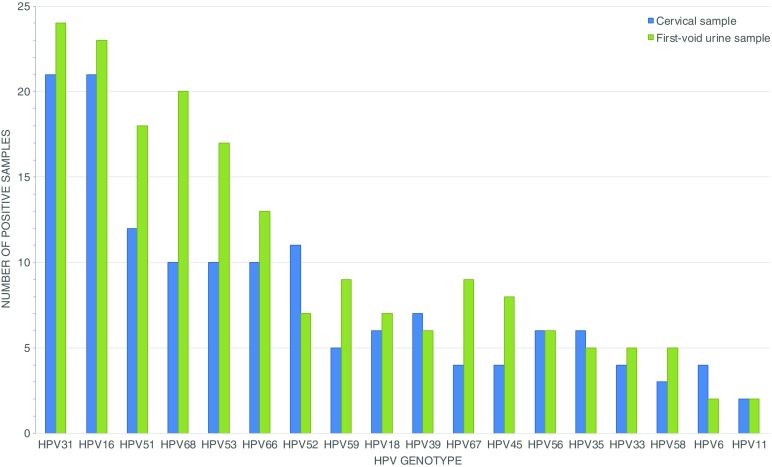
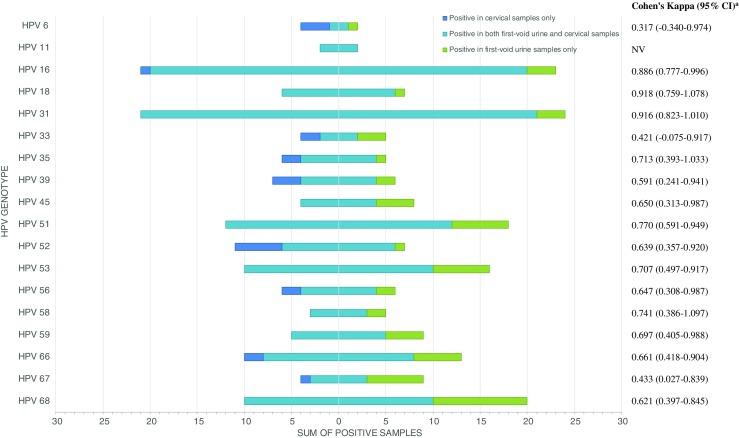
The performance and acceptability of first-void urine as specimen for the detection of HPV DNA in a Belgian referral population was evaluated using an optimized sample collection and processing protocol. One hundred ten first-void urine and cervical samples were collected from 25- to 64-year-old women who were referred for colposcopy (January-November 2016). Paired samples were analyzed by the Riatol qPCR HPV genotyping assay. Acceptability data were gathered through questionnaires (NCT02714127). A higher high-risk HPV DNA prevalence was observed in first-void urine (n = 76/110) compared to cervical samples (n = 73/110), with HPV31 and HPV16/31 being most prevalent correspondingly. For both any and high-risk HPV DNA, good agreement was observed between paired samples (Cohen's Kappa of 0.660 (95% CI: 0.486-0.833) and 0.688 (95% CI: 0.542-0.835), respectively). In addition, significant positive correlations in HPV copies (per microliter of DNA extract) between paired samples were observed for HPV16 (r = 0.670; FDR (false discovery rate)-adjusted p = 0.006), HPV18 (r = 0.893; FDR-adjusted p = 0.031), HPV31 (r = 0.527; FDR-adjusted p = 0.031), HPV53 (r = 0.691; FDR-adjusted p = 0.017), and HPV68 (r = 0.569; FDR-adjusted p = 0.031). First-void urine sampling using a first-void urine collection device was preferred over a clinician-collected cervical sample. And mostly, first-void urine sampling at home was favored over collection at the clinic or the general practitioner's office. First-void urine sampling is a highly preferred, non-invasive method that ensures good agreement in HPV DNA (copies) with reference cervical samples. It is particularly interesting as a screening technique to reach non-participants, and its clinical performance should be further evaluated.
采用优化的样本采集和处理方案,评估了首段尿样作为检测 HPV DNA 的标本在比利时转诊人群中的性能和可接受性。2016 年 1 月至 11 月,采集了 25 至 64 岁转诊行阴道镜检查的女性的 110 份首段尿和宫颈样本。使用 Riatol qPCR HPV 基因分型检测分析配对样本。通过问卷(NCT02714127)收集可接受性数据。与宫颈样本(n=110)相比,首段尿(n=76)中观察到较高的高危 HPV DNA 流行率,相应的 HPV31 和 HPV16/31 最为常见。对于任何高危 HPV DNA,配对样本之间均观察到良好的一致性(Cohen's Kappa 分别为 0.660(95%CI:0.486-0.833)和 0.688(95%CI:0.542-0.835))。此外,在 HPV 拷贝数(每微升 DNA 提取液)方面,配对样本之间 HPV16(r=0.670;FDR(假发现率)校正 p=0.006)、HPV18(r=0.893;FDR 校正 p=0.031)、HPV31(r=0.527;FDR 校正 p=0.031)、HPV53(r=0.691;FDR 校正 p=0.017)和 HPV68(r=0.569;FDR 校正 p=0.031)呈显著正相关。与临床医生采集的宫颈样本相比,使用首段尿采集装置采集首段尿样本更受青睐。而且,大多倾向于在家中采集首段尿样本,而不是在诊所或全科医生办公室采集。首段尿采样是一种高度可接受的非侵入性方法,可确保与参考宫颈样本的 HPV DNA(拷贝数)良好一致。作为一种筛选技术,它特别适用于未能参与的人群,其临床性能应进一步评估。