Vora Neil M, Orciari Lillian A, Bertumen J Bradford, Damon Inger, Ellison James A, Fowler Vance G, Franka Richard, Petersen Brett W, Satheshkumar P S, Schexnayder Stephen M, Smith Todd G, Wallace Ryan M, Weinstein Susan, Williams Carl, Yager Pamela, Niezgoda Michael
MMWR Morb Mortal Wkly Rep. 2018 Feb 9;67(5):161-165. doi: 10.15585/mmwr.mm6705a3.
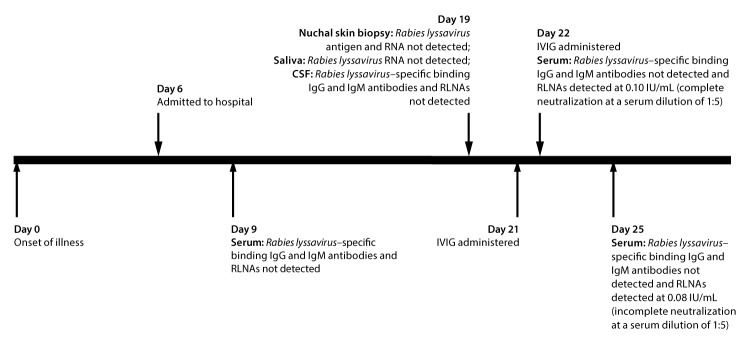
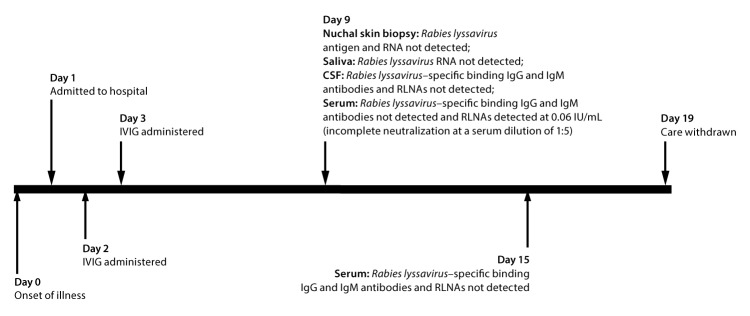
Rabies is an acute encephalitis that is nearly always fatal. It is caused by infection with viruses of the genus Lyssavirus, the most common of which is Rabies lyssavirus. The Council of State and Territorial Epidemiologists (CSTE) defines a confirmed human rabies case as an illness compatible with rabies that meets at least one of five different laboratory criteria.* Four of these criteria do not depend on the patient's rabies vaccination status; however, the remaining criterion, "identification of Lyssavirus-specific antibody (i.e. by indirect fluorescent antibody…test or complete [Rabies lyssavirus] neutralization at 1:5 dilution) in the serum," is only considered diagnostic in unvaccinated patients. Lyssavirus-specific antibodies include Rabies lyssavirus-specific binding immunoglobulin G (IgG) and immunoglobulin M (IgM) antibodies and Rabies lyssavirus neutralizing antibodies (RLNAs). This report describes six patients who were tested for rabies by CDC and who met CSTE criteria for confirmed human rabies because they had illnesses compatible with rabies, had not been vaccinated for rabies, and were found to have serum RLNAs (with complete Rabies lyssavirus neutralization at a serum dilution of 1:5). An additional four patients are described who were tested for rabies by CDC who were found to have serum RLNAs (with incomplete Rabies lyssavirus neutralization at a serum dilution of 1:5) despite having not been vaccinated for rabies. None of these 10 patients received a rabies diagnosis; rather, they were considered to have been passively immunized against rabies through recent receipt of intravenous immune globulin (IVIG). Serum RLNA test results should be interpreted with caution in patients who have not been vaccinated against rabies but who have recently received IVIG.
狂犬病是一种几乎总会致命的急性脑炎。它由狂犬病病毒属病毒感染引起,其中最常见的是狂犬病病毒。州和地区流行病学家委员会(CSTE)将确诊的人类狂犬病病例定义为一种与狂犬病相符的疾病,该疾病至少符合五项不同实验室标准中的一项。*这些标准中的四项不取决于患者的狂犬病疫苗接种状况;然而,其余标准“在血清中鉴定狂犬病病毒特异性抗体(即通过间接荧光抗体……试验或1:5稀释度下的完全[狂犬病病毒]中和)”仅在未接种疫苗的患者中被视为诊断依据。狂犬病病毒特异性抗体包括狂犬病病毒特异性结合免疫球蛋白G(IgG)和免疫球蛋白M(IgM)抗体以及狂犬病病毒中和抗体(RLNAs)。本报告描述了六名由美国疾病控制与预防中心(CDC)进行狂犬病检测的患者,他们符合CSTE确诊人类狂犬病的标准,因为他们患有与狂犬病相符的疾病、未接种狂犬病疫苗,并且被发现血清中有RLNAs(在血清稀释度为1:5时具有完全狂犬病病毒中和)。还描述了另外四名由CDC进行狂犬病检测的患者,尽管他们未接种狂犬病疫苗,但被发现血清中有RLNAs(在血清稀释度为1:5时具有不完全狂犬病病毒中和)。这10名患者均未被诊断为狂犬病;相反,他们被认为是通过近期接受静脉注射免疫球蛋白(IVIG)而被动免疫了狂犬病。对于未接种狂犬病疫苗但近期接受过IVIG的患者,血清RLNA检测结果的解读应谨慎。