Department of Neurovirology, WHO Collaborating Centre for Reference and Research in Rabies, National Institute of Mental Health and Neurosciences (NIMHANS), Bangalore, India.
Department of Biostatistics, National Institute of Mental Health and Neurosciences (NIMHANS), Bangalore, India.
PLoS Negl Trop Dis. 2019 Jan 29;13(1):e0007128. doi: 10.1371/journal.pntd.0007128. eCollection 2019 Jan.
Early ante-mortem laboratory confirmation of human rabies is essential to aid patient management and institute public health measures. Few studies have highlighted the diagnostic value of antibody detection in CSF/serum in rabies, and its utility is usually undermined owing to the late seroconversion and short survival in infected patients. This study was undertaken to examine the ante-mortem diagnostic utility and prognostic value of antibody detection by rapid fluorescent focus inhibition test (RFFIT) in cerebrospinal fluid (CSF)/serum samples received from clinically suspected human rabies cases from January 2015 to December 2017.
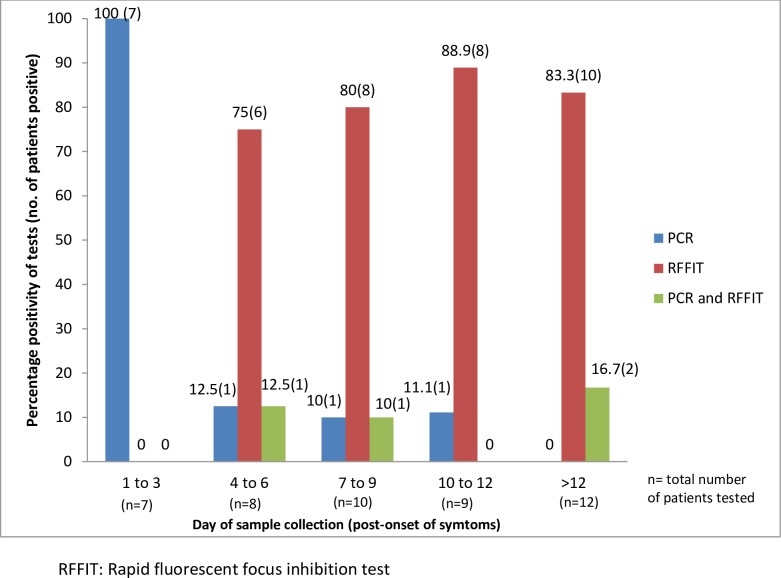
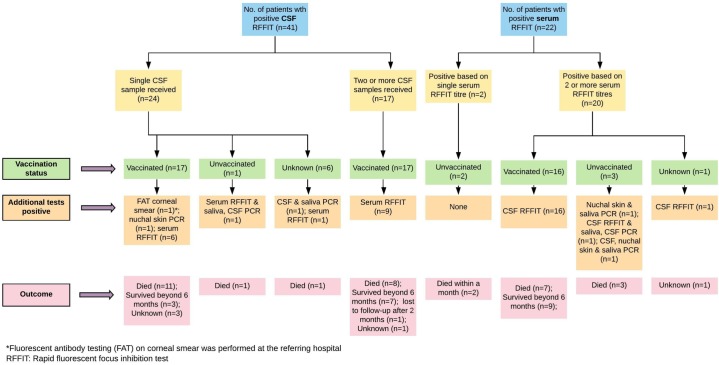
METHODOLOGY/PRINCIPAL FINDINGS: Samples collected ante-mortem and post-mortem from 130 and 6 patients with clinically suspected rabies respectively, were received in the laboratory during the study period. Ante-mortem laboratory confirmation was achieved in 55/130 (42.3%) cases. Real time PCR for detection of viral nucleic acid performed on saliva, nuchal skin, brain tissue and CSF samples could confirm the diagnosis in 15 (27.2%) of the 55 laboratory confirmed cases. Ante-mortem diagnosis could be achieved by RFFIT (in CSF and/or serum) in 45 (34.6%) of the 130 clinically suspected cases, accounting for 81.8% of the total 55 laboratory confirmed cases. The sensitivity of CSF RFFIT increased with the day of sample collection (post-onset of symptoms) and was found to be 100% after 12 days of illness. Patients who had received prior vaccination had an increased probability of a positive RFFIT and negative PCR result. Patients who were positive by RFFIT alone at initial diagnosis had longer survival (albeit with neurological sequelae) than patients who were positive by PCR alone or both RFFIT and PCR.
CONCLUSIONS/SIGNIFICANCE: Detection of antibodies in the CSF/serum is a valuable ante-mortem diagnostic tool in human rabies, especially in patients who survive beyond a week. It was also found to have a limited role as a prognostic marker to predict outcomes in patients.
早期对人狂犬病进行生前实验室确认对于帮助患者管理和实施公共卫生措施至关重要。很少有研究强调了在狂犬病中检测 CSF/血清中抗体的诊断价值,而且由于感染患者的血清学转换较晚和存活时间短,其应用通常受到影响。本研究旨在检查 2015 年 1 月至 2017 年 12 月期间从临床疑似狂犬病病例中获得的 CSF/血清样本中快速荧光灶抑制试验(RFFIT)检测抗体的生前诊断效用和预后价值。
方法/主要发现:在研究期间,实验室共收到 130 例和 6 例临床疑似狂犬病患者的生前和死后样本。55/130(42.3%)例患者生前实验室确诊。对唾液、颈背皮肤、脑组织和 CSF 样本进行的病毒核酸实时 PCR 检测可在 15(27.2%)例实验室确诊病例中确认诊断。在 130 例临床疑似病例中,通过 RFFIT(在 CSF 和/或血清中)可在 45(34.6%)例中获得生前诊断,占 55 例实验室确诊病例的 81.8%。CSF RFFIT 的敏感性随样本采集日(症状发作后)增加,在发病后 12 天达到 100%。接受过疫苗接种的患者有更高的可能性获得 RFFIT 阳性和 PCR 阴性结果。初次诊断时仅 RFFIT 阳性的患者比仅 PCR 阳性或 RFFIT 和 PCR 均阳性的患者存活时间更长(尽管有神经后遗症)。
结论/意义:在人狂犬病中,检测 CSF/血清中的抗体是一种有价值的生前诊断工具,尤其是在存活时间超过一周的患者中。它也被发现作为一种预后标志物,可预测患者的结局。