Dhooria Sahajal, Agarwal Ritesh, Sehgal Inderpaul Singh, Prasad Kuruswamy Thurai, Garg Mandeep, Bal Amanjit, Aggarwal Ashutosh Nath, Behera Digambar
Department of Pulmonary Medicine, Postgraduate Institute of Medical Education and Research, Chandigarh, India.
Department of Radiodiagnosis and Imaging, Postgraduate Institute of Medical Education and Research, Chandigarh, India.
PLoS One. 2018 Feb 8;13(2):e0191938. doi: 10.1371/journal.pone.0191938. eCollection 2018.
The spectrum of interstitial lung diseases (ILDs) have mainly been reported from the developed countries; data from developing countries is sparse and conflicting. The aim of this study is to describe the distribution of various ILDs from a developing country.
This is an analysis of prospectively collected clinical, radiological and histological data of consecutive subjects (age >12 years) with ILDs from a single tertiary care medical center. The diagnosis of the specific subtype of ILD was made according to standard criteria for various ILDs.
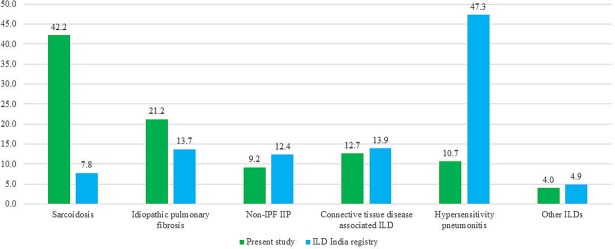
A total of 803 subjects (mean age, 50.6 years; 50.2% women) were enrolled between March 2015 to February 2017 of which 566 (70.5%) were diagnosed during the study period (incident cases). Sarcoidosis (42.2%), idiopathic pulmonary fibrosis (IPF, 21.2%), connective tissue disease (CTD)-related ILDs (12.7%), hypersensitivity pneumonitis (10.7%), and non-IPF idiopathic interstitial pneumonias (9.2%) were the most common ILDs. The spectrum of ILDs was not significantly different (p = 0.87) between incident and prevalent cases. A histopathological specimen was obtained in 49.9% of the subjects yielding a histologically confirmed diagnosis in 40.6%. A diagnostic procedure was not performed in 402 subjects; the most common reasons were presence of definite usual interstitial pneumonia pattern on high resolution computed tomography and patients' unwillingness to undergo the procedure.
Sarcoidosis, IPF and CTD-ILDs were the most common ILDs seen at a tertiary center in northern India similar to the spectrum reported from developed countries. More studies are required from developing countries to ascertain the spectrum of ILDs in different geographic locales.
间质性肺疾病(ILDs)的谱型主要来自发达国家的报道;发展中国家的数据稀少且相互矛盾。本研究的目的是描述一个发展中国家各种ILDs的分布情况。
这是一项对来自单一三级医疗中心的连续ILDs患者(年龄>12岁)的前瞻性收集的临床、放射学和组织学数据的分析。根据各种ILDs的标准标准对ILD的特定亚型进行诊断。
2015年3月至2017年2月共纳入803名受试者(平均年龄50.6岁;50.2%为女性),其中566名(70.5%)在研究期间被诊断(新发病例)。结节病(42.2%)、特发性肺纤维化(IPF,21.2%)、结缔组织病(CTD)相关ILDs(12.7%)、过敏性肺炎(10.7%)和非IPF特发性间质性肺炎(9.2%)是最常见的ILDs。新发病例和现患病例之间的ILDs谱型无显著差异(p = 0.87)。49.9%的受试者获得了组织病理学标本,其中40.6%得到了组织学确诊。402名受试者未进行诊断性检查;最常见的原因是高分辨率计算机断层扫描显示明确的普通型间质性肺炎模式以及患者不愿接受该检查。
结节病、IPF和CTD-ILDs是印度北部一家三级中心最常见的ILDs,与发达国家报道的谱型相似。发展中国家需要更多研究来确定不同地理区域的ILDs谱型。