Meegahakumbura Muditha K, Wambulwa Moses C, Li Miao-Miao, Thapa Kishore K, Sun Yong-Shuai, Möller Michael, Xu Jian-Chu, Yang Jun-Bo, Liu Jie, Liu Ben-Ying, Li De-Zhu, Gao Lian-Ming
Key Laboratory for Plant Diversity and Biogeography of East Asia, Kunming Institute of Botany, Chinese Academy of Sciences, Kunming, China.
Germplasm Bank of Wild Species in Southwest China, Kunming Institute of Botany, Chinese Academy of Sciences, Kunming, China.
Front Plant Sci. 2018 Jan 25;8:2270. doi: 10.3389/fpls.2017.02270. eCollection 2017.
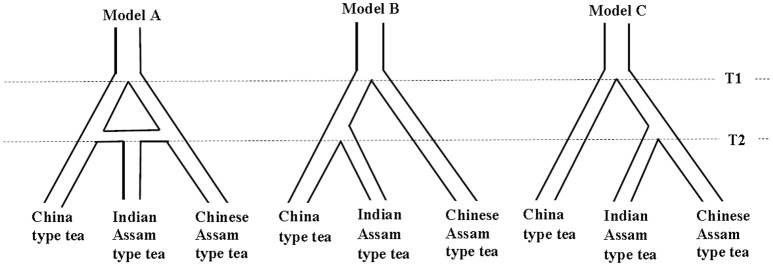
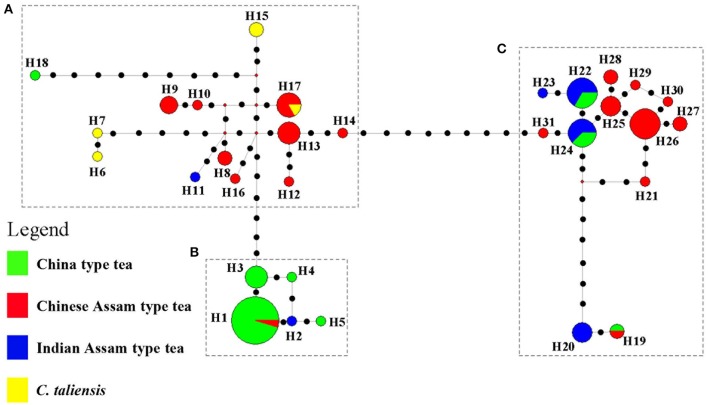
Although China and India are the two largest tea-producing countries, the domestication origin and breeding history of the tea plant in these two countries remain unclear. Our previous study suggested that the tea plant includes three distinct lineages (China type tea, Chinese Assam type tea and Indian Assam type tea), which were independently domesticated in China and India, respectively. To determine the origin and historical timeline of tea domestication in these two countries we used a combination of 23 nSSRs (402 samples) and three cpDNA regions (101 samples) to genotype domesticated tea plants and its wild relative. Based on a combination of demographic modeling, NewHybrids and Neighbour joining tree analyses, three independent domestication centers were found. In addition, two origins of Chinese Assam type tea were detected: Southern and Western Yunnan of China. Results from demographic modeling suggested that China type tea and Assam type tea first diverged 22,000 year ago during the last glacial maximum and subsequently split into the Chinese Assam type tea and Indian Assam type tea lineages 2770 year ago, corresponding well with the early record of tea usage in Yunnan, China. Furthermore, we found that the three tea types underwent different breeding histories where hybridization appears to have been the most important approach for tea cultivar breeding and improvements: a high proportion of the hybrid lineages were found to be F and BCs. Collectively, our results underscore the necessity for the conservation of Chinese Assam type tea germplasm and landraces as a valuable resource for future tea breeding.
虽然中国和印度是两个最大的茶叶生产国,但这两个国家茶树的驯化起源和育种历史仍不清楚。我们之前的研究表明,茶树包括三个不同的谱系(中国型茶、中国阿萨姆型茶和印度阿萨姆型茶),它们分别在中国和印度独立驯化。为了确定这两个国家茶叶驯化的起源和历史时间线,我们结合使用了23个核微卫星标记(402个样本)和三个叶绿体DNA区域(101个样本)对驯化茶树及其野生近缘种进行基因分型。基于群体动态建模、NewHybrids和邻接法树分析,发现了三个独立的驯化中心。此外,还检测到中国阿萨姆型茶有两个起源地:中国云南南部和西部。群体动态建模结果表明,中国型茶和阿萨姆型茶在末次盛冰期22000年前首次分化,随后在2770年前分裂为中国阿萨姆型茶和印度阿萨姆型茶谱系,这与中国云南早期的茶叶使用记录相吻合。此外,我们发现这三种茶经历了不同的育种历史,其中杂交似乎是茶树品种选育和改良的最重要方法:发现高比例的杂交谱系为F1和回交后代。总的来说,我们的结果强调了保护中国阿萨姆型茶种质和地方品种作为未来茶叶育种宝贵资源的必要性。