1Sackler Institute for Translational Neurodevelopment, Institute of Psychiatry, Psychology and Neuroscience, King's College London, De Crespigny Park, Denmark Hill, London, SE5 8AF UK.
2Department of Forensic and Neurodevelopmental Sciences, Institute of Psychiatry, Psychology and Neuroscience, King's College London, London, UK.
Mol Autism. 2018 Jan 30;9:7. doi: 10.1186/s13229-018-0187-7. eCollection 2018.
Impairments in social communication are a core feature of Autism Spectrum Disorder (ASD). Because the ability to infer other people's emotions from their facial expressions is critical for many aspects of social communication, deficits in expression recognition are a plausible candidate marker for ASD. However, previous studies on facial expression recognition produced mixed results, which may be due to differences in the sensitivity of the many tests used and/or the heterogeneity among individuals with ASD. To ascertain whether expression recognition may serve as a (which distinguishes people with ASD from a comparison group) or a (which helps to divide ASD into more homogeneous subgroups), a crucial first step is to move beyond identification of mean group differences and to better understand the frequency and severity of impairments.
This study tested 46 individuals with ASD and 52 age- and IQ-matched typically developing (TD) participants on the Films Expression Task, which combines three key features of real-life expression recognition: naturalistic facial expressions, a broad range of simple and complex emotions, and short presentation time. Test-retest reliability was assessed in 28 individuals who did not participate in the main study and revealed acceptable reliability (ICC = .74).
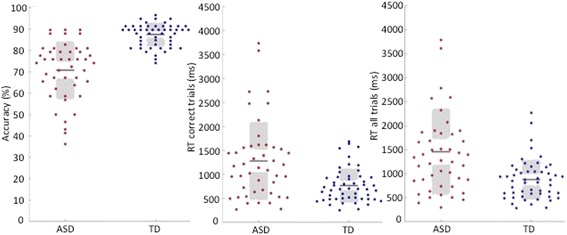
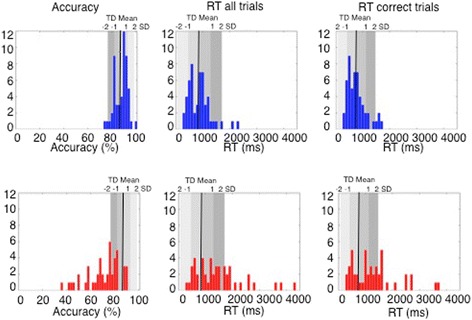
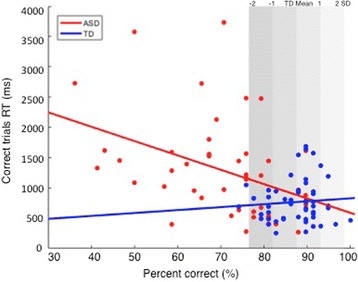
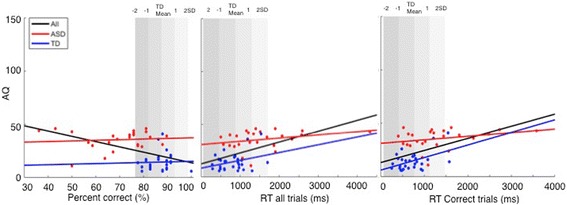
Case-control comparisons showed highly significant mean group differences for accuracy ( = 1.1 × 10), with an effect size (Cohen's = 1.6), more than twice as large as the mean effect size reported in a previous meta-analysis (Uljarevic and Hamilton, 2012, ). The ASD group also had significantly increased mean reaction times overall ( = .00015, = .83) and on correct trials ( = .0002, = .78). However, whereas 63% of people with ASD showed severe deficits (they performed below two standard deviations of the TD mean, a small subgroup (15.3%) performed normally (within one standard deviation of the mean).
These findings indicate that the majority of people with ASD have severe expression recognition deficits and that the Films Expression Test is a sensitive task for biomarker research in ASD. Future work is needed to establish whether ASD subgroups with and without expression recognition deficits differ from one another in terms of their symptom profile or neurobiological underpinnings.
社交沟通障碍是自闭症谱系障碍(ASD)的核心特征。由于从他人面部表情推断他人情绪的能力对社交沟通的许多方面至关重要,因此表情识别缺陷是 ASD 的一个合理候选标志物。然而,之前关于面部表情识别的研究结果喜忧参半,这可能是由于所使用的许多测试的灵敏度不同,以及 ASD 个体之间的异质性所致。为了确定表情识别是否可以作为(将 ASD 患者与对照组区分开来的生物标志物),或者作为(有助于将 ASD 分为更同质的亚组的生物标志物),至关重要的第一步是超越识别平均组间差异,并更好地了解损伤的频率和严重程度。
本研究使用电影表情任务(Films Expression Task)对 46 名 ASD 患者和 52 名年龄和智商匹配的正常发育(TD)参与者进行了测试,该任务结合了现实生活中表情识别的三个关键特征:自然的面部表情、广泛的简单和复杂情绪以及短暂的呈现时间。28 名未参与主要研究的个体进行了测试-重测信度评估,结果显示信度可接受(ICC=0.74)。
病例对照比较显示,准确性的均值组间差异具有高度显著性( =1.1×10),效应量(Cohen's =1.6)是之前元分析(Uljarevic 和 Hamilton,2012 年)报道的平均效应量的两倍多。ASD 组的总体反应时间也显著增加( =0.00015, =0.83)和正确试验( =0.0002, =0.78)。然而,63%的 ASD 患者存在严重缺陷(他们的表现低于 TD 平均值的两个标准差以下,一小部分(15.3%)表现正常(在平均值的一个标准差内)。
这些发现表明,大多数 ASD 患者存在严重的表情识别缺陷,电影表情测试是 ASD 生物标志物研究的一项敏感任务。未来的工作需要确定是否具有表情识别缺陷和没有表情识别缺陷的 ASD 亚组在症状特征或神经生物学基础方面彼此不同。