Strässler Elisabeth Tamara, Aalto-Setälä Katriina, Kiamehr Mostafa, Landmesser Ulf, Kränkel Nicolle
Charité - Universitätsmedizin Berlin, corporate member of Freie Universität Berlin, Humboldt-Universität zu Berlin and Berlin Institute of Health, Berlin, Germany.
Partner Site Berlin, German Centre for Cardiovascular Research (DZHK), Berlin, Germany.
Front Cardiovasc Med. 2018 Jan 25;5:4. doi: 10.3389/fcvm.2018.00004. eCollection 2018.
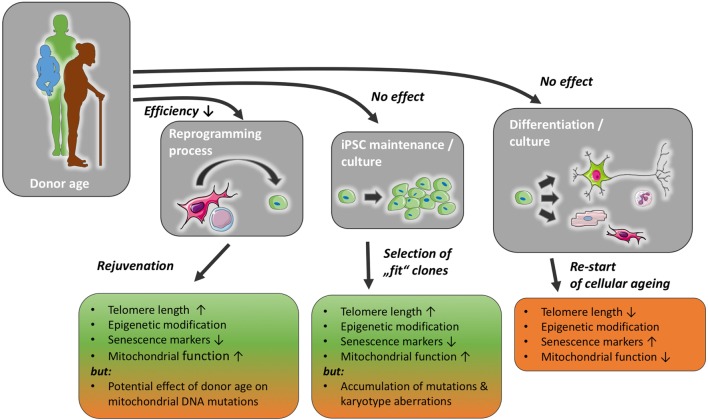
Induced pluripotent stem cells (iPSCs) avoid many of the restrictions that hamper the application of human embryonic stem cells: limited availability of source material due to legal restrictions in some countries, immunogenic rejection and ethical concerns. Also, the donor's clinical phenotype is often known when working with iPSCs. Therefore, iPSCs seem ideal to tackle the two biggest tasks of regenerative medicine: degenerative diseases with genetic cause (e.g., Duchenne's muscular dystrophy) and organ replacement in age-related diseases (e.g., end-stage heart or renal failure), especially in combination with recently developed gene-editing tools. In the setting of autologous transplantation in elderly patients, donor age becomes a potentially relevant factor that needs to be assessed. Here, we review and critically discuss available data pertinent to the questions: How does donor age influence the reprogramming process and iPSC functionality? Would it even be possible to reprogram senescent somatic cells? How does donor age affect iPSC differentiation into specialised cells and their functionality? We also identify research needs, which might help resolve current unknowns. Until recently, most hallmarks of ageing were attributed to an accumulation of DNA damage over time, and it was thus expected that DNA damage from a somatic cell would accumulate in iPSCs and the cells derived from them. In line with this, a decreased lifespan of cloned organisms compared with the donor was also observed in early cloning experiments. Therefore, it was questioned for a time whether iPSC derived from an old individual's somatic cells would suffer from early senescence and, thus, may not be a viable option either for disease modelling nor future clinical applications. Instead, typical signs of cellular ageing are reverted in the process of iPSC reprogramming, and iPSCs from older donors do not show diminished differentiation potential nor do iPSC-derived cells from older donors suffer early senescence or show functional impairments when compared with those from younger donors. Thus, the data would suggest that donor age does not limit iPSC application for modelling genetic diseases nor regenerative therapies. However, open questions remain, e.g., regarding the potential tumourigenicity of iPSC-derived cells and the impact of epigenetic pattern retention.
诱导多能干细胞(iPSC)避免了许多阻碍人类胚胎干细胞应用的限制:由于一些国家的法律限制导致源材料可用性有限、免疫原性排斥以及伦理问题。此外,在使用iPSC时,供体的临床表型通常是已知的。因此,iPSC似乎是解决再生医学两大最重要任务的理想选择:由遗传原因导致的退行性疾病(如杜氏肌营养不良症)以及与年龄相关疾病中的器官替换(如终末期心脏或肾衰竭),特别是与最近开发的基因编辑工具相结合时。在老年患者自体移植的情况下,供体年龄成为一个需要评估的潜在相关因素。在此,我们回顾并批判性地讨论与以下问题相关的现有数据:供体年龄如何影响重编程过程和iPSC的功能?是否甚至有可能对衰老的体细胞进行重编程?供体年龄如何影响iPSC向特化细胞的分化及其功能?我们还确定了研究需求,这可能有助于解决当前的未知问题。直到最近,大多数衰老特征都归因于随着时间推移DNA损伤的积累,因此预计体细胞的DNA损伤会在iPSC及其衍生细胞中积累。与此一致的是,在早期克隆实验中也观察到克隆生物体的寿命比供体缩短。因此,曾有一段时间人们质疑源自老年个体体细胞的iPSC是否会早衰,从而对于疾病建模和未来临床应用而言可能都不是一个可行的选择。相反,细胞衰老的典型特征在iPSC重编程过程中会逆转,与年轻供体来源的iPSC相比,老年供体来源的iPSC并未表现出分化潜能降低,其衍生细胞也未出现早衰或功能受损。因此,数据表明供体年龄并不限制iPSC在遗传疾病建模或再生治疗中的应用。然而,仍存在一些未解决的问题,例如iPSC衍生细胞的潜在致瘤性以及表观遗传模式保留的影响。