Felix Isaac M, Pereira Luiz Felipe C
Departamento de Física, Universidade Federal do Rio Grande do Norte, Natal, 59078-970, Brazil.
Sci Rep. 2018 Feb 9;8(1):2737. doi: 10.1038/s41598-018-20997-8.
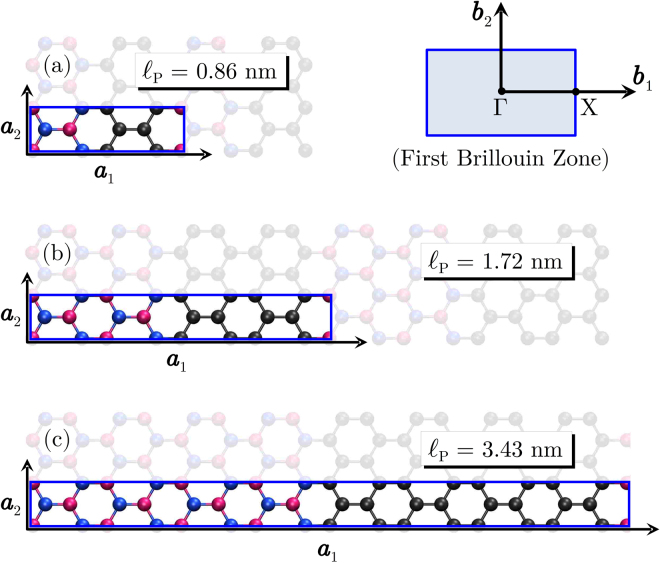
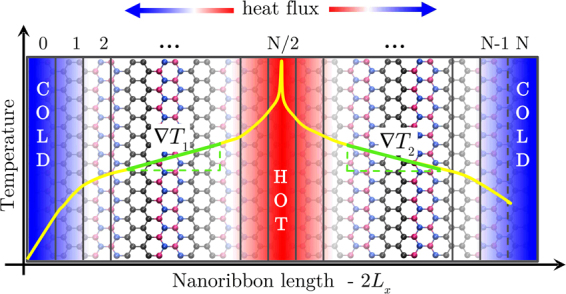
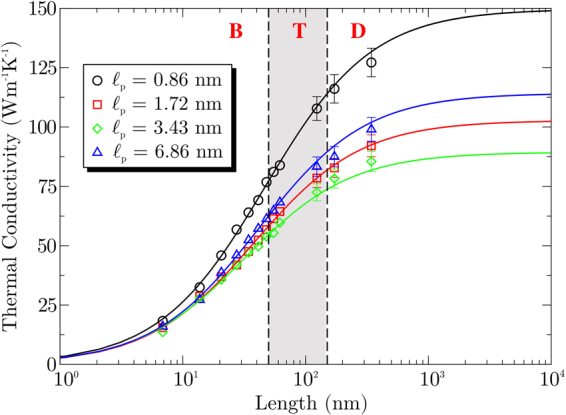
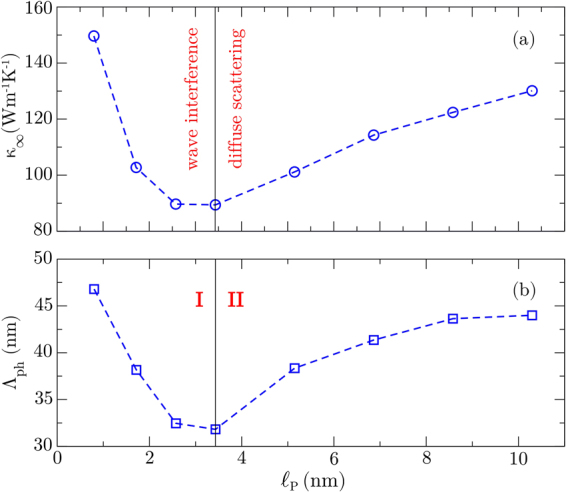
Superlattices are ideal model systems for the realization and understanding of coherent (wave-like) and incoherent (particle-like) phonon thermal transport. Single layer heterostructures of graphene and hexagonal boron nitride have been produced recently with sharp edges and controlled domain sizes. In this study we employ nonequilibrium molecular dynamics simulations to investigate the thermal conductivity of superlattice nanoribbons with equal-sized domains of graphene and hexagonal boron nitride. We analyze the dependence of the conductivity with the domain sizes, and with the total length of the ribbons. We determine that the thermal conductivity reaches a minimum value of 89 W mK for ribbons with a superlattice period of 3.43 nm. The effective phonon mean free path is also determined and shows a minimum value of 32 nm for the same superlattice period. Our results also reveal that a crossover from coherent to incoherent phonon transport is present at room temperature for BNC nanoribbons, as the superlattice period becomes comparable to the phonon coherence length. Analyzing phonon populations relative to the smallest superlattice period, we attribute the minimum thermal conductivity to a reduction in the population of flexural phonons when the superlattice period equals 3.43 nm. The ability to manipulate thermal conductivity using superlattice-based two-dimensional materials, such as graphene-hBN nanoribbons, opens up opportunities for application in future nanostructured thermoelectric devices.
超晶格是用于实现和理解相干(类波)和非相干(类粒子)声子热输运的理想模型系统。最近已制备出具有尖锐边缘和可控畴尺寸的石墨烯和六方氮化硼单层异质结构。在本研究中,我们采用非平衡分子动力学模拟来研究具有等尺寸石墨烯和六方氮化硼畴的超晶格纳米带的热导率。我们分析了热导率与畴尺寸以及纳米带总长度的关系。我们确定,对于超晶格周期为3.43 nm的纳米带,热导率达到最小值89 W/(m·K)。还确定了有效声子平均自由程,对于相同的超晶格周期,其最小值为32 nm。我们的结果还表明,对于BNC纳米带,在室温下,当超晶格周期与声子相干长度可比时,存在从相干声子输运到非相干声子输运的转变。通过分析相对于最小超晶格周期的声子数,我们将最小热导率归因于当超晶格周期等于3.43 nm时弯曲声子数的减少。利用基于超晶格的二维材料(如石墨烯 - hBN纳米带)来调控热导率的能力,为未来纳米结构热电装置的应用开辟了机会。