Institute for Prevention and Occupational Medicine of the German Social Accident Insurance, Institute of the Ruhr-Universität Bochum (IPA), Bürkle-de-la-Camp-Platz 1, 44789, Bochum, Germany.
Gerinnungszentrum Rhein-Ruhr, Königstraße 13, 47051, Duisburg, Germany.
Part Fibre Toxicol. 2018 Feb 12;15(1):8. doi: 10.1186/s12989-018-0246-4.
Inhalation of high concentrations of zinc oxide particles (ZnO) may cause metal fume fever. In an earlier human inhalation study, no effects were observed after exposure to ZnO concentrations of 0.5 mg/m. Further data from experimental studies with pure ZnO in the concentration range between 0.5 and 2.5 mg/m are not available. It was the aim of this experimental study to establish the concentration-response relationship of pure nano-sized ZnO particles.
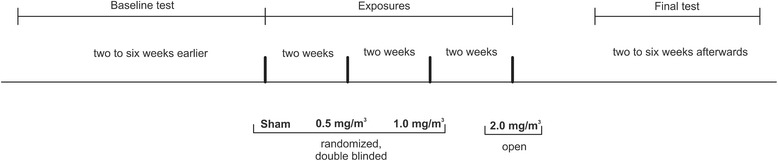
Sixteen healthy subjects were exposed to filtered air and ZnO particles (0.5, 1.0 and 2.0 mg/m) for 4 h on 4 different days, including 2 h of cycling with a low workload. The effects were assessed before, immediately after, and about 24 h after each exposure. Effect parameters were symptoms, body temperature, inflammatory markers and clotting factors in blood, and lung function.
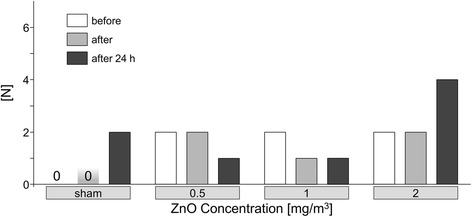
Concentration-dependent increases in symptoms, body temperature, acute phase proteins and neutrophils in blood were detected after ZnO inhalation. Significant effects were detected with ZnO concentrations of 1.0 mg/m or higher, with the most sensitive parameters being inflammatory markers in blood.
A concentration-response relationship with nano-sized ZnO particles in a low concentration range was demonstrated. Systemic inflammatory effects of inhaled nano-sized ZnO particles were observed at concentrations well below the occpational exposure limit for ZnO in many countries. It is recommended to reassess the exposure limit for ZnO at workplaces.
吸入高浓度的氧化锌(ZnO)颗粒可能会导致金属烟雾热。在早期的人类吸入研究中,暴露于 0.5mg/m 的 ZnO 浓度下没有观察到影响。在 0.5 至 2.5mg/m 的浓度范围内用纯 ZnO 进行的实验研究中没有进一步的数据。本实验研究的目的是建立纯纳米 ZnO 颗粒的浓度-反应关系。
16 名健康受试者在 4 天内分别暴露于过滤空气和 ZnO 颗粒(0.5、1.0 和 2.0mg/m)4 小时,其中包括 2 小时低负荷的循环运动。在每次暴露前后约 24 小时评估效果。效应参数为症状、体温、血液中的炎症标志物和凝血因子以及肺功能。
在吸入 ZnO 后,检测到症状、体温、急性期蛋白和血液中的中性粒细胞呈浓度依赖性增加。在 ZnO 浓度为 1.0mg/m 或更高时,检测到显著的影响,最敏感的参数是血液中的炎症标志物。
在低浓度范围内证明了纳米 ZnO 颗粒的浓度-反应关系。在许多国家,工作场所 ZnO 的职业暴露限值以下,观察到吸入的纳米 ZnO 颗粒的全身炎症作用。建议重新评估工作场所的 ZnO 暴露限值。