Institute for Prevention and Occupational Medicine of the German Social Accident Insurance, Institute of the Ruhr University Bochum (IPA), Bürkle-de-la-Camp-Platz 1, 44789, Bochum, Germany.
BMC Pulm Med. 2019 Dec 30;19(1):266. doi: 10.1186/s12890-019-1026-0.
Workers in the zinc production and processing of galvanized sheet steel are exposed to a complex mixture of particles and gases, including zinc oxide (ZnO) that can affect human health. We aimed to study the effects of short-term controlled exposure to nano-sized ZnO on airway inflammatory markers in healthy volunteers.
Sixteen subjects (8 females, 8 men; age 19-42, non-smokers) were exposed to filtered air and ZnO nanoparticles (0.5, 1.0 and 2.0 mg/m) for 4 h, including 2 h of cycling with a low workload. Induced sputum samples were collected during a medical baseline and a final examination and also about 24 h after each exposure. A number of inflammatory cellular and soluble markers were analyzed.
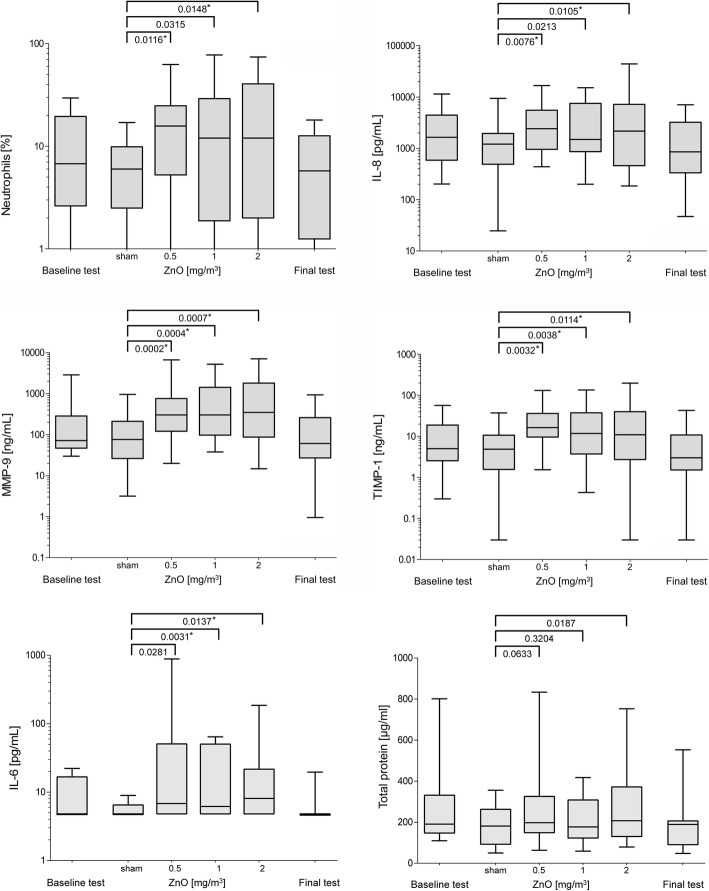
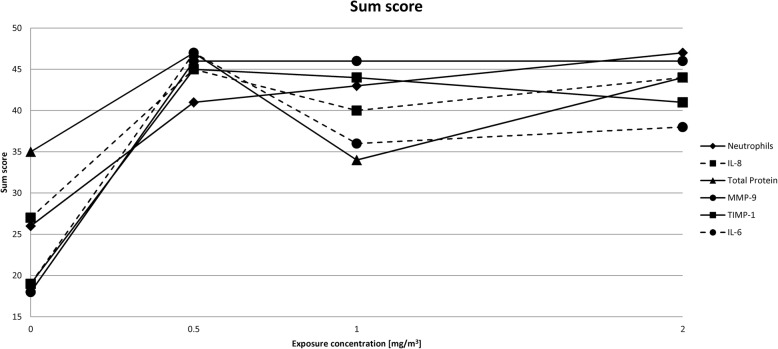
Frequency and intensity of symptoms of airway irritation (throat irritation and cough) were increased in some subjects 24 h after ZnO exposures when compared to filtered air. The group comparison between filtered air and ZnO exposures showed statistically significant increases of neutrophils and interleukin-8 (IL-8), interleukin-6 (IL-6), matrix metalloproteinase (MMP-9) and tissue inhibitors of metalloproteinases (TIMP-1) in sputum starting at the lowest ZnO concentration of 0.5 mg/m. However, a concentration-response relationship was absent. Effects were reversible. Strong correlations were found between neutrophil numbers and concentrations of total protein, IL-8, MMP-9, and TIMP-1.
Controlled exposures of healthy subjects to ZnO nanoparticles induce reversible airway inflammation which was observed at a concentration of 0.5 mg/m and higher. The lack of a concentration-response relationship warrants further studies.
镀锌钢板锌生产和加工行业的工人会暴露在包括氧化锌(ZnO)在内的复杂粒子和气态混合物中,这可能会影响人类健康。我们旨在研究短期受控暴露于纳米级 ZnO 对健康志愿者气道炎症标志物的影响。
16 名受试者(8 名女性,8 名男性;年龄 19-42 岁,不吸烟)暴露于过滤空气和 ZnO 纳米颗粒(0.5、1.0 和 2.0mg/m)中 4 小时,包括 2 小时低负荷的骑车运动。在基线和最后一次检查期间以及每次暴露后约 24 小时采集诱导痰样本。分析了多种炎症细胞和可溶性标志物。
与过滤空气相比,一些受试者在暴露于 ZnO 24 小时后,气道刺激症状(咽喉刺激和咳嗽)的频率和强度增加。与过滤空气相比,在最低 ZnO 浓度 0.5mg/m 时,组间比较显示出痰中中性粒细胞和白细胞介素-8(IL-8)、白细胞介素-6(IL-6)、基质金属蛋白酶(MMP-9)和金属蛋白酶抑制剂(TIMP-1)的统计学显著增加。但是,不存在浓度-反应关系。效果是可逆的。在中性粒细胞数量和总蛋白、IL-8、MMP-9 和 TIMP-1 的浓度之间发现了强烈的相关性。
健康受试者受控暴露于 ZnO 纳米颗粒可引起可逆性气道炎症,在 0.5mg/m 及更高浓度时可观察到。缺乏浓度-反应关系需要进一步研究。