Institute of Bioengineering, School of Life Sciences, Ecole Polytechnique Fédérale de Lausanne, CH-1015 Lausanne, Switzerland.
Nestlé Institute of Health Sciences, CH-1015 Lausanne, Switzerland.
Proc Natl Acad Sci U S A. 2018 Feb 20;115(8):E1916-E1925. doi: 10.1073/pnas.1715225115. Epub 2018 Feb 5.
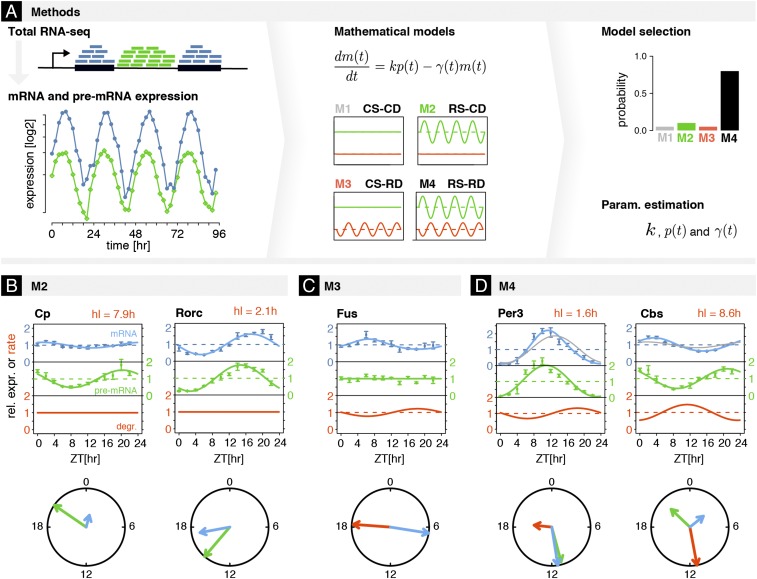
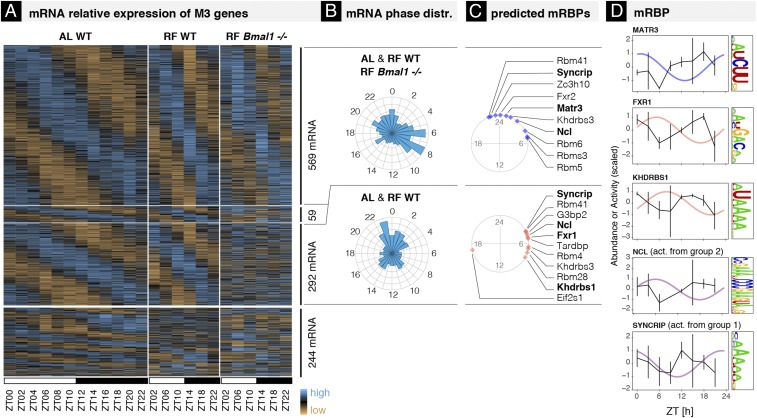
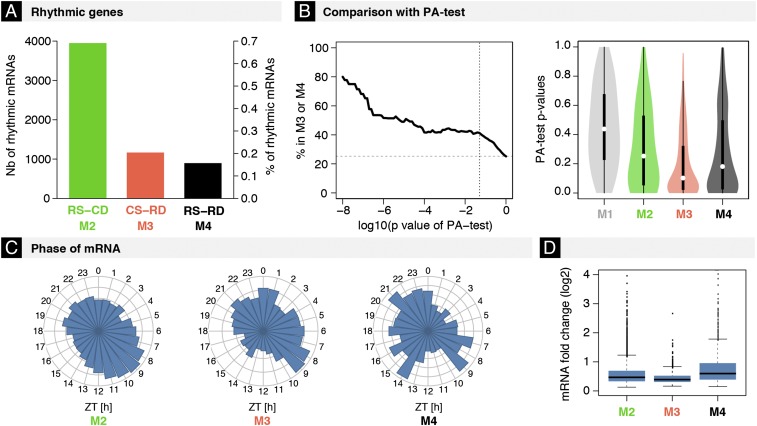
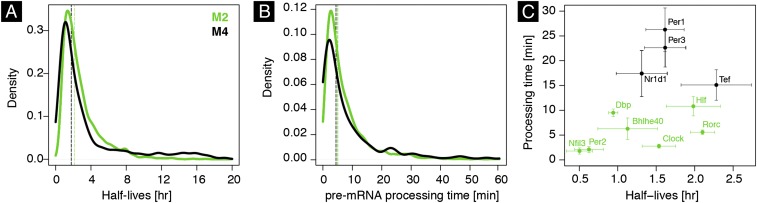
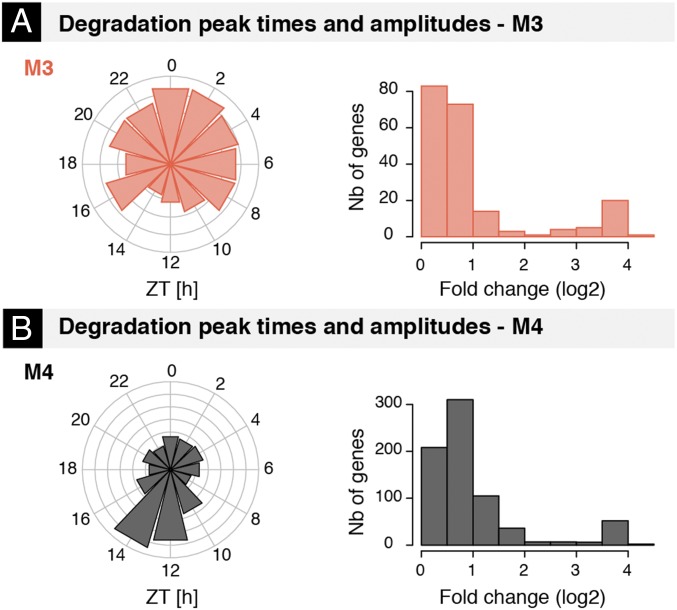
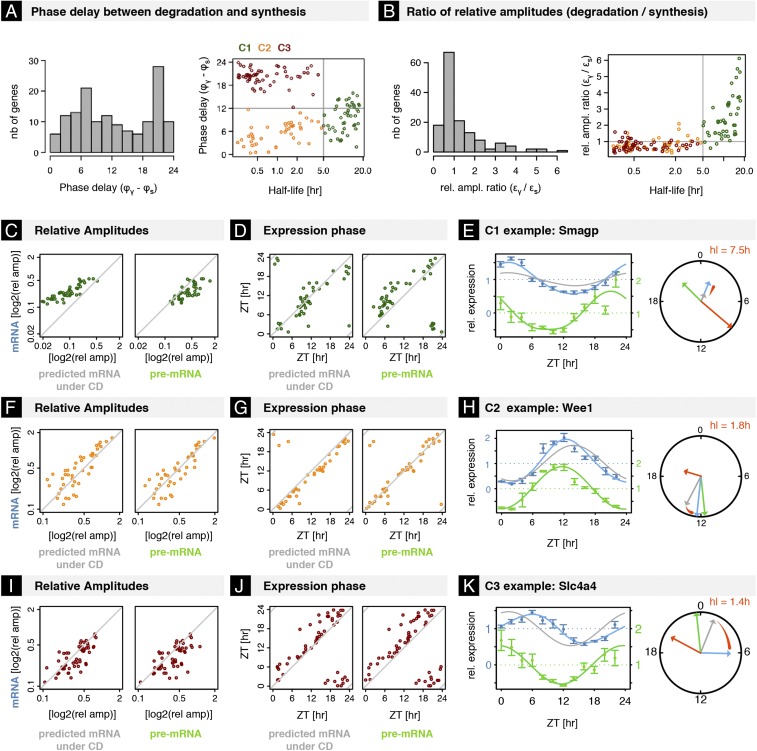
The mammalian circadian clock coordinates physiology with environmental cycles through the regulation of daily oscillations of gene expression. Thousands of transcripts exhibit rhythmic accumulations across mouse tissues, as determined by the balance of their synthesis and degradation. While diurnally rhythmic transcription regulation is well studied and often thought to be the main factor generating rhythmic mRNA accumulation, the extent of rhythmic posttranscriptional regulation is debated, and the kinetic parameters (e.g., half-lives), as well as the underlying regulators (e.g., mRNA-binding proteins) are relatively unexplored. Here, we developed a quantitative model for cyclic accumulations of pre-mRNA and mRNA from total RNA-seq data, and applied it to mouse liver. This allowed us to identify that about 20% of mRNA rhythms were driven by rhythmic mRNA degradation, and another 15% of mRNAs regulated by both rhythmic transcription and mRNA degradation. The method could also estimate mRNA half-lives and processing times in intact mouse liver. We then showed that, depending on mRNA half-life, rhythmic mRNA degradation can either amplify or tune phases of mRNA rhythms. By comparing mRNA rhythms in wild-type and animals, we found that the rhythmic degradation of many transcripts did not depend on a functional BMAL1. Interestingly clock-dependent and -independent degradation rhythms peaked at distinct times of day. We further predicted mRNA-binding proteins (mRBPs) that were implicated in the posttranscriptional regulation of mRNAs, either through stabilizing or destabilizing activities. Together, our results demonstrate how posttranscriptional regulation temporally shapes rhythmic mRNA accumulation in mouse liver.
哺乳动物的生物钟通过调节基因表达的日常波动,使生理机能与环境周期相协调。成千上万的转录本在小鼠组织中表现出节律性积累,这是由它们的合成和降解平衡决定的。虽然昼夜节律转录调控研究得很好,并且通常被认为是产生节律性 mRNA 积累的主要因素,但节律性转录后调控的程度存在争议,其动力学参数(例如半衰期)以及潜在的调控因子(例如 mRNA 结合蛋白)相对未知。在这里,我们开发了一种从总 RNA-seq 数据定量预测前体 mRNA 和 mRNA 循环积累的模型,并将其应用于小鼠肝脏。这使我们能够确定约 20%的 mRNA 节律是由 mRNA 降解的节律驱动的,另外 15%的 mRNA 受转录和 mRNA 降解的节律调节。该方法还可以估计完整小鼠肝脏中 mRNA 的半衰期和加工时间。然后,我们表明,根据 mRNA 的半衰期,节律性 mRNA 降解可以放大或调整 mRNA 节律的相位。通过比较野生型和 动物的 mRNA 节律,我们发现许多转录本的节律性降解并不依赖于功能性 BMAL1。有趣的是,依赖于时钟和不依赖于时钟的降解节律在一天中的不同时间达到峰值。我们进一步预测了涉及 mRNA 后转录调控的 mRNA 结合蛋白(mRBPs),这些蛋白通过稳定或不稳定的活性发挥作用。总之,我们的研究结果表明,转录后调控如何在小鼠肝脏中塑造 mRNA 积累的节律性。