School of Life Sciences, University of Dundee, Dundee DD1 5EH, United Kingdom;
School of Mathematical and Computer Sciences, Heriot-Watt University Malaysia, 62200 Putrajaya, Malaysia.
Proc Natl Acad Sci U S A. 2018 Feb 20;115(8):1883-1888. doi: 10.1073/pnas.1714478115. Epub 2018 Feb 5.
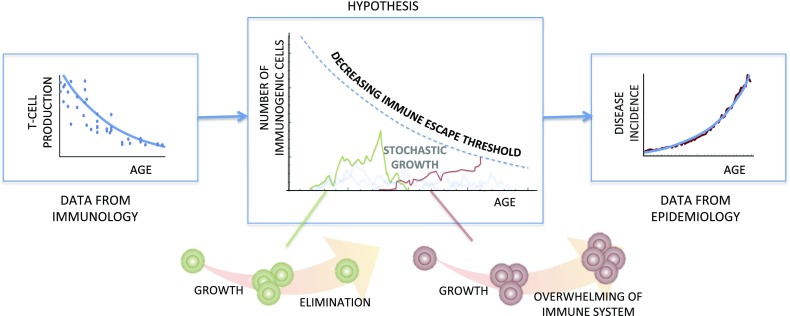
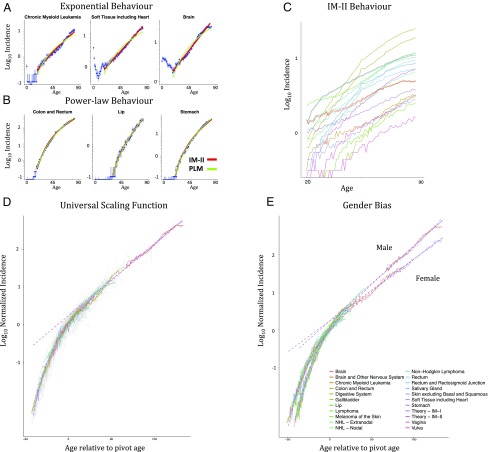
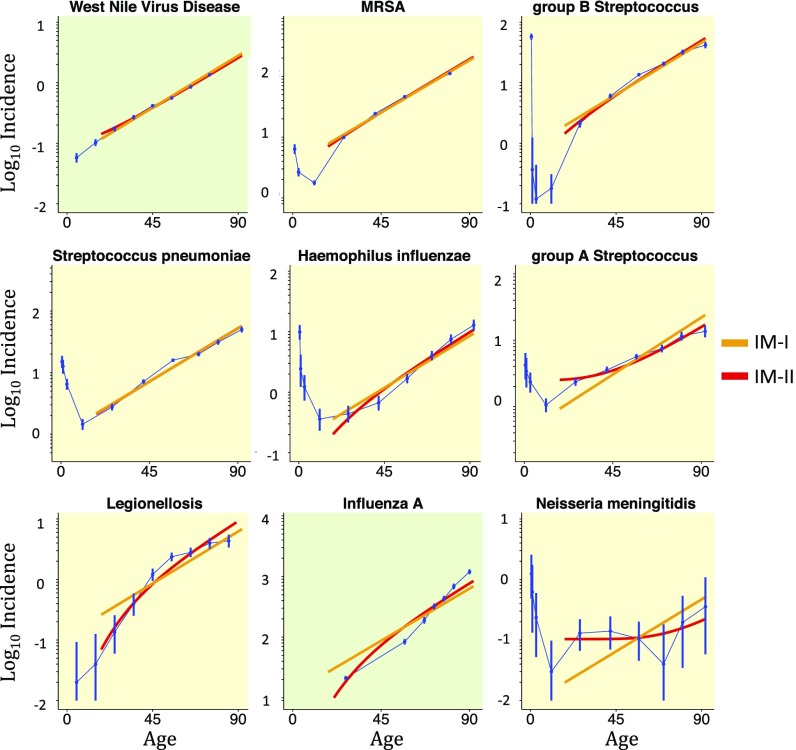
For many cancer types, incidence rises rapidly with age as an apparent power law, supporting the idea that cancer is caused by a gradual accumulation of genetic mutations. Similarly, the incidence of many infectious diseases strongly increases with age. Here, combining data from immunology and epidemiology, we show that many of these dramatic age-related increases in incidence can be modeled based on immune system decline, rather than mutation accumulation. In humans, the thymus atrophies from infancy, resulting in an exponential decline in T cell production with a half-life of ∼16 years, which we use as the basis for a minimal mathematical model of disease incidence. Our model outperforms the power law model with the same number of fitting parameters in describing cancer incidence data across a wide spectrum of different cancers, and provides excellent fits to infectious disease data. This framework provides mechanistic insight into cancer emergence, suggesting that age-related decline in T cell output is a major risk factor.
对于许多癌症类型,发病率随着年龄的增长呈明显的幂律上升,这支持了癌症是由遗传突变逐渐积累引起的观点。同样,许多传染病的发病率也随着年龄的增长而急剧上升。在这里,我们结合免疫学和流行病学的数据表明,许多与年龄相关的发病率的显著增加可以基于免疫系统的衰退来建模,而不是突变的积累。在人类中,胸腺从婴儿期开始萎缩,导致 T 细胞产生呈指数下降,半衰期约为 16 年,我们将其用作疾病发病率的最小数学模型的基础。我们的模型在描述广泛不同癌症的癌症发病率数据方面表现优于具有相同拟合参数数量的幂律模型,并为传染病数据提供了极好的拟合。该框架为癌症的发生提供了机制上的见解,表明与年龄相关的 T 细胞输出下降是一个主要的风险因素。