Laboratory of Vibration and Acoustics, Florianópolis, Brazil.
Naval Postgraduate School, Monterey, CA, USA.
Biomed Eng Online. 2018 Feb 13;17(1):23. doi: 10.1186/s12938-018-0454-z.
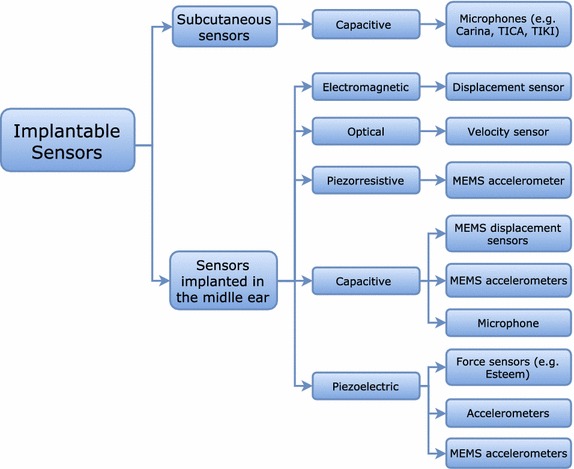
Most commercially available cochlear implants and hearing aids use microphones as sensors for capturing the external sound field. These microphones are in general located in an external element, which is also responsible for processing the sound signal. However, the presence of the external element is the cause of several problems such as discomfort, impossibility of being used during physical activities and sleeping, and social stigma. These limitations have driven studies with the goal of developing totally implantable hearing devices, and the design of an implantable sensor has been one of the main challenges to be overcome. Different designs of implantable sensors can be found in the literature and in some commercial implantable hearing aids, including different transduction mechanisms (capacitive, piezoelectric, electromagnetic, etc), configurations microphones, accelerometers, force sensor, etc) and locations (subcutaneous or middle ear). In this work, a detailed technical review of such designs is presented and a general classification is proposed. The technical characteristics of each sensors are presented and discussed in view of the main requirements for an implantable sensor for hearing devices, including sensitivity, internal noise, frequency bandwidth and energy consumption. The feasibility of implantation of each sensor is also evaluated and compared.
大多数市售的人工耳蜗和助听器都使用麦克风作为传感器来捕捉外部声场。这些麦克风通常位于外部元件中,该元件还负责处理声音信号。然而,外部元件的存在导致了一些问题,例如不适、无法在体育活动和睡眠期间使用以及社会耻辱感。这些限制推动了开发完全可植入听力设备的研究,而可植入传感器的设计是需要克服的主要挑战之一。可植入传感器的不同设计可以在文献和一些商业可植入助听器中找到,包括不同的换能机制(电容式、压电式、电磁式等)、麦克风配置、加速度计、力传感器等)和位置(皮下或中耳)。在这项工作中,对这些设计进行了详细的技术回顾,并提出了一种通用分类。根据用于听力设备的可植入传感器的主要要求(包括灵敏度、内部噪声、带宽和能耗),提出并讨论了每个传感器的技术特点。还评估和比较了每个传感器的植入可行性。