Müller Dominik, Schopp Pascal, Melchinger Albrecht E
University of Hohenheim, Institute of Plant Breeding, Seed Science and Population Genetics, Fruhwirthstr. 21, 70599 Stuttgart and.
KWS SAAT SE, Grimsehlstraβe 31, 37574 Einbeck.
G3 (Bethesda). 2018 Mar 28;8(4):1173-1181. doi: 10.1534/g3.118.200091.
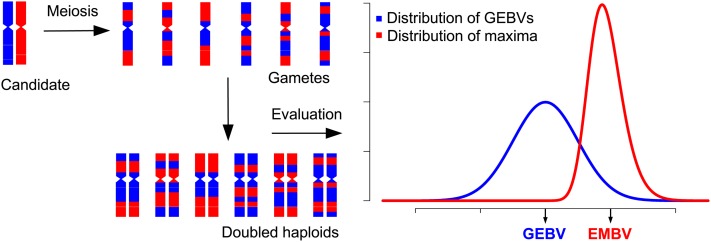
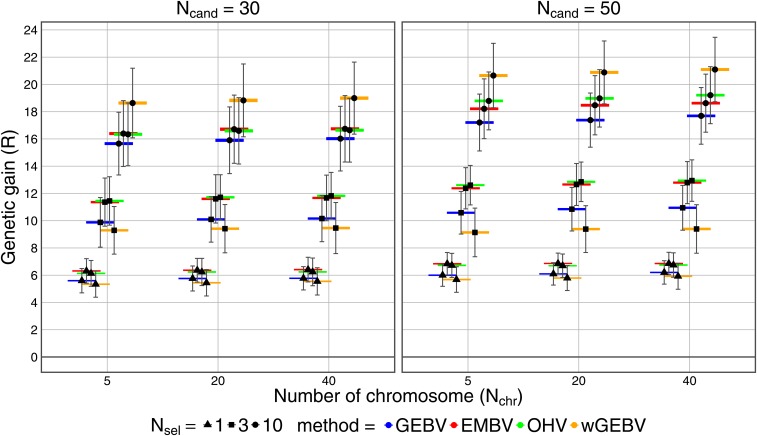
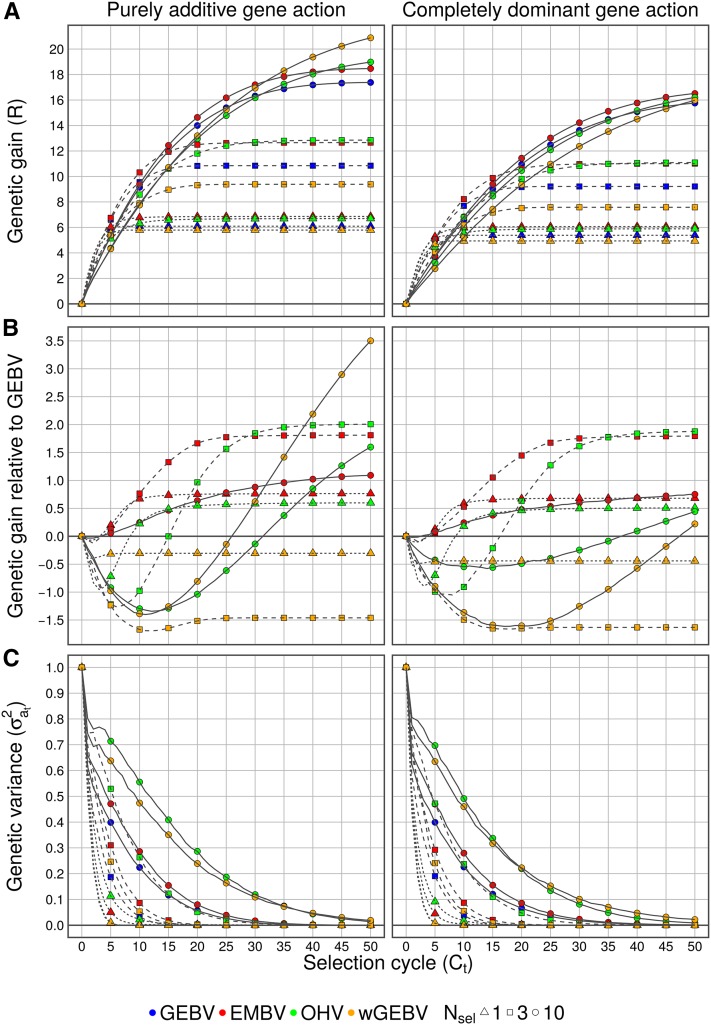
Genomic selection (GS) offers the possibility to estimate the effects of genome-wide molecular markers, which can be used to calculate genomic estimated breeding values (GEBVs) for individuals without phenotypes. GEBVs can serve as a selection criterion in recurrent GS, maximizing single-cycle but not necessarily long-term genetic gain. As simple genome-wide sums, GEBVs do not take into account other genomic information, such as the map positions of loci and linkage phases of alleles. Therefore, we herein propose a novel selection criterion called expected maximum haploid breeding value (EMBV). EMBV predicts the expected performance of the best among a limited number of gametes that a candidate contributes to the next generation, if selected. We used simulations to examine the performance of EMBV in comparison with GEBV as well as the recently proposed criterion optimal haploid value (OHV) and weighted GS. We considered different population sizes, numbers of selected candidates, chromosome numbers and levels of dominant gene action. Criterion EMBV outperformed GEBV after about 5 selection cycles, achieved higher long-term genetic gain and maintained higher diversity in the population. The other selection criteria showed the potential to surpass both GEBV and EMBV in advanced cycles of the breeding program, but yielded substantially lower genetic gain in early to intermediate cycles, which makes them unattractive for practical breeding. Moreover, they were largely inferior in scenarios with dominant gene action. Overall, EMBV shows high potential to be a promising alternative selection criterion to GEBV for recurrent genomic selection.
基因组选择(GS)提供了估计全基因组分子标记效应的可能性,这些标记可用于计算无表型个体的基因组估计育种值(GEBV)。GEBV可作为轮回GS中的选择标准,最大化单周期遗传增益,但不一定能实现长期遗传增益。作为简单的全基因组总和,GEBV没有考虑其他基因组信息,如基因座的图谱位置和等位基因的连锁相位。因此,我们在此提出一种新的选择标准,称为预期最大单倍体育种值(EMBV)。EMBV预测了候选个体如果被选中,其对下一代贡献的有限数量配子中最佳配子的预期表现。我们使用模拟来检验EMBV与GEBV以及最近提出的标准最优单倍体值(OHV)和加权GS相比的性能。我们考虑了不同的群体大小、所选候选个体数量、染色体数量和显性基因作用水平。标准EMBV在大约5个选择周期后优于GEBV,实现了更高的长期遗传增益,并在群体中保持了更高的多样性。其他选择标准在育种计划的后期周期显示出超过GEBV和EMBV的潜力,但在早期到中期周期产生的遗传增益显著较低,这使得它们在实际育种中缺乏吸引力。此外,在存在显性基因作用的情况下,它们在很大程度上较差。总体而言,EMBV显示出作为GEBV的一种有前途的替代选择标准用于轮回基因组选择的巨大潜力。